


JEE Advanced · Chemistry · 23. Coordination Compounds
Among the following complexes \((K-P), \mathrm{K}_3\left[\mathrm{Fe}(\mathrm{CN})_6\right](K)\),
\(\left[\right.\) Co \(\left.\left(\mathrm{NH}_3\right)_6\right] \mathrm{Cl}_3(L), \mathrm{Na}_3\left[\mathrm{Co}(\mathrm{ox})_3\right](M)\),
\(\left[\mathrm{Ni}\left(\mathrm{H}_2 \mathrm{O}\right)_6\right] \mathrm{Cl}_2(\mathrm{~N}) ; \mathrm{K}_2\left[\mathrm{Pt}(\mathrm{CN})_4\right](\mathrm{O})\) and \(\left[\mathrm{Zn}\left(\mathrm{H}_2 \mathrm{O}\right)_6\right]\left(\mathrm{NO}_3\right)_2(P)\)
the diamagnetic complexes are
- A \(K, L, M, N\)
- B \(K, M, O, P\)
- C \(L, M, O, P\)
- D \(L, M, N, O\)
Answer & Solution
Correct Answer
(C) \(L, M, O, P\)
Step-by-step Solution
Detailed explanation
For a diamagnetic complex, there should not be any unpaired electron in the valence shell of central metral. In \(\mathrm{K}_3\left[\mathrm{Fe}(\mathrm{CN})_6\right]\), Fe (III) has \(d^5\)-configuration (odd electrons), hence it is paramagnetic. In [Co( \(\left.\left.\mathrm{NH}_3\right)_6\right] \mathrm{Cl}_3\), Co (III) has \(d^6\) configuration in a strong ligand field, hence all the electrons are paired and the complex is diamagnetic. In \(\mathrm{Na}_3\left[\mathrm{Co}(\mathrm{ox})_3\right]\), \(\mathrm{Co}\) (III) has \(d^6\)-configuration and oxalate being a chelating ligand, very strong ligand and all the six electrons remains paired in lower \(t_{2 g}\) level, diamagnetic. In \(\left[\mathrm{Ni}\left(\mathrm{H}_2 \mathrm{O}\right)_6\right] \mathrm{Cl}_2, \mathrm{Ni}\) (II) has \(3 d^8\)-configuration and \(\mathrm{H}_2 \mathrm{O}\) is a weak ligand hence

In \(\mathrm{K}_2\left[\mathrm{Pt}(\mathrm{CN})_4\right]\), Pt (II) has \(d^8\)-configuration and \(\mathrm{CN}^{-}\)is a strong ligand, hence all the eight electrons are spin-paired. Therefore, complex is diamagnetic.
In \(\left[\mathrm{Zn}\left(\mathrm{H}_2 \mathrm{O}\right)_6\right]\left(\mathrm{NO}_3\right)_2, \mathrm{Zn}\) (II) has \({ }_3 \mathrm{~d}^{10}\) configuration spin paired, hence diamagnetic.
In \(\mathrm{K}_2\left[\mathrm{Pt}(\mathrm{CN})_4\right]\), Pt (II) has \(d^8\)-configuration and \(\mathrm{CN}^{-}\)is a strong ligand, hence all the eight electrons are spin-paired. Therefore, complex is diamagnetic.
In \(\left[\mathrm{Zn}\left(\mathrm{H}_2 \mathrm{O}\right)_6\right]\left(\mathrm{NO}_3\right)_2, \mathrm{Zn}\) (II) has \({ }_3 \mathrm{~d}^{10}\) configuration spin paired, hence diamagnetic.
See the Complete Solution
Get step-by-step explanations for this and 2.5 Lakh+ more JEE, NEET & CET questions.
- Unlock all solutions
- Practice the full chapter
- Track accuracy across PYQs
4.8 rated on Google Play · 14,000+ reviews
More questions from Chemistry
- When the following aldohexose exists in its D-configuration, the total number of stereoisomers in its pyranose form is :
\(\mathrm{CHO}-\mathrm{CH}_{2}-\mathrm{CHOH}-\mathrm{CHOH}-\mathrm{CHOH}\) \(-~\mathrm{CH}_{2} \mathrm{OH}\)JEE Advanced 2012 Hard - For diatomic molecules, the correct statement(s) about the molecular orbitals formed by the overlap of two orbitals is(are)JEE Advanced 2022 Medium
- An aqueous solution is prepared by dissolving mole of an ionic salt in of water at . The salt remains dissociated in the solution. The vapour pressure of the solution is of . Vapor pressure of water at is of . The number of ions present per formula unit of the ionic salt is _____.JEE Advanced 2022 Medium
- Statement \(\mathbf{1}\left[\mathrm{Fe}\left(\mathrm{H}_2 \mathrm{O}\right)_5 \mathrm{NO}\right] \mathrm{SO}_4\) is paramagnetic.
Statement 2 The \(\mathrm{Fe}\) in \(\left[\mathrm{Fe}\left(\mathrm{H}_2 \mathrm{O}\right)_5 \mathrm{NO}\right] \mathrm{SO}_4\) has three unpaired electrons.JEE Advanced 2008 Medium - The product formed in the reaction of with white phosphorous isJEE Advanced 2014 Easy
- The correct statement(s) for orthoboric acid is/areJEE Advanced 2014 Easy
More PYQs from JEE Advanced
- Paragraph:
Football teams \(T_{1}\) and \(T_{2}\) have to play two games against each other. It is assumed that the outcomes of the two games are independent. The probabilities of \(T_{1}\) winning, drawing and losing a game against \(T_{2}\) are \(\frac{1}{2}, \frac{1}{6}\) and \(\frac{1}{3}\), respectively. Each team gets \(3\) points for a win, \(1\) point for a draw and \(0\) point for a loss in a game. Let \(X\) and \(Y\) denote the total points scored by teams \(T_{1}\) and \(T_{2}\), respectively, after two games.
Question:
\(P(X=Y)\) isJEE Advanced 2016 Easy - Consider the region \(R=\left\{(x, y) \in \mathbb{R} \times \mathbb{R}: x \geq 0\right.\) and \(\left.y^{2} \leq 4-x\right\}\). Let \(\mathcal{F}\) be the family of all circles that are contained in \(R\) and have centers on the \(x\)-axis. Let \(C\) be the circle that has largest radius among the circles in \(\mathcal{F}\). Let \((\alpha, \beta)\) be a point where the circle \(C\) meets the curve \(y^{2}=4-x\).
The radius of the circles is____.JEE Advanced 2021 Easy - Three lines are given by
and
Let the lines cut the plane at the points and respectively. If the area of the triangle is then the value of equals_________JEE Advanced 2019 Easy - Match the statements of Column I with these in Column II.
[Note : Here \(z\) takes values in the complex plane and \(\operatorname{Im}(z)\) and \(\operatorname{Re}(z)\) denote respectively, the imaginary part and the real part of \(z\) ]Column I Column II (A)The set of points \(z\) satisfying \(|z-i| z||=|z+i| z||\) is contained in or equal to (p)an ellipse with eccentricity \(4 / 5\) (B) The set of points \(z\) satisfying \(|z+4|+|z-4|=0\) is contained in or equal to (q) the set of points \(z\) satisfying \(\operatorname{Im}(z)=0\) (C) If \(|w|=2\), then the set of points \(z=w-\frac{1}{w}\) is contained in or equal to (r) the set of points \(z\) satisfying \(|\operatorname{Im} z| \leq 1\) (D) If \(|w|=1\), then the set of points \(z=w+\frac{1}{w}\) is contained in or equal to (s) the set of points satisfying \(|\operatorname{Re} z| \leq 2\) (t) the set of points \(z\) satisfying \(|z| \leq 3\) JEE Advanced 2010 Hard - The correct functional group \(X\) and the reagent/reaction conditions \(Y\) in the following schemes are \(\mathrm{X}-\left(\mathrm{CH}_2\right)_4-X\)
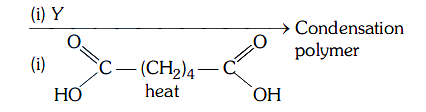 JEE Advanced 2011 Hard
 - Paragraph :
Phase space diagrams are useful tools in analyzing all kinds of dynamical problems. They are especially useful in studying the changes in motion as initial position and momentum are changed. Here we consider some simple dynamical systems in one-dimension. For such systems, phase space is a plane in which position is plotted along horizontal axis and momentum is plotted along vertical axis. The phase space diagram is \(x(t) v s p(t)\) curve in this plane. The arrow on the
curve indicates the time flow. For example, the phase space diagram for a particle moving with constant velocity is a straight line as shown in the figure. We use the sign convention in which position or momentum upwards (or to right) is positive and downwards (or to left) is negative.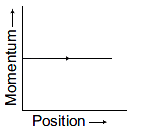
Question :
The phase space diagram for simple harmonic motion is a circle centered at the origin. In the figure, the two circles represent the same oscillator but for different initial conditions, and \(E_1\) and \(E_2\) are the total mechanical energies respectively. Then,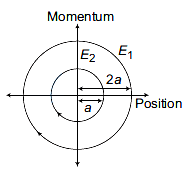 JEE Advanced 2011 Easy