


JEE Advanced · Physics · 27. Atomic Physics
Paragraph:
In a mixture of \(\mathrm{H}-\mathrm{H}^{+}\)gas \(\left(\mathrm{He}^{+}\right.\)is singly ionised \(\mathrm{He}\) atom), \(\mathrm{H}\) atoms and \(\mathrm{He}^{+}\)ions are excited to their respective first excited states. Subsequently, \(\mathrm{H}\) atoms transfer their total excitation energy to \(\mathrm{He}^{+}\)ions (by collisions). Assume that the Bohr model of atom is exactly valid.
Question:
The ratio of the kinetic energy of the \(n=2\) electron for the \(\mathrm{H}\) atom to that of \(\mathrm{He}^{+}\) ion is
- A \(\frac{1}{4}\)
- B \(\frac{1}{2}\)
- C 1
- D 2
Answer & Solution
Correct Answer
(A) \(\frac{1}{4}\)
Step-by-step Solution
Detailed explanation
Kinetic energy \(K \propto Z^2\)
\(
\frac{K_H}{K_{\mathrm{He}^{+}}}=\left(\frac{1}{2}\right)^2=\frac{1}{4}
\)
\(\therefore\) correct option is (a).
\(
\frac{K_H}{K_{\mathrm{He}^{+}}}=\left(\frac{1}{2}\right)^2=\frac{1}{4}
\)
\(\therefore\) correct option is (a).
See the Complete Solution
Get step-by-step explanations for this and 2.5 Lakh+ more JEE, NEET & CET questions.
- Unlock all solutions
- Practice the full chapter
- Track accuracy across PYQs
4.8 rated on Google Play · 14,000+ reviews
More questions from Physics
- A cylindrical furnace has height and diameter both . It is maintained at temperature . The air gets heated inside the furnace at constant pressure and its temperature becomes . The hot air with density rises up a vertical chimney of diameter and height above the furnace and exits the chimney (see the figure). As a result, atmospheric air of density , pressure and temperature enters the furnace. Assume air as an ideal gas, neglect the variations in and inside the chimney and the furnace. Also ignore the viscous effects.
[Given: The acceleration due to gravity and ]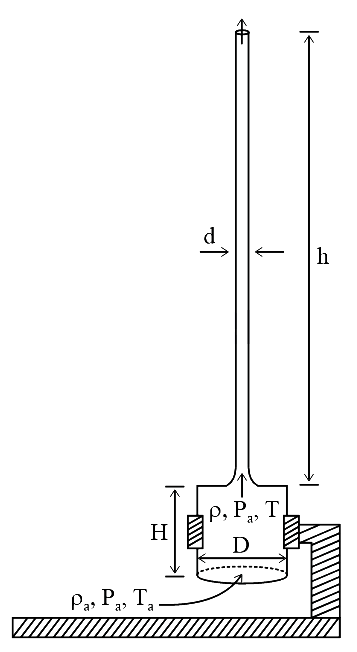
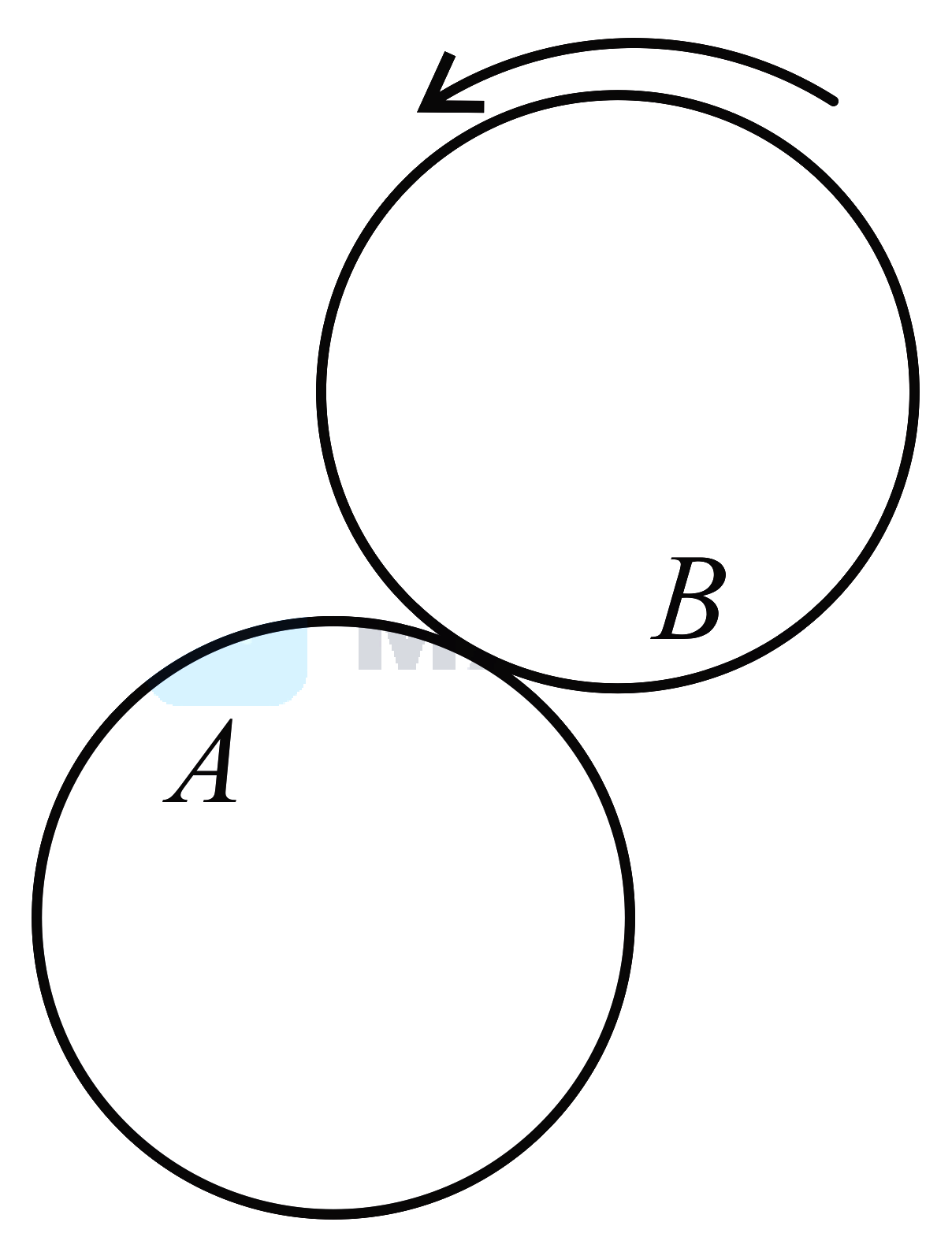
Considering the air flow to be streamline, the steady mass flow rate of air exiting the chimney is _____ .JEE Advanced 2023 Medium - A flat surface of a thin uniform disk of radius is glued to a horizontal table. Another thin uniform disk of mass and with the same radius rolls without slipping on the circumference of , as shown in the figure. A flat surface of also lies on the plane of the table. The center of mass of has fixed angular speed about the vertical axis passing through the center of . The angular momentum of is with respect to the center of . Which of the following is the value of ?
 JEE Advanced 2022 Medium
 - A free hydrogen atom after absorbing a photon of wavelength gets excited from the state to the state Immediately after that the electron jumps to state by emitting a photon of wavelength Let the change in momentum of atom due to the absorption and the emission are and respectively. If Which of the option(s) is/are correct?
[Use and are Planck's constant and speed of light, respectively]JEE Advanced 2019 Medium - A train is moving along a straight line with a constant acceleration a. A boy standing in the train throws a ball forward with a speed of \(10 \mathrm{~m} / \mathrm{s}\), at an angle of \(60^{\circ}\) to the horizontal. The boy has to move forward by \(1.15 \mathrm{~m}\) inside the train to catch the ball back at the initial height. The acceleration of the train in \(\mathrm{m} / \mathrm{s}^2\), isJEE Advanced 2011 Medium
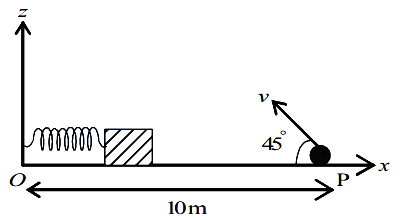
- A small block is connected to one end of a massless spring of un-stretched length \(4.9 \mathrm{~m}\). The other end of the spring (see the figure) is fixed. The system lies on a horizontal frictionless surface. The block is stretched by \(0.2 \mathrm{~m}\) and released from rest at \(t=0\). It then executes simple harmonic motion with angular frequency \(\omega=\pi / 3 \mathrm{rad} / \mathrm{s}\). Simultaneously at \(t=0\), a small pebble is projected with speed \(v\) form point \(P\) at an angle of \(45^{\circ}\) as shown in the figure. Point \(P\) is at a horizontal distance of \(10 \mathrm{~m}\) from \(O\). If the pebble hits the block at \(t=1 \mathrm{~s}\), the value of \(v\) is (take \(g\) \(=10 \mathrm{~m} / \mathrm{s}^{2}\) )
 JEE Advanced 2012 Hard
 - Paragraph :
A thermal power plant produces electric power of \(600 \mathrm{~kW}\) at \(4000 \mathrm{~V}\), which is to be transported to a place \(20 \mathrm{~km}\) away from the power plant for consumers' usage. It can be transported either directly with a cable of large current carrying capacity or by using a combination of step-up and step-down transformers at the two ends. The drawback of the direct transmission is the large energy dissipation. In the method using transformers, the dissipation is much smaller. In this method, a step-up transformer is used at the plant side so that the current is reduced to a smaller value. At the consumers' end, a step-down transformer is used to supply power to the consumers at the specified lower voltage. It is reasonable to assume that the power cable is purely resistive and the transformers are ideal with a power factor unity. All the currents and voltages mentioned are rms values.
Question :
In the method using the transformers, assume that the ratio of the number of turns in the primary to that in the secondary in the step-up transformer is \(1: 10\). If the power to the consumers has to be supplied at \(200 \mathrm{~V}\), the ratio of the number of turns in the primary to that in the secondary in the step-down transformer isJEE Advanced 2013 Medium
More PYQs from JEE Advanced
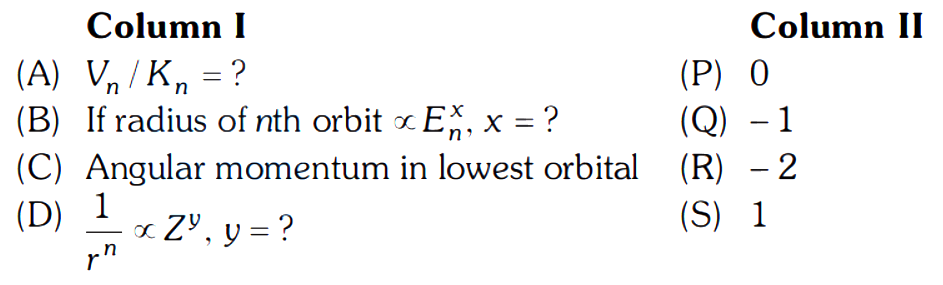
- According to Bohr's theory \(E_n=\) Total energy, \(K_n=\) Kinetic energy, \(V_n=\) Potential energy, \(r_n=\) Radius of \(n\)th orbit
 JEE Advanced 2006 Easy
 -
Column I Column II In a triangle let and be the lengths of the angles and , respectively. If and then possible values of for which is are In a triangle let and be the lengths of the sides opposite to the angles and , respectively. If , then possible value(s) of is (are) In let and be the position vectors of and with respect to the origin , respectively. If the distance of from the bisector of the acute angle of with is , then possible value (s) of is (are) Suppose that denotes the area of the region bounded by and where Then the value (s) of when and , is (are) JEE Advanced 2015 Hard - \(\mathrm{AgNO}_3(a q)\) was added to an aqueous \(\mathrm{KCl}\) solution gradually and the conductivity of the solution was measured. The plot of conductance \((\Lambda)\) versus the volume of \(\mathrm{AgNO}_3\) is
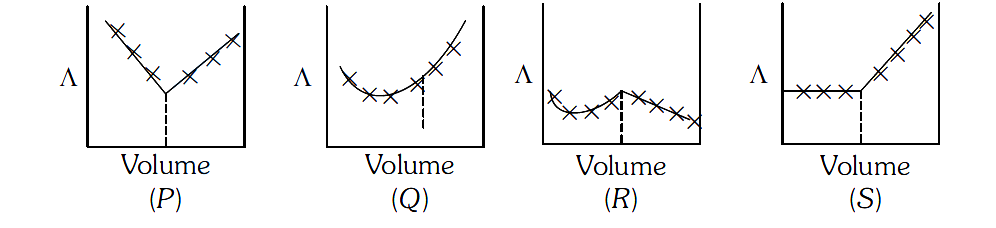 JEE Advanced 2011 Medium
 - Paragraph :
A spray gun is shown in the figure where a piston pushes air out of a nozzle. A thin tube of uniform cross section is connected to the nozzle. The other end of the tube is in a small liquid container. As the piston pushes air through the nozzle, the liquid from the container rises into the nozzle and is sprayed out. For the spray gun shown, the radii of the piston and the nozzle are \(20 \mathrm{~mm}\) and \(1 \mathrm{~mm}\), respectively. The upper end of the container is open to the atmosphere.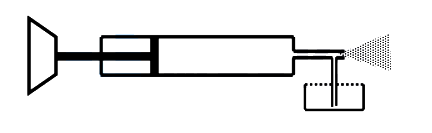
Question :
If the piston is pushed at a speed of \(5 \mathrm{~mms}^{-1}\), the air comes out of the nozzle with a speed ofJEE Advanced 2014 Easy - Paragraph :
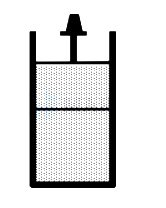
In the figure a container is shown to have a movable (without friction) piston on top. The container and the piston are all made of perfectly insulating material allowing no heat transfer between outside and inside the container. The container is divided into two compartments by a rigid partition made of a thermally conducting material that allows slow transfer of heat. The lower compartment of the container is filled with \(2\) moles of an ideal monatomic gas at \(700 K\) and the upper compartment is filled with \(2\) moles of an ideal diatomic gas at \(400 K\). The heat capacities per mole of an ideal monatomic gas are \(C_{V}=\frac{3}{2} R, C_{P}=\frac{5}{2} R\), and those for an ideal diatomic gas are \(C_{V}=\frac{5}{2} R, C_{P}=\frac{7}{2} R\).
Question :
Consider the partition to be rigidly fixed so that it does not move. When equilibrium is achieved, the final temperature of the gases will beJEE Advanced 2014 Medium - Let \(S\) denote the locus of the mid-points of those chords of the parabola \(y^2=x\), such that the area of the region enclosed between the parabola and the chord is \(\frac{4}{3}\). Let \(R\) denote the region lying in the first quadrant, enclosed by the parabola \(y^2=x\), the curve \(S\), and the lines \(x=1\) and \(x=4\).
Then which of the following statements is (are) TRUE?JEE Advanced 2025 Hard