


JEE Advanced · Chemistry · 4. Chemical Bonding
The species having bond order different from that in \(\mathrm{CO}\) is
- A \(\mathrm{NO}^{-}\)
- B \(\mathrm{NO}^{+}\)
- C \(\mathrm{CN}^{-}\)
- D \(\mathrm{N}_2\)
Answer & Solution
Correct Answer
(A) \(\mathrm{NO}^{-}\)
Step-by-step Solution
Detailed explanation
\(\mathrm{CO}\) : total \(e^{-s}=6+8=14\)
\(\sigma 1 s^2, \sigma^* 1 s^2, \sigma 2 s^2, \sigma^* 2 s^2, \pi 2 p_x^{1+1}\) \(=\pi 2 p_y^{1+1}, \sigma 2 p_z^2 \)
\( \mathrm{BO}=\frac{10-4}{2}=3 \)
\( \mathrm{NO}^{-}=\text {Total } e^{-} s=7+8+1=16 \)
\( \sigma 1 s^2, \sigma^* 1 s^2, \sigma 2 s^2, \sigma^* 2 s^2, \sigma 2 p_z^2, \pi 2 p_x^{1+1} \)
\( =\pi 2 p_y^{1+1}, \pi^* 2 p_x^1=\pi^* 2 p_y^1 \)
\( \mathrm{BO}=\frac{10-6}{2}=\frac{4}{2}=2\)
Total number of \(e^{-} s: \mathrm{CN}^{-}=6~+\) \(7+1=14\)
\(
\mathrm{N}_2=7+7=14
\)
\(\sigma 1 s^2, \sigma^* 1 s^2, \sigma 2 s^2, \sigma^* 2 s^2, \pi 2 p_x^{1+1}\) \(=\pi 2 p_y^{1+1}, \sigma 2 p_z^2 \)
\( \mathrm{BO}=\frac{10-4}{2}=3 \)
\( \mathrm{NO}^{-}=\text {Total } e^{-} s=7+8+1=16 \)
\( \sigma 1 s^2, \sigma^* 1 s^2, \sigma 2 s^2, \sigma^* 2 s^2, \sigma 2 p_z^2, \pi 2 p_x^{1+1} \)
\( =\pi 2 p_y^{1+1}, \pi^* 2 p_x^1=\pi^* 2 p_y^1 \)
\( \mathrm{BO}=\frac{10-6}{2}=\frac{4}{2}=2\)
Total number of \(e^{-} s: \mathrm{CN}^{-}=6~+\) \(7+1=14\)
\(
\mathrm{N}_2=7+7=14
\)
See the Complete Solution
Get step-by-step explanations for this and 2.5 Lakh+ more JEE, NEET & CET questions.
- Unlock all solutions
- Practice the full chapter
- Track accuracy across PYQs
4.8 rated on Google Play · 14,000+ reviews
More questions from Chemistry
- The crystalline form of borax hasJEE Advanced 2016 Easy
- The IUPAC name of \(\mathrm{C}_6 \mathrm{H}_5 \mathrm{COCl}\) isJEE Advanced 2006 Easy
- Paragraph:
An acylic hydrocarbon \(P\), having molecular formula \(\mathrm{C}_6 \mathrm{H}_{10}\), gave acetone as the only organic product through the following sequence of reactions, in which \(Q\) is an intermediate organic compounds.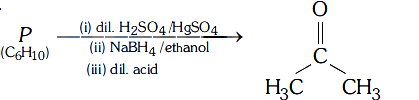
Question:
The structure of compound P isJEE Advanced 2011 Medium - Paragraph:
Copper is the most noble of the first row transition metals and occurs in small deposits in several countries. Ores of copper include chalcanthite \(\left(\mathrm{CuSO}_4 \cdot 5 \mathrm{H}_2 \mathrm{O}\right)\), atacamite \(\left(\mathrm{Cu}_2 \mathrm{Cl}(\mathrm{OH})_3\right)\), cuprite \(\left(\mathrm{Cu}_2 \mathrm{O}\right)\), copper glance \(\left(\mathrm{Cu}_2 \mathrm{~S}\right)\) and malachite \(\left(\mathrm{Cu}_2(\mathrm{OH})_2 \mathrm{CO}_3\right)\). However, 80\% of the world copper production comes from the ore chalcopyrite \(\left(\mathrm{CuFeS}_2\right)\). The extraction of copper from chalcopyrite involves partial roasting, removal of iron and self-reduction.
Question:
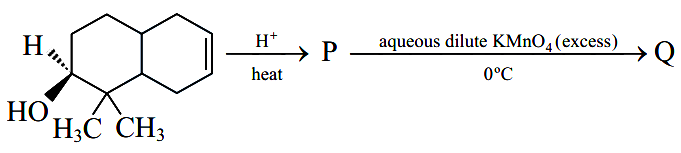
Partial roasting of chalcopyrite producesJEE Advanced 2010 Hard - The number of hydroxyl group(s) in Q is
 JEE Advanced 2015 Medium
 - For a double strand DNA, one strand is given below:

The amount of energy required to split the double strand DNA into two single strands is _______ kcal \(\mathrm{mol}^{-1}.\)
[Given: Average energy per \(\mathrm{H}\)-bond for A-T base pair \(=1.0 \mathrm{kcal} \mathrm{mol}^{-1}, \mathrm{G}-\mathrm{C}\) base pair \(=1.5 \mathrm{kcal}\) \(\mathrm{mol}^{-1}\), and A-U base pair \(=1.25 \mathrm{kcal} \mathrm{mol}^{-1}.\) Ignore electrostatic repulsion between the phosphate groups.]JEE Advanced 2024 Hard
More PYQs from JEE Advanced
- The number of points in , for which , is:JEE Advanced 2013 Hard
- Columns 1, 2 and 3 contain starting materials, reaction conditions and type of reactions respectively.
The only CORRECT combination that gives two different carboxylic acids isColumn 1 Column 2 Column 3 (I) Toulene (i) \(NaOH\) \( /Br _2\) (P) Condensation (II) Acetophenone (ii) \(B r_2 / h v\) (Q) Carboxylation (III) Benzaldehyde (iii) \(\left( CH _3 CO \right)_2\) \(O / CH _3\) \(COOK\) (R) Substitution (IV) Phenol (iv) \(NaOH\) \(/CO _2\) (S) Haloform JEE Advanced 2017 Medium - Let where and are real number, and is the identity matrix. If is the minimum of the set { and is the minimum of the set then the value of isJEE Advanced 2019 Hard
- Paragraph:
A small spherical monoatomic ideal gas bubble \(\left(\gamma=\frac{5}{3}\right)\) is trapped inside a liquid of density \(\rho_1\) (see figure). Assume that the bubble does not exchange any heat with the liquid. The bubble contains \(n\) moles of gas. The temperature of the gas when the bubble is at the bottom is \(T_0\), the height of the liquid is \(H\) and the atmospheric pressure is \(p_0\) (Neglect surface tension).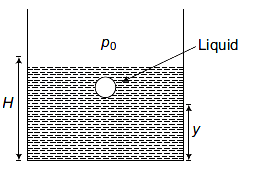
Question:
As the bubble moves upwards, besides the buoyancy force the following forces are acting on it.JEE Advanced 2008 Medium - The heating of \(\mathrm{NH}_4 \mathrm{NO}_2\) at \(60-70^{\circ} \mathrm{C}\) and \(\mathrm{NH}_4 \mathrm{NO}_3\) at \(200-250^{\circ} \mathrm{C}\) is associated with the formation of nitrogen containing compounds \(\mathbf{X}\) and \(\mathbf{Y}\), respectively. \(\mathbf{X}\) and \(\mathbf{Y}\), respectively, areJEE Advanced 2025 Easy
- The nitrogen oxide(s) that contain(s) N.N bond(s) is (are)JEE Advanced 2009 Easy