


JEE Advanced · Chemistry · 30. Polymers
Among cellulose, polyvinyl chloride, nylon and natural rubber, the polymer in which the intermolecular force of attraction is weakest in
- A nylon
- B polyvinyl chloride
- C cellulose
- D natural rubber
Answer & Solution
Correct Answer
(D) natural rubber
Step-by-step Solution
Detailed explanation
Nylon has amid linkage capable of forming intermolecular H - bonding as
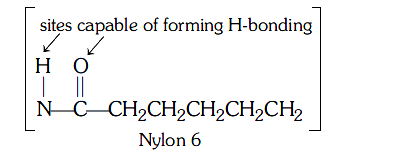
Due to \(\mathrm{H}\)-bonding, nylon has strong intermolecular attraction.
Cellulose is a polyhydroxy compound, also capable of forming strong intermolecular \(\mathrm{H}\)-bonding. Polyvinyl chloride is a polar polymer due to carbon chlorine bond and it possess strong dipole-dipole attraction. Natural rubber is poly (isoprene), a hydrocarbon, possess weak van der Waal's attraction.
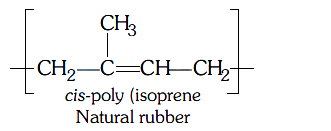
Due to \(\mathrm{H}\)-bonding, nylon has strong intermolecular attraction.
Cellulose is a polyhydroxy compound, also capable of forming strong intermolecular \(\mathrm{H}\)-bonding. Polyvinyl chloride is a polar polymer due to carbon chlorine bond and it possess strong dipole-dipole attraction. Natural rubber is poly (isoprene), a hydrocarbon, possess weak van der Waal's attraction.
See the Complete Solution
Get step-by-step explanations for this and 2.5 Lakh+ more JEE, NEET & CET questions.
- Unlock all solutions
- Practice the full chapter
- Track accuracy across PYQs
4.8 rated on Google Play · 14,000+ reviews
More questions from Chemistry
- The green colour produced in the borax bead test of a chromium(III) salt is due to -JEE Advanced 2019 Easy
- At 300 K , an ideal dilute solution of a macromolecule exerts osmotic pressure that is expressed in terms of the height ( h ) of the solution (density \(=1.00 \mathrm{~g} \mathrm{~cm}^{-3}\) ) where h is equal to 2.00 cm . If the concentration of the dilute solution of the macromolecule is \(2.00 \mathrm{~g} \mathrm{dm}^{-3}\), the molar mass of the macromolecule is calculated to be \(\boldsymbol{X} \times 10^4 \mathrm{~g} \mathrm{~mol}^{-1}\). The value of \(\boldsymbol{X}\) is \(\qquad\) .
Use : Universal gas constant \((\mathrm{R})=8.3 \mathrm{~J} \mathrm{~K}^{-1} \mathrm{~mol}^{-1}\) and acceleration due to gravity \((\mathrm{g})=10 \mathrm{~m} \mathrm{~s}^{-2}\)JEE Advanced 2025 Easy - Based on VSEPR theory, the number of 90 degree \(\mathrm{F}-\mathrm{Br}-\mathrm{F}\) angles in \(\mathrm{BrF}_5\) isJEE Advanced 2010 Hard
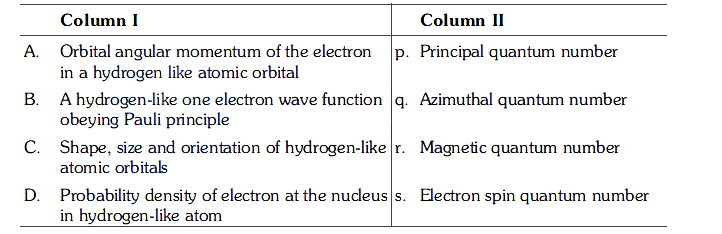
- Match the entries in Column I with the correctly related quantum number(s) in Column II. Indicate your answer by darkening the appropriate bubbles of the \(4 \times 4\) matrix given in the ORS.
 JEE Advanced 2008 Easy
 - In an electrochemicalcell, dichromate ions in aqueous acidic medium are reduced to \(\mathrm{Cr}^{3+}\). The current (in amperes) that flows through the cell for 48.25 minutes to produce 1 mole of \(\mathrm{Cr}^{3+}\) is _____ .
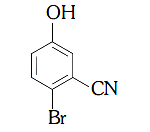
Use: 1 Faraday \(=96500 \mathrm{C} \mathrm{mol}^{-1}\)JEE Advanced 2025 Easy - The IUPAC name of the following compound, is
 JEE Advanced 2009 Easy
More PYQs from JEE Advanced
- Paragraph :
\(P_{14-16}\) : Paragraph for Questions Nos. 14 to 16 A fixed thermally conducting cylinder has a radius \(R\) and height \(L_0\). The cylinder is open at its bottom and has a small hole at its top. A piston of mass \(M\) is held at a distance \(L\) from the top surface as shown in the figure. The atmospheric pressure is \(p_0\).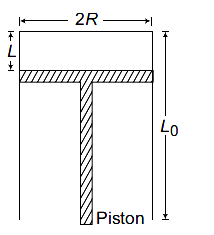
Question :
The piston is now pulled out slowly and held at a distance \(2 L\) from the top. The pressure in the cylinder between its top and the piston will then beJEE Advanced 2007 Easy - The electrochemical extraction of aluminium from bauxite ore involvesJEE Advanced 2022 Medium
- If \(y(x)\) satisfies the differential equation \(y^{\prime}-y \tan x\) \(=2 x \sec x\) and \(y(0)=0\), thenJEE Advanced 2012 Medium
- The reversible expansion of an ideal gas under adiabatic and isothermal conditions is shown in the figure. Which of the following statement(s) is (are) correct?
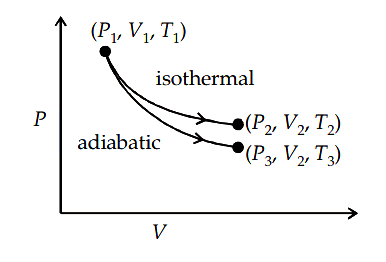 JEE Advanced 2012 Medium
 - \(\frac{d^2 x}{d y^2}\) equalsJEE Advanced 2007 Medium
- In a Young's double slit experiment, a combination of two glass wedges \(A\) and \(B\), having refractive indices 1.7 and 1.5, respectively, are placed in front of the slits, as shown in the figure. The separation between the slits is \(d=2 \mathrm{~mm}\) and the shortest distance between the slits and the screen is \(D=2 \mathrm{~m}\). Thickness of the combination of the wedges is \(t=12 \mu \mathrm{~m}\). The value of \(l\) as shown in the figure is 1 mm . Neglect any refraction effect at the slanted interface of the wedges. Due to the combination of the wedges, the central maximum shifts (in mm ) with respect to O by ______
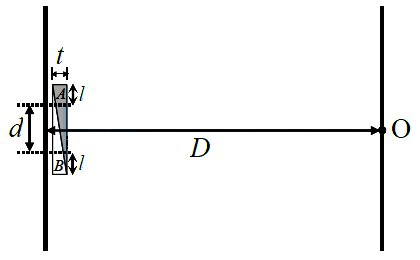 JEE Advanced 2025 Hard