


JEE Advanced · Chemistry · 13. GOC
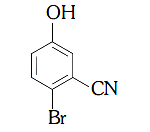
The IUPAC name of the following compound, is
- A 4-bromo-3-cyanophenol
- B 2-bromo-5-hydroxybenzonitrile
- C 2-cyano-4-hydroxybromobenzene
- D 6-bromo-3-hydroxybenzonitrile
Answer & Solution
Correct Answer
(B) 2-bromo-5-hydroxybenzonitrile
Step-by-step Solution
Detailed explanation
Cyano group has the highest priority therefore, parent name must be benzonitrile. \(\mathrm{Br}\) occurs at 2-position, and hydroxyl at 3-position, hence clockwise numbering will be the correct one.
See the Complete Solution
Get step-by-step explanations for this and 2.5 Lakh+ more JEE, NEET & CET questions.
- Unlock all solutions
- Practice the full chapter
- Track accuracy across PYQs
4.8 rated on Google Play · 14,000+ reviews
More questions from Chemistry
- Paragraph:
\(RCONH _2\) is converted into \(RNH _2\) by means of Hofmann bromamide degradation.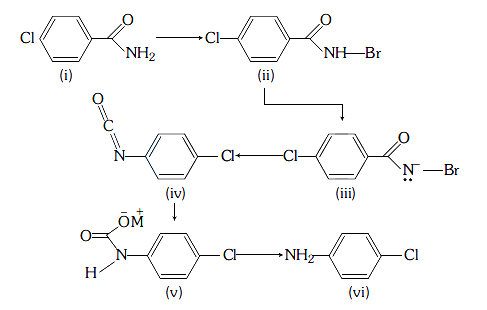
In this reaction, \(R \mathrm{CONHBr}\) is formed from which this reaction has derived its name. Electron donating group at phenyl activates the reaction. Hofmann degradation reaction is an intramolecular reaction.
Question:
Which is the rate determining step in Hofmann bromamide degradation?JEE Advanced 2006 Hard - Among PbS, CuS, HgS, MnS, , NiS, CoS, and , the total number of black coloured sulphides isJEE Advanced 2014 Easy
- In the following reaction sequence in aqueous solution, the species and respectively, are
\(S _2 O _3^{2-} \xrightarrow{ Ag ^{+}} \underset{\substack{\text { Clear } \\ \text { Solution }}}{ X } \xrightarrow{ Ag ^{+}} \underset{\substack{\text { White } \\ \text { Precipitate }}}{ Y }\) \(\xrightarrow{\text { With time }} \underset{\substack{\text { Black } \\ \text { Precipitate }}}{ Z }\)JEE Advanced 2016 Easy - The major products obtained from the reactions in List-II are the reactants for the named reactions mentioned in List-I. Match each entry in List-I with the appropriate entry in List-II and choose the correct options.
List - I List - II (P) Stephen reaction (1) 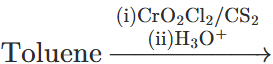
(Q) Sandmeyer reaction (2) 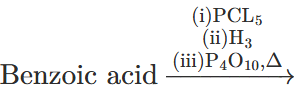
(R) Hoffmann bromamide degradation reaction (3) 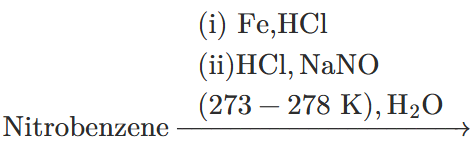
(S) Cannizzaro reaction (4) 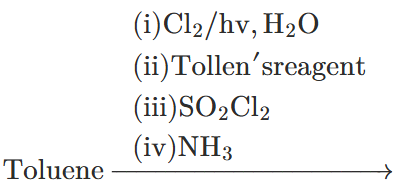
(5) 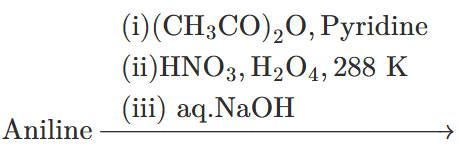 JEE Advanced 2025 Hard
 - The oxidation number of \(\mathrm{Mn}\) in the product of alkaline oxidative fusion of \(\mathrm{MnO}_2\) isJEE Advanced 2009 Medium
- Given, that the abundances of isotopes, \({ }_{54} \mathrm{Fe},{ }_{56} \mathrm{~F}\) and \({ }_{57} \mathrm{Fe}\) are \(5 \%\), \(90 \%\) and \(5 \%\), respectively, the atomic mass of \(\mathrm{Fe}\) isJEE Advanced 2009 Medium
More PYQs from JEE Advanced
- Paragraph:
An aqueous solution of metal ion \(\mathbf{M} 1\) reacts separately with reagents \(\mathbf{Q}\) and \(\mathbf{R}\) in excess to give tetrahedral and square planar complexes, respectively. An aqueous solution of another metal ion M2 always forms tetrahedral complexes with these reagents. Aqueous solution of \(\mathbf{M} 2\) on reaction with reagent \(\mathbf{S}\) gives white precipitate which dissolves in excess of \(\mathbf{S}\). The reactions are summarized in the scheme given below: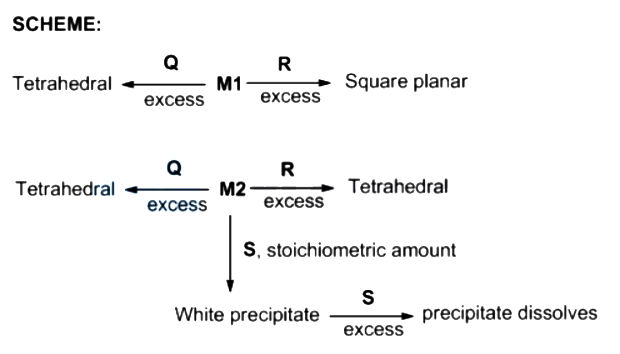
Question:
\(\mathbf{M} 1, \mathbf{Q}\) and \(\mathbf{R}\), respectively areJEE Advanced 2014 Easy - If a chord, which is not a tangent, of the parabola has the equation , and midpoint (h, k), then which of the following is (are) possible value(s) of and ?
JEE Advanced 2017 Easy - Incandescent bulbs are designed by keeping in mind that the resistance of their filament increases with the increase in temperature. If at room temperature, \(100 \mathrm{~W}, 60 \mathrm{~W}\) and \(40 \mathrm{~W}\) bulbs have filament resistances \(R_{100}, R_{60}\) and \(R_{40}\), respectively, the relation between these resistances isJEE Advanced 2010 Medium
- A plot of the number of neutrons against the number of protons of the stable nuclei exhibits upwards deviation from linearity for atomic number, . For an unstable nucleus having ratio less than , the possible mode(s) of decay is (are):JEE Advanced 2016 Medium
- With respect to the compoundschoose the correct statement(s).
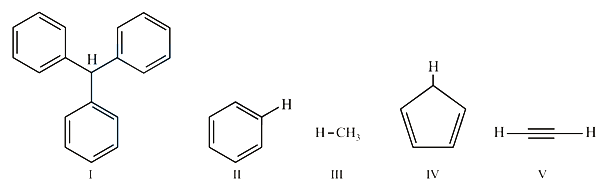 JEE Advanced 2020 Medium
 - A spherical soap bubble inside an air chamber at pressure \(P_0=10^5 \mathrm{~Pa}\) has a certain radius so that the excess pressure inside the bubble is \(\Delta P=144 \mathrm{~Pa}\). Now, the chamber pressure is reduced to \(8 P_0 / 27\) so that the bubble radius and its excess pressure change. In this process, all the temperatures remain unchanged. Assume air to be an ideal gas and the excess pressure \(\Delta P\) in both the cases to be much smaller than the chamber pressure. The new excess pressure \(\Delta P\) in \(\mathrm{Pa}\) is ________ .JEE Advanced 2024 Medium