


JEE Advanced · Chemistry · 2. Atomic Structure
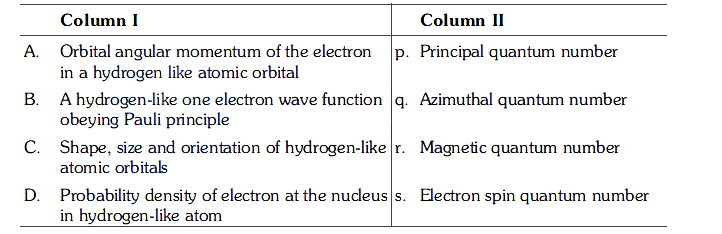
Match the entries in Column I with the correctly related quantum number(s) in Column II. Indicate your answer by darkening the appropriate bubbles of the \(4 \times 4\) matrix given in the ORS.
- A (A) q, (B) q,r,s, (C) p,q,r,s, (D) p,q
- B (A) p, (B) p,q,s, (C) p,q,s, (D) p
- C (A) p, (B) q,r,s, (C) p,q,r,s, (D) p,q
- D (A) q, (B) p,q,r,s, (C) p,q,r, (D) p
Answer & Solution
Correct Answer
(D) (A) q, (B) p,q,r,s, (C) p,q,r, (D) p
Step-by-step Solution
Detailed explanation
A-q; B-p, q, r, s; C-p, q, r; D-p, q, r
(B) A hydrogen-like one electron wave function obeying Pauli's principle First, as it is the wave function so it will be characterised by \(n, l\) and \(m\). Further, it obeys the Pauli's principle, that's why it will be characterised completely by adding spin quantum number also.
(D) Radial probability density of electron at the nucleus basically depends on azimuthal quantum number, but as it is the function of radius depends on principal quantum number, When angular probability density is included, that depends on magnetic quantum number.
(B) A hydrogen-like one electron wave function obeying Pauli's principle First, as it is the wave function so it will be characterised by \(n, l\) and \(m\). Further, it obeys the Pauli's principle, that's why it will be characterised completely by adding spin quantum number also.
(D) Radial probability density of electron at the nucleus basically depends on azimuthal quantum number, but as it is the function of radius depends on principal quantum number, When angular probability density is included, that depends on magnetic quantum number.
See the Complete Solution
Get step-by-step explanations for this and 2.5 Lakh+ more JEE, NEET & CET questions.
- Unlock all solutions
- Practice the full chapter
- Track accuracy across PYQs
4.8 rated on Google Play · 14,000+ reviews
More questions from Chemistry
- Among the following, the surfactant that will form micelles in aqueous solution at the lowest molar concentration at ambient conditions isJEE Advanced 2008 Medium
- Paragraph:
Chemical reactions involve interaction of atoms and molecules. A large number of atoms/molecules (approximately \(6.023 \times 10^{23}\) ) are present in a few grams of any chemical compound varying with their atomic/molecular masses. To handle such large numbers conveniently, the mole concept was introduced. This concept has implications in diverse areas such as analytical chemistry, biochemistry, electrochemistry and radiochemistry. The following example illustrates a typical case, involving chemical/electrochemical reaction, which requires a clear understanding of the mole concept.
A \(4.0\) molar aqueous solution of \(\mathrm{NaCl}\) is prepared and \(500 \mathrm{~mL}\) of this solution is electrolysed. This leads to the evolution of chlorine gas at one of electrodes (atomic mass: \(\mathrm{Na}=23, \mathrm{Hg}=200 ; 1\) faraday \(=96500\) coulombs).
Question:
The total number of moles of chlorine gas evolved isJEE Advanced 2007 Medium - The total number of compounds having at least one bridging oxo group among the molecules given below is
\(\text N _2\text O _5,\)\(\text P _4\text O _6,\)\(\text P _4\text O _8,\)\(\text H _4\text P _2\text O _5,\)\(\text H _5\text P _3\text O _{10},\) \(\text H _2\text S_2\text O _3,\text H _2\text S_2\text O _5\)JEE Advanced 2018 Medium - The total number of lone pairs of electrons in isJEE Advanced 2015 Easy
- Hyperconjugation involves overlap of the following orbitalsJEE Advanced 2008 Easy
- Among the following, the number of compounds than can react with \(\mathrm{PCl}_5\) to give \(\mathrm{POCl}_3\) is \(\mathrm{O}_2, \mathrm{CO}_2, \mathrm{SO}_2, \mathrm{H}_2 \mathrm{O}, \mathrm{H}_2 \mathrm{SO}_4, \mathrm{P}_4 \mathrm{O}_{10}\).JEE Advanced 2011 Medium
More PYQs from JEE Advanced
- Paragraph:
Properties such as boiling point, freezing point and vapour pressure of a pure solvent change when solute molecules are added to get homogeneous solution. These are called colligative properties. Applications of colligative properties are very useful in day-to-day life. One of its examples is the use of ethylene glycol and water mixture as anti-freezing liquid in the radiator automobiles.
A solution \(M\) is prepared by mixing ethanol and water. The mole fraction of ethanol in the mixtrue is \(0.9\)
Given Freezing point depression constant of water \(\left(k^{\text {water }}\right)=1.86 \mathrm{~K} \mathrm{~kg} \mathrm{~mol}^{-1}\)
Freezing point depression constant of ethanol \(\left(k_f^{\text {ethanol }}\right)=2.0 \mathrm{Kkg} \mathrm{mol}^{-1}\)
Boiling point elevation constant of water \(\left(k_b^{\text {water }}\right)=0.52 \mathrm{Kkg} \mathrm{mol}^{-1}\)
Boiling point elevation constant of ethanol \(\left(k_b^{\text {ethanol }}\right)=1.2 \mathrm{Kkg} \mathrm{mol}^{-1}\)
Standard freezing point of water \(=273 \mathrm{~K}\)
Standard freezing point of ethanol \(=155.7 \mathrm{~K}\)
Standard boiling point of water \(=373 \mathrm{~K}\)
Standard boiling point of ethanol \(=351.5 \mathrm{~K}\)
Vapour pressure of pure water \(=328 \mathrm{~mm}\) of \(\mathrm{Hg}\)
Vapour pressure of pure ethanol \(=40 \mathrm{~mm}\) of \(\mathrm{Hg}\)
Molecular weight of water \(=18 \mathrm{~g} \mathrm{~mol}^{-1}\)
Molecular weight of ethanol \(=46 \mathrm{~g} \mathrm{~mol}^{-1}\)
In answering the following questions, consider the solutions to be ideal dilute solutions and solutes to be non-volatile and non-dissociative.
Question:
Water is added to the solution \(M\) such that the mole fraction of water in the solution becomes \(0.9\) The boiling point of this solutions isJEE Advanced 2008 Medium - A moving coil galvanometer has 50 turns and each turn has an area . The magnetic field produced by the magnet inside the galvanometer is . The torsional constant of the suspension wire is . When a current flows through the galvanometer, a full scale deflection occurs if the coil rotates by . The resistance of the coil of the galvanometer is . This galvanometer is to be converted into an ammeter capable of measuring current in the range . For this purpose, a shunt resistance is to be added in parallel to the galvanometer. The value of this shunt resistance, in ohms, is __________.JEE Advanced 2018 Hard
- A particle of mass is moving in the -plane such that its velocity at a point is given as where is a non-zero constant. What is the force acting on the particle?JEE Advanced 2023 Hard
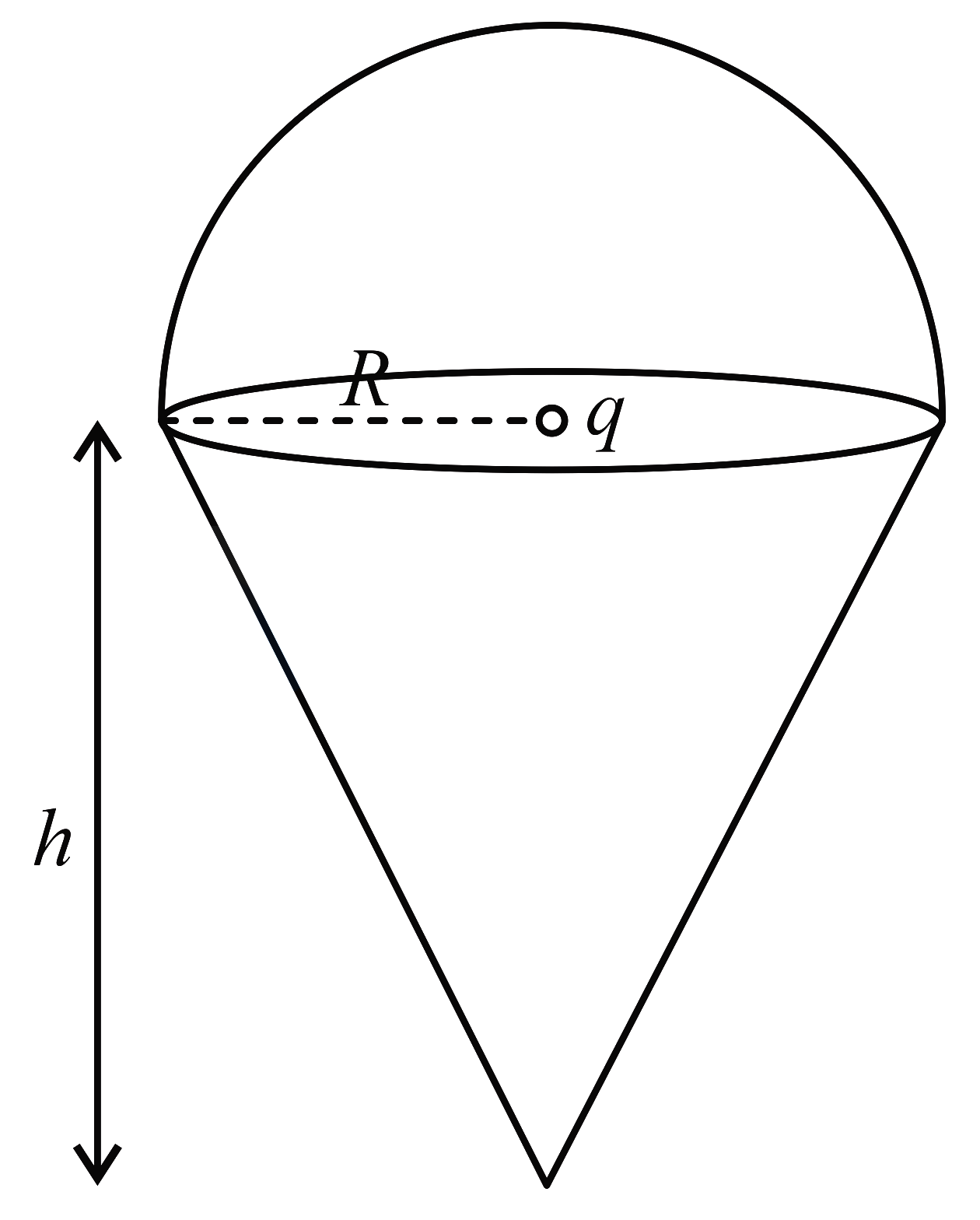
- A charge is surrounded by a closed surface consisting of an inverted cone of height and base radius , and a hemisphere of radius as shown in the figure. The electric flux through the conical surface is (in units). The value of is _________.
 JEE Advanced 2022 Easy
 - Paragraph:
Consider an evacuated cylindrical chamber of height \(h\) having rigid conducting plates at the ends and an insulating curved surface as shown in the figure. A number of spherical balls made of a light weight and soft material and coated with a conducting material are placed on the bottom plate. The balls have a radius \(r \ll h\). Now a high voltage source \((HV)\) is connected across the conducting plates such that the bottom plate is at \(+V_{0}\) and the top plate at \(-V_{0} .\) Due to their conducting surface, the balls will get charged, will become equipotential with the plate and are repelled by it. The balls will eventually collide with the top plate, where the coefficient of restitution can be taken to be zero due to the soft nature of the material of the balls. The electric field in the chamber can be considered to be that of a parallel plate capacitor. Assume that there are no collisions between the balls and the interaction between them is negligible. (Ignore gravity)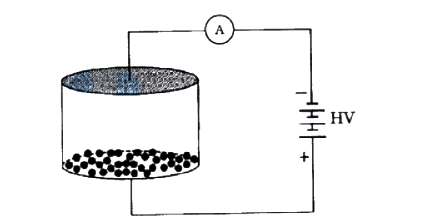
Question:
The average current in the steady state registered by the ammeter in the circuit will beJEE Advanced 2016 Medium - A series LCR circuit is connected to a Volt source. The resonant angular frequency of the circuit is and current amplitude at resonance is . When the angular frequency of the source is , the current amplitude in the circuit is . If , match each entry in List- with an appropriate value from List- and choose the correct option.
List- List- in The quality factor of the circuit The bandwidth of the circuit in The peak power dissipated at resonance in Watt JEE Advanced 2023 Medium