


JEE Mains · Maths · STD 11 - 6. permutation and combination
ધારો કે \(b _{1} b _{2} b _{3} b _{4}\) એ. \(1 \leq i \leq 4\) માટે \(b _{i} \in\{1,2,3, \ldots \ldots, 100\}\) અને \(i \neq j\) માટે \(b _{i} \neq b _{j}\) હોય,તેવું \(4\) ઘટકો વાળું એક એવું ક્રમસય છે કે જેથી \(b _{1}, b _{2^{\prime}} b _{3}\) ક્રમિક પૂણાંકો હોય અથવા તો \(b _{2}, b _{3}, b _{4}\) ક્રમિક પૂર્ણાંકો હોય.તો આવાં ક્રમમયો \(b _{1} b _{2} b _{3} b _{4}\)ની સંખ્યા \(\dots\dots\dots\)છે.
- A \(17915\)
- B \(18915\)
- C \(19915\)
- D \(20915\)
Answer & Solution
Correct Answer
(B) \(18915\)
Step-by-step Solution
Detailed explanation
\(b _{ i } \in\{1,2,3 \ldots \ldots .100\}\) Let \(A=\) set when \(b_{1} b_{2} b_{3}\) are consecutive \(n ( A )=\frac{97+97+\ldots \ldots+97}{98 \text { times }}=97 \times 98\) Similarly when \(b_{2} b_{3} b_{4}\) are consecutive \(N ( A )=97 \times 98\)…
See the Complete Solution
Get step-by-step explanations for this and 2.5 Lakh+ more JEE, NEET & CET questions.
- Unlock all solutions
- Practice the full chapter
- Track accuracy across PYQs
4.8 rated on Google Play · 14,000+ reviews
More questions from Maths
- ધારો કે \(S=\{z \in C:|z-1|=1\) અને \((\sqrt{2}-1)(z+\bar{z})-i(z-\bar{z})=2 \sqrt{2}\}\). ધારો કે \(\mathrm{z}_1, \mathrm{z}_2\) \(\in S\) એવા છે કે \(\left|z_1\right|=S\) માં \(z\) ના મહત્તમ મૂલ્ય અને \(\left|z_2\right|=S\) માં \(z\) ના ન્યૂનતમ મૂલ્ય છે. તો \(\left|\sqrt{2} z_1-z_2\right|^2\) = ........... છે.JEE Mains 2024 Hard
- સમીકરણ \(2 x+3 \tan x=\pi, x \in[-2 \pi, 2 \pi]-\left\{ \pm \frac{\pi}{2}, \pm \frac{3 \pi}{2}\right\}\) ના ઉકેલોની સંખ્યા ___ છે.JEE Mains 2025 Easy
- ધારો કે \(A(3, 0, -1), B(2, 10, 6)\) અને \(C(1, 2, 1)\) એ ત્રિકોણના શિરોબિંદુઑ છે અને \(M\) એ \(AC\) નું મધ્યબિંદુ છે . જો \(G\) એ \(BM\) ને \(2 : 1\) ગુણોતરમાં વિભાજન કરે છે તો \(\cos \,\left( {\angle GOA} \right)\) મેળવો (\(O\) એ ઉગમબિંદુ છે )JEE Mains 2019 Hard
- ધારો કે રેખા \(\frac{x-2}{\alpha}=\frac{y-2}{-5}=\frac{z+2}{2}\) એ સમતલ \(x+3 y-2 z+\beta=0 \) માં આવેલી છે તો \((\alpha+\beta)\) ની કિમંત મેળવો.JEE Mains 2021 Easy
- રેખાઓ \(x+2 y+7=0\) અને \(2 x-y+8=0\) થી હંમેશા સમાન અંતરે રહે તે રીતે ગતિ કરતા બિંદુ \(P\) નો બિંદુપથ \(x^2-y^2+2 h x y+2 g x+2 f y+c=0\) છે. તો \(g+c+h-f\) નું મૂલ્ય ........... છે.JEE Mains 2024 Hard
- શ્રેઢી \({1^2} + 2 \cdot {2^2} + {3^2} + 2 \cdot {4^2} + {5^2} + .\;.\;.\;.\) ના પ્રથમ \(20\) પદોનો સરવાળો ધારો કે \(A\) છે અને પ્રથમ \(40\) પદોનો સરવાળો ધારો કે \(B\) છે. જો \(B - 2A = 100\lambda \) તો \(\lambda \) મેળવો.JEE Mains 2018 Hard
More PYQs from JEE Mains
- પરવલય \(y^2\, = 8x\) ને બિંદુ \((- 8, 0)\) માંથી દોરેલો સ્પર્શક પરવલયને અનુક્રમે બિંદુ \(P\) અને \(Q\) માં છેદે છે જો \(F\) એ પરવલયની નાભી હોય તો ત્રિકોણ \(PFQ\) નું ક્ષેત્રફળ ચો એકમમાં ............ થાયJEE Mains 2018 Hard
- \(\mathrm{k}(\mathrm{k} \neq 0 )\) ની બધીજ પૂર્ણાંક સંખ્યાનો સરવાળો મેળવો કે જેથી \(x\) નું સમીકરણ \(\frac{2}{x-1}-\frac{1}{x-2}=\frac{2}{k}\) ને એકપણ વાસ્તવિક બીજ ન હોય .JEE Mains 2021 Hard
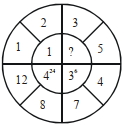
- આકૃતિમાં આપેલ "?" વાળી કિમંત મેળવો.
 JEE Mains 2021 Medium
 - ન્યૂનતમ ધન પૂર્ણાંક \(\mathrm{n}\) મેળવો કે જેથી \(\frac{(2 \mathrm{i})^{\mathrm{n}}}{(1-\mathrm{i})^{\mathrm{n}-2}}, \mathrm{i}=\sqrt{-1}\) એ ધન પૃણાંક બને.JEE Mains 2021 Medium
- ત્રિકોણીમતીય પ્રતિવિધેયોની મુખ્ય કિંમતો ધ્યાને લેતાં, સમીકરણ \(\cos ^{-1}(x)-2 \sin ^{-1}(x)=\cos ^{-1}(2 x)\) ના તમામ ઉકેલોનો સરવાળો .......... છે.JEE Mains 2022 Hard
- જો વિધેય \(f(x)=\left(\frac{1}{x}\right)^{2 x} ; x>0\) એ \(x=\frac{1}{\mathrm{e}}\) આગળ મહત્તમ મૂલ્ય ધારણ કરે, તો :JEE Mains 2024 Hard