


WBJEE · Maths · Application of Derivatives
The greatest and least values of \(f(x)=\tan ^{-1} x-\frac{1}{2} \ln x\) on \(\left[\frac{1}{\sqrt{3}}, \sqrt{3}\right]\) are
- A \(\mathrm{f}_{\min }=\sqrt{3}-1\)
- B \(\mathrm{f}_{\max }=\pi / 6+\frac{1}{4} \ell \mathrm{n} 3\)
- C \(\mathrm{f}_{\min }=\pi / 3-\frac{1}{4} \ell \mathrm{n} 3\)
- D \(\mathrm{f}_{\max }=\pi / 12+\ell \mathrm{n} 5\)
Answer & Solution
Correct Answer
(C) \(\mathrm{f}_{\min }=\pi / 3-\frac{1}{4} \ell \mathrm{n} 3\)
Step-by-step Solution
Detailed explanation
\(f(x)=\tan ^{-1} x-1 / 2 \ln x, x \in[1 / \sqrt{3}, \sqrt{3}]\) \(f^{\prime}(x)=\frac{1}{1+x^{2}}-\frac{1}{2 x}=\frac{2 x-\left(1+x^{2}\right)}{2 x\left(1+x^{2}\right)}=\frac{-(x-1)^{2}}{2 x\left(1+x^{2}\right)}\) when \(x>0, f^{\prime}(x) < 0\) \(f(x)\) is decreasing function.…
See the Complete Solution
Get step-by-step explanations for this and 2.5 Lakh+ more JEE, NEET & CET questions.
- Unlock all solutions
- Practice the full chapter
- Track accuracy across PYQs
4.8 rated on Google Play · 14,000+ reviews
More questions from Maths
- Two particles \(A\) and \(B\) move from rest along a straight line with constant accelerations \(f\) and \(h,\) respectively. If \(A\) takes \(m\) seconds more than \(B\) and describes \(n\) units more than that of \(B\) acquiring the same speed, thenWBJEE 2019 Easy
- Let \(f(x)\) denotes the fractional part of a real number \(x\). Then, the value of \(\int_{0}^{\sqrt{3}} f\left(x^{2}\right) d x\) isWBJEE 2015 Medium
- Equation of a tangent to the hyperbola \(5 x^{2}-y^{2}=5\) and which passes through an external point (2,8) isWBJEE 2019 Medium
- The quadratic expression \((2 x+1)^{2}-p x+q \neq 0\) for any real \(x,\) ifWBJEE 2015 Medium
- The point of contact of the tangent to the parabola \(y^2=9 x\) which passes through the point \((4,10)\) and makes an angle \(\theta\) with the positive side of the axis of the parabola where \(\tan \theta>2\), isWBJEE 2022 Easy
- If \(f(x)=\left\{\begin{array}{ll}2 x^{2}+1, & x \leq 1 \\ 4 x^{3}-1, & x>1\end{array},\right.\) then \(\int_{0}^{2} f(x) d x\) isWBJEE 2014 Easy
More PYQs from WBJEE
- A gas bubble of \(2 \mathrm{cm}\) diameter rises througha liquid of density \(1.75 \mathrm{g} \mathrm{cm}^{-3}\) with a fixed speed of \(0.35 \mathrm{cms}^{-1}\). Neglect the density of the gas. The coefficient of viscosity of the liquid isWBJEE 2016 Hard
- The number of zeros at the end of 100! isWBJEE 2022 Easy
- Let \(f(x)\) be a differentiable function in \([2,7]\). If \(f(2)=3\) and \(f^{\prime}(x) \leq 5\) for all \(x\) in \((2,7),\) then the maximum posaible value of \(f(x)\) at \(x=7\) isWBJEE 2014 Medium
- A force \(\overrightarrow{\mathrm{F}}=a \hat{i}+b \hat{\mathrm{j}}+c \hat{k}\) is acting on a body of mass \(m\). The body was initially at rest at the origin. The co-ordinates of the body after time ' t ' will beWBJEE 2025 Medium
- A circuit consists of three batteries of emf \(E_{1}=1 \mathrm{V}, E_{2}=2 \mathrm{V}\) and \(E_{3}=3 \mathrm{V}\) and internal resistances \(1 \Omega, 2 \Omega\) and \(1 \Omega\) respectively which are connected in parallel as shown in the figure. The potential difference between points \(P\) and \(Q\) is
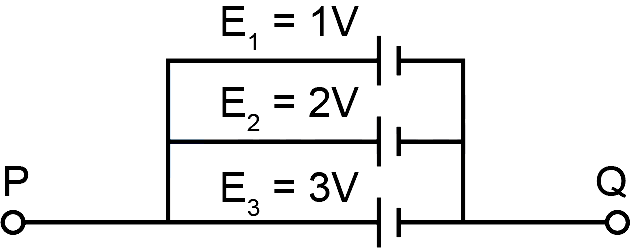 WBJEE 2014 Medium
 - The current through a coil of self inductance \(\mathrm{L}=2 m \mathrm{H}\) is given by \(\mathrm{I}=t^2 e^{-t}\) at time \(t\). How long it will take to make the e \(\mathrm{m} . f\) zero?WBJEE 2010 Easy