


WBJEE · Maths · Functions
Two particles \(A\) and \(B\) move from rest along a straight line with constant accelerations \(f\) and \(h,\) respectively. If \(A\) takes \(m\) seconds more than \(B\) and describes \(n\) units more than that of \(B\) acquiring the same speed, then
- A \((f+h) m^{2}=h n\)
- B \((f-f h) m^{2}=f h n\)
- C \((h-f) n=\frac{1}{2}\) \(fhm^{2}\)
- D \(\frac{1}{2}(f+h) n=\) \(fhm^{2}\)
Answer & Solution
Correct Answer
(C) \((h-f) n=\frac{1}{2}\) \(fhm^{2}\)
Step-by-step Solution
Detailed explanation
Let \(B\) travels \(x\) units, \(v=u+a t\) According to problem, \(h t=f(t+m)\) \(\begin{aligned} h t=& f t+f m \\ h t-f t &=f m \\ t(h-f) &=f m \\ \frac{h-f}{f} &=\frac{m}{t} \end{aligned}\) \(t=m\left(\frac{f}{h-f}\right)\)…
See the Complete Solution
Get step-by-step explanations for this and 2.5 Lakh+ more JEE, NEET & CET questions.
- Unlock all solutions
- Practice the full chapter
- Track accuracy across PYQs
4.8 rated on Google Play · 14,000+ reviews
More questions from Maths
- If \(f(x)=\sin x+2 \cos ^{2} x, \frac{\pi}{4} \leq x \leq \frac{3 \pi}{4} .\) Then, \(f\) attains itsWBJEE 2013 Medium
- The area bounded by the parabolas \(y=4 x^{2}, y=\frac{x^{2}}{9}\) and the straight line \(y=2\) isWBJEE 2021 Medium
- Let \(I=\int_{10}^{19} \frac{\sin x}{1+x^{6}} d x\). Then,WBJEE 2017 Medium
- Six numbers are in AP such that their sum is 3 . The first term is 4 times the third term. Then, the fifth term isWBJEE 2012 Medium
- If \(\left|Z_1\right|=\left|Z_2\right|=\left|Z_3\right|=1\) and \(Z_1+Z_2+Z_3=0\), then the area of the triangle whose vertices are \(Z_1, Z_2, Z_3\) isWBJEE 2025 Medium
- The differential equation representing the family of curves \(y^{2}=2 d(x+\sqrt{d})\) where \(d\) is a parameter, is ofWBJEE 2018 Easy
More PYQs from WBJEE
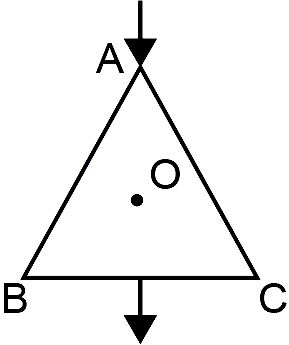
- An equilateral triangle is made by uniform wires \(A B, B C, C A .\) A current \(I\) enters at \(A\) and leaves from the mid point of \(B C\). If the lengths of each side of the triangle is \(L,\) the magnetic field \(B\) at the centroid \(O\) of the triangle is
 WBJEE 2013 Easy
 - A force \(\overrightarrow{\mathrm{F}}=a \hat{i}+b \hat{\mathrm{j}}+c \hat{k}\) is acting on a body of mass \(m\). The body was initially at rest at the origin. The co-ordinates of the body after time ' t ' will beWBJEE 2025 Medium
-
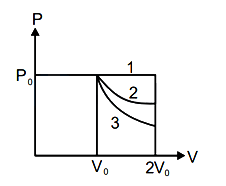
In the given figure, 1 represents isobaric, 2 represents isothermal and 3 represents adiabatic processes of an ideal gas. If \(\Delta \mathrm{U}_{1}, \Delta \mathrm{U}_{2}, \Delta \mathrm{U}_{3}\) be the changes in internal energy in these processes respectively, thenWBJEE 2021 Easy - The value of \(\tan \frac{\pi}{5}+2 \tan \frac{2 \pi}{5}+4 \cot \frac{4 \pi}{5}\) isWBJEE 2014 Medium
- In borax the number of B \(-\mathrm{O}-\mathrm{B}\) links and B - OH bonds present are, respectivelyWBJEE 2013 Easy
- \(\mathrm{N}_{2} \mathrm{H}_{4}\) and \(\mathrm{H}_{2} \mathrm{O}_{2}\) show similarity inWBJEE 2021 Easy