


KCET · Physics · Magnetic Properties of Matter
Pick out the WRONG statements about magnetic substances.
(\(\chi\) = magnetic susceptibility)
(\(\mu_r\) = relative permeability).
I. Substances with \(-1 \leq \chi < 0\) are diamagnetic.
II. Substances with \(\chi \gg 1\) are paramagnetic.
III. Substances with \(\chi \ll 1\) are ferromagnetic.
IV. Substances with \(\mu_r \gg 1\) are ferromagnetic.
- A I and II
- B III and IV
- C II and III
- D II and IV
Answer & Solution
Correct Answer
(C) II and III
Step-by-step Solution
Detailed explanation
For diamagnetic substances, the magnetic susceptibility \(\chi\) is small and negative, so \(-1 \leq \chi < 0\). Statement I is correct.
For paramagnetic substances, \(\chi\) is small and positive, so \(0 < \chi < \epsilon\). Statement II states \(\chi \gg 1\), which is incorrect as this condition applies to ferromagnetic substances.
For ferromagnetic substances, \(\chi\) is very large and positive, so \(\chi \gg 1\). Statement III states \(\chi \ll 1\), which is incorrect.
For ferromagnetic substances, the relative permeability \(\mu_r = 1 + \chi\). Since \(\chi \gg 1\), it follows that \(\mu_r \gg 1\). Statement IV is correct.
Therefore, statements II and III are wrong.
Answer: II and III
For paramagnetic substances, \(\chi\) is small and positive, so \(0 < \chi < \epsilon\). Statement II states \(\chi \gg 1\), which is incorrect as this condition applies to ferromagnetic substances.
For ferromagnetic substances, \(\chi\) is very large and positive, so \(\chi \gg 1\). Statement III states \(\chi \ll 1\), which is incorrect.
For ferromagnetic substances, the relative permeability \(\mu_r = 1 + \chi\). Since \(\chi \gg 1\), it follows that \(\mu_r \gg 1\). Statement IV is correct.
Therefore, statements II and III are wrong.
Answer: II and III
See the Complete Solution
Get step-by-step explanations for this and 2.5 Lakh+ more JEE, NEET & CET questions.
- Unlock all solutions
- Practice the full chapter
- Track accuracy across PYQs
4.8 rated on Google Play · 14,000+ reviews
More questions from Physics
- Which of the following is not a vector quantity?KCET 2014 Medium
- See the diagram. Area of each plate is \(2.0 \mathrm{~m}^{2}\) and \(d=2 \times 10^{-3} \mathrm{~m}\). A charge of \(8.85 \times 10^{-8} \mathrm{C}\) is given to \(Q\). Then the potential of \(Q\) becomes
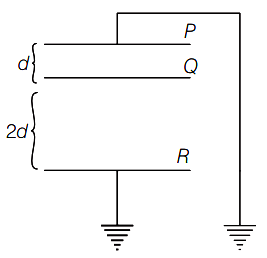 KCET 2013 Easy
 - The magnetic field at the centre ' \( \mathrm{O} \) ' in the given figure is
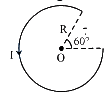 KCET 2019 Medium
 - The time required for the light to pass through a glass slab (refractive index \(=1.5\) ) of thickness \(4 \mathrm{~mm}\) is
( \(c=3 \times 10^{8} \mathrm{~ms}^{-1}\), speed of light in free space)KCET 2011 Medium - A wooden block of mass M lies on a rough floor. Another wooden block of the same mass is hanging from the point \(O\) through strings as shown in the figure. To achieve equilibrium, the co-efficient of static friction between the block on the floor with the floor itself is
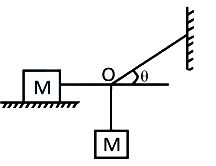 KCET 2025 Medium
 - A carbon film resistor has colour code Green Black Violet Gold. The value of the resistor isKCET 2014 Easy
More PYQs from KCET
- The value of \(\sin ^{2} 51^{\circ}+\sin ^{2} 39^{\circ}\) isKCET 2020 Medium
- The orthocentre of the triangle with vertices \(A(0,0), B\left(0, \frac{3}{2}\right), C(-5,0)\) isKCET 2007 Medium
- Decay constants of two radio-active samples A and \(\mathrm{B}\) are \(15 \mathrm{x}\) and \(3 \mathrm{x}\) respectively. They have equal number of initial nuclei. The ratio of the number of nuclei left in \(\mathrm{A}\) and \(\mathrm{B}\) after a time \(\frac{1}{6 \mathrm{x}}\) isKCET 2012 Medium
- How many chiral carbon atoms are present in \(2,3,4\)-trichloropentane?KCET 2007 Medium
- The electronic configuration of \(\mathrm{Cu}^{2+}\) ion isKCET 2013 Easy
- Which one of these is not known ?KCET 2014 Hard