


KCET · Physics · Nuclear Physics
Decay constants of two radio-active samples A and \(\mathrm{B}\) are \(15 \mathrm{x}\) and \(3 \mathrm{x}\) respectively. They have equal number of initial nuclei. The ratio of the number of nuclei left in \(\mathrm{A}\) and \(\mathrm{B}\) after a time \(\frac{1}{6 \mathrm{x}}\) is
- A \(\mathrm{e}^{-2}\)
- B \(\mathrm{e}\)
- C \(\mathrm{e}^{2}\)
- D \(\mathrm{e}^{-1}\)
Answer & Solution
Correct Answer
(A) \(\mathrm{e}^{-2}\)
Step-by-step Solution
Detailed explanation
\(\mathrm{N}_{1}=\mathrm{N}_{01} \mathrm{e}^{-\lambda_{1} \mathrm{t}}=\mathrm{N}_{0} \mathrm{e}^{-15 \mathrm{x} \times \frac{1}{6 \mathrm{x}}}=\mathrm{N}_{0} \mathrm{e}^{-5 / 2}\)
and \(\mathrm{N}_{2}=\mathrm{N}_{02} \mathrm{e}^{-\lambda_{2} \mathrm{t}}=\mathrm{N}_{0} \mathrm{e}^{-3 \mathrm{x} \times \frac{1}{6 \mathrm{x}}}=\mathrm{N}_{0} \mathrm{e}^{-1 / 2}\)
\(\therefore \quad \frac{\mathrm{N}_{1}}{\mathrm{~N}_{2}}=\mathrm{e}^{-2}\)
and \(\mathrm{N}_{2}=\mathrm{N}_{02} \mathrm{e}^{-\lambda_{2} \mathrm{t}}=\mathrm{N}_{0} \mathrm{e}^{-3 \mathrm{x} \times \frac{1}{6 \mathrm{x}}}=\mathrm{N}_{0} \mathrm{e}^{-1 / 2}\)
\(\therefore \quad \frac{\mathrm{N}_{1}}{\mathrm{~N}_{2}}=\mathrm{e}^{-2}\)
See the Complete Solution
Get step-by-step explanations for this and 2.5 Lakh+ more JEE, NEET & CET questions.
- Unlock all solutions
- Practice the full chapter
- Track accuracy across PYQs
4.8 rated on Google Play · 14,000+ reviews
More questions from Physics
- Which of the following expression can be deduced on the basis of dimensional analysis? (All symbols have their usual meanings)KCET 2025 Medium
- If \( \varepsilon_{0} \) and \( \mu_{0} \) are the permittivity and permeability of free space and \( \varepsilon \) and \( \mu \) are the corresponding quantities for a medium, then refractive index of the medium isKCET 2015 Medium
- The variation of photo-current with collector potential for different frequencies of incident
radiation \( v_{1}, v_{2} \) and \( v_{3} \) is as shown in the graph, then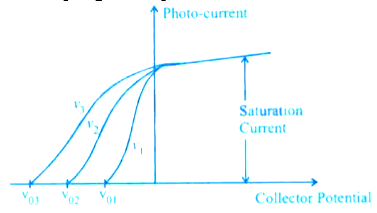 KCET 2016 Medium
 - A proton, an electron and an \(\alpha\)-particle enter at right angles to a uniform magnetic field with the same velocity. If \(R_p, R_e\) and \(R_\alpha\) are the radii of circular paths of these particles, thenKCET 2026 Medium
- The ratio of kinetic energy to the potential energy of a particle executing SHM at a distance
equal to half its amplitude, the distance being measured from its equilibrium position isKCET 2015 Easy - A mass of \(1\) kg is executing SHM. Its displacement is given by \(x = 6.0\cos(100t + \pi/4)\) cm. What is the maximum kinetic energy?KCET 2026 Medium
More PYQs from KCET
- How many microsporangia are located at the corners of a typical bilobed anther of angiosperm?KCET 2021 Medium
- If the scattering intensity of a liquid is 8 units at a wavelength of \(500 \mathrm{~nm}\), then the scattering intensity at a wavelength of \(400 \mathrm{~nm}\) will be approximatelyKCET 2011 Hard
- If A and B are invertible square matrices of order n, then which of the following is not correct?KCET 2026 Easy
- Match the following select the correct option for the quantity of electricity, in \(\mathrm{Cmol}^{-1}\) required to deposit various metals at cathode
\begin{array}{|l|l|l|l|}\hline & List - I & & List- II \\\hline a & \mathrm{Ag}^{+} & i & 386000 \mathrm{Cmol}^{-1} \\\hline b & \mathrm{Mg}^{2+} & ii & 289500 \mathrm{Cmol}^{-1} \\\hline c & \mathrm{Al}^{3+} & iii & 96500 \mathrm{Cmol}^{-1} \\\hline d & \mathrm{Ti}^{4+} & iv & 193000 \mathrm{Cmol}^{-1} \\\hline\end{array}KCET 2025 Medium - The \(\mathrm{C}-\mathrm{H}\) bond and \(\mathrm{C}-\mathrm{C}\) bond in ethane are formed by which of the following types of overlap?KCET 2012 Easy
- \( \left[\mathrm{Fe}\left(\mathrm{NO}_{2}\right)_{3} \mathrm{Cl}_{3}\right] \) and \( \left[\mathrm{Fe}(\mathrm{O}-\mathrm{NO})_{} \mathrm{Cl}_{3}\right] \) showsKCET 2018 Easy