


KCET · Physics · Capacitance
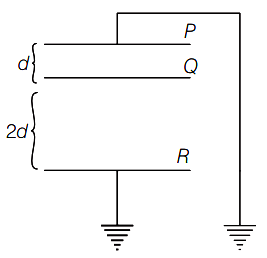
See the diagram. Area of each plate is \(2.0 \mathrm{~m}^{2}\) and \(d=2 \times 10^{-3} \mathrm{~m}\). A charge of \(8.85 \times 10^{-8} \mathrm{C}\) is given to \(Q\). Then the potential of \(Q\) becomes
- A \(13 \mathrm{~V}\)
- B \(10 \mathrm{~V}\)
- C \(6.67 \mathrm{~V}\)
- D \(8.825 \mathrm{~V}\)
Answer & Solution
Correct Answer
(C) \(6.67 \mathrm{~V}\)
Step-by-step Solution
Detailed explanation
In the given arrangement, plate \(Q\) is common for two capacitors which are connected in parallel.
\(\therefore C_{\text {eff }}=C_{P}=C_{1}+C_{2} \)
\( \Rightarrow C_{P}=\frac{\varepsilon_{0} A}{d}+\frac{\varepsilon_{0} A}{2 d}=\frac{2 \varepsilon_{0} A}{2 d}\)
The given arrangement can be shown as
Let \(V\) be the potential difference across the capacitor, which is equal to the potential of the plate \(Q\)
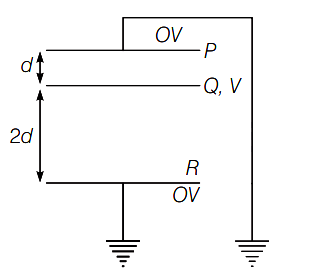
So, \(\quad C=\frac{q}{V}\) i.e., \(C_{\text {eff }}=\frac{q}{V}\)
i.e., \(\quad \frac{3 \varepsilon_{0} A}{2 d}=\frac{8.85 \times 10^{-8}}{V}\)
\(\Rightarrow V =\frac{8.85 \times 10^{-8} \times 2 \times 2 \times 10^{-3}}{3 \times 8.85 \times 10^{-12} \times 2} \)
\( =\frac{2}{3} \times 10=\frac{20}{3}=6.67 \mathrm{~V}\)
\(\therefore C_{\text {eff }}=C_{P}=C_{1}+C_{2} \)
\( \Rightarrow C_{P}=\frac{\varepsilon_{0} A}{d}+\frac{\varepsilon_{0} A}{2 d}=\frac{2 \varepsilon_{0} A}{2 d}\)
The given arrangement can be shown as
Let \(V\) be the potential difference across the capacitor, which is equal to the potential of the plate \(Q\)
So, \(\quad C=\frac{q}{V}\) i.e., \(C_{\text {eff }}=\frac{q}{V}\)
i.e., \(\quad \frac{3 \varepsilon_{0} A}{2 d}=\frac{8.85 \times 10^{-8}}{V}\)
\(\Rightarrow V =\frac{8.85 \times 10^{-8} \times 2 \times 2 \times 10^{-3}}{3 \times 8.85 \times 10^{-12} \times 2} \)
\( =\frac{2}{3} \times 10=\frac{20}{3}=6.67 \mathrm{~V}\)
See the Complete Solution
Get step-by-step explanations for this and 2.5 Lakh+ more JEE, NEET & CET questions.
- Unlock all solutions
- Practice the full chapter
- Track accuracy across PYQs
4.8 rated on Google Play · 14,000+ reviews
More questions from Physics
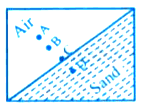
- Which of the points is likely position of the centre of mass of the system shown in the figure?
 KCET 2016 Medium
 - White light reflected from a soap film (Refractive Index \(=1.5\) ) has a maxima at \(600 \mathrm{~nm}\) and a minima at \(450 \mathrm{~nm}\) with no minimum in between. Then the thickness of the film isKCET 2013 Medium
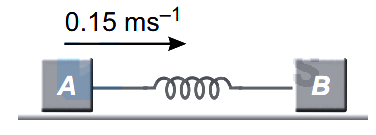
- Two rectangular blocks \(A\) and \(B\) of masses \(2 \mathrm{~kg}\) and \(3 \mathrm{~kg}\) respectively are connected by a spring of spring constant \(10.8 \mathrm{Nm}^{-1}\) and are placed on a frictionless horizontal surface. The block A was given an initial velocity of \(0.15 \mathrm{~ms}^{-1}\) in the direction shown in the figure. The maximum compression of the spring during the motion is
 KCET 2009 Hard
 - A current of \(5 \mathrm{~A}\) is flowing at \(220 \mathrm{~V}\) in the primary coil of a transformer. If the voltage produced in the secondary coil is \(2200 \mathrm{~V}\) and \(50 \%\) of power is lost, then the current in secondary will beKCET 2008 Medium
- Flash spectrum confirms a/an\KCET 2011 Easy
- An object is placed at a distance of \( 20 \mathrm{~cm} \) from the pole of a concave mirror of focal length \( 10 \)
\( \mathrm{cm} \). The distance of the image formed isKCET 2018 Medium
More PYQs from KCET
- An organic compound \( \mathrm{X} \) is oxidised by using acidified \( \mathrm{K}_{2} \mathrm{Cr}_{2} \mathrm{O}_{7} \) solution. The product obtained
reacts with phenyl hydrazine but does not answer silver mirror test. The compound \( X \) is,KCET 2016 Medium - During citric acid cycle, the various organic acids undergo decarboxylation. Which of the following organic acids of the above cycle have 4C, 5C and 6C respectively?KCET 2020 Medium
- Let \( { }^{*} \) be a binary operation defined on \( R \) by \( a * b=\frac{a+b}{4} \forall a, b \in R \) then the operation \( * \) is
O examsnet com)KCET 2016 Hard - How many chiral carbon atoms are present in \(2,3,4\)-trichloropentane?KCET 2007 Medium
- Which one of the following is the identifiable character of Neanderthal man?KCET 2017 Hard
- In a triangle \( A B C, a[b \cos C-c \cos B]= \)KCET 2014 Medium