


KCET · Maths · Straight Lines
The orthocentre of the triangle with vertices \(A(0,0), B\left(0, \frac{3}{2}\right), C(-5,0)\) is
- A \(\left(\frac{5}{2}, \frac{3}{4}\right)\)
- B \(\left(\frac{-5}{2}, \frac{3}{4}\right)\)
- C \(\left(-5, \frac{3}{2}\right)\)
- D \((0,0)\)
Answer & Solution
Correct Answer
(D) \((0,0)\)
Step-by-step Solution
Detailed explanation
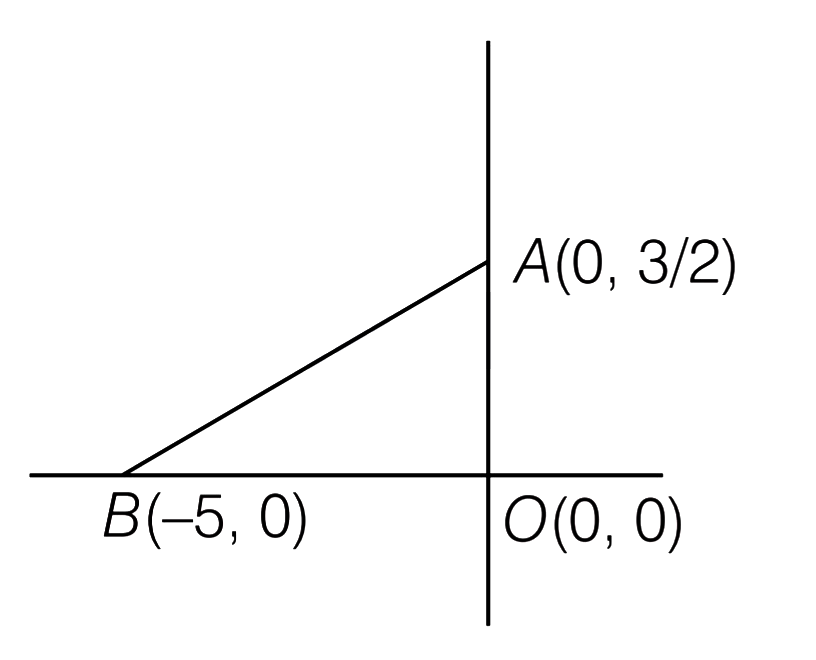
Let \(\triangle A O B\) is the given triangle.
Slope of \(A B=\frac{\frac{3}{2}-0}{0+5}=\frac{3}{10}\)
Slope of \(B O=\frac{0-0}{0+5}=0\)
The equation of line passing through \(A\) and perpendicular to \(B O\) is \(y-0=-0\left(x-\frac{3}{2}\right)\)
\(\Rightarrow \quad y=0\)
and equation of line passing through 0 and perpendicular to \(A B\) is \(y-0=-\frac{10}{3}(x-0)\) \(\Rightarrow \quad y=-\frac{10}{3} x\)
The intersection point of Eqs. (i) and (ii) is \((0,0)\), which is the required orthocentre.
Slope of \(A B=\frac{\frac{3}{2}-0}{0+5}=\frac{3}{10}\)
Slope of \(B O=\frac{0-0}{0+5}=0\)
The equation of line passing through \(A\) and perpendicular to \(B O\) is \(y-0=-0\left(x-\frac{3}{2}\right)\)
\(\Rightarrow \quad y=0\)
and equation of line passing through 0 and perpendicular to \(A B\) is \(y-0=-\frac{10}{3}(x-0)\) \(\Rightarrow \quad y=-\frac{10}{3} x\)
The intersection point of Eqs. (i) and (ii) is \((0,0)\), which is the required orthocentre.
See the Complete Solution
Get step-by-step explanations for this and 2.5 Lakh+ more JEE, NEET & CET questions.
- Unlock all solutions
- Practice the full chapter
- Track accuracy across PYQs
4.8 rated on Google Play · 14,000+ reviews
More questions from Maths
- If \( y=\left|\begin{array}{ccc}f(x) & g(x) & h(x) \\ l & m & n \\ a & b & c\end{array}\right| \), then \( \frac{d y}{d x} \) is equal toKCET 2017 Hard
- The sum of the series, \(\frac{1}{2.3} \cdot 2+\frac{2}{3.4} \cdot 2^{2}+\frac{3}{4.5} \cdot 2^{3}+\ldots\) upto \(n\) terms isKCET 2013 Hard
- The mean deviation about the mean for the date \(4,7,8,9,10,12,13,17\) isKCET 2025 Medium
- If \(y=e^{\log _{e}\left[1+x+x^{2}+\ldots\right]}\), then \(\frac{d y}{d x}\) is equal toKCET 2012 Easy
- \(\int_0^1 \log \left(\frac{1}{x}-1\right) d x\) isKCET 2025 Medium
- If \(f(x)=f^{\prime}(x)+f^{\prime \prime}(x)+f^{\prime \prime \prime}(x)+\ldots\) and \(f(0)=1\), then \(f(x)\) is equal toKCET 2013 Hard
More PYQs from KCET
- A perfect gas at \(27^{\circ} \mathrm{C}\) is heated at constant pressure so as to double its volume. The increase in temperature of the gas will beKCET 2011 Easy
- \(\frac{3 x^{2}+1}{x^{2}-6 x+8}\) is equal toKCET 2007 Hard
- Adenosine is an example ofKCET 2015 Easy
- RNA polymerase -I transcribes eukaryotic ribosome which does not consist ofKCET 2015 Easy
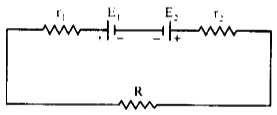
- Two cells of emf \( E_{1} \) and \( E_{2} \) are joined in opposition (such that \( E_{1}>E_{2} \) ). If \( r_{1} \) and \( r_{2} \) be the internal resistance and \( R \) be the external resistance, then the terminal potential difference is
 KCET 2015 Hard
 - Consider the following statements :
Statement(I) : The set of all solutions of the linear inequalities \(3 x+8 \lt 17\) and \(2 x+8 \geq 12\) are \(x \lt 3\) and \(x \geq 2\) respectively.
Statement(II) : The common set of solutions of linear inequalities \(3 x+8 \lt 17\) and \(2 x+8 \geq 12\) is \((2,3)\).
Which of the following is true?KCET 2025 Easy