


KCET · Physics · Rotational Motion
A coin placed on a rotating turn table just slips if it is placed at a distance of \(4 \mathrm{~cm}\) from the centre. If the angular velocity of the turn table is doubled it will just slip at a distance of
- A \(1 \mathrm{~cm}\)
- B \(2 \mathrm{~cm}\)
- C \(4 \mathrm{~cm}\)
- D \(8 \mathrm{~cm}\)
Answer & Solution
Correct Answer
(A) \(1 \mathrm{~cm}\)
Step-by-step Solution
Detailed explanation
When the coin placed on a rotating table is first about to slips, then till the time the coin rotates along with the table, necessary centripetal force for rotation will be provided by the frictional force,
i.e., \(\quad m r \omega^{2}=\mu m g\)
where,
\(m=\) mass of the coin,
\(r=\) distance of the coin from the centre of the table,
\(\omega=\) angular velocity,
\(\mu=\) coefficient of friction
and \(g=\) acceleration due to gravity.
Since, \(m, \mu\) and \(g\) remains constant, so
\(r \omega^{2}=\) constant
\(\Rightarrow \quad r \propto \frac{1}{\omega^{2}}\)
or \(\quad \frac{r_{2}}{r_{1}}=\left(\frac{\omega_{1}}{\omega_{2}}\right)^{2}\)
Given, \(\omega_{2}=2 \omega_{1}, r_{1}=4 \mathrm{~cm}\)
\(\Rightarrow \quad \frac{r_{2}}{r_{1}}=\left(\frac{\omega_{1}}{2 \omega_{1}}\right)^{2}\)
or
\(r_{2}=\frac{r_{1}}{4}=\frac{4}{4}=1 \mathrm{~cm}\)
i.e., \(\quad m r \omega^{2}=\mu m g\)
where,
\(m=\) mass of the coin,
\(r=\) distance of the coin from the centre of the table,
\(\omega=\) angular velocity,
\(\mu=\) coefficient of friction
and \(g=\) acceleration due to gravity.
Since, \(m, \mu\) and \(g\) remains constant, so
\(r \omega^{2}=\) constant
\(\Rightarrow \quad r \propto \frac{1}{\omega^{2}}\)
or \(\quad \frac{r_{2}}{r_{1}}=\left(\frac{\omega_{1}}{\omega_{2}}\right)^{2}\)
Given, \(\omega_{2}=2 \omega_{1}, r_{1}=4 \mathrm{~cm}\)
\(\Rightarrow \quad \frac{r_{2}}{r_{1}}=\left(\frac{\omega_{1}}{2 \omega_{1}}\right)^{2}\)
or
\(r_{2}=\frac{r_{1}}{4}=\frac{4}{4}=1 \mathrm{~cm}\)
See the Complete Solution
Get step-by-step explanations for this and 2.5 Lakh+ more JEE, NEET & CET questions.
- Unlock all solutions
- Practice the full chapter
- Track accuracy across PYQs
4.8 rated on Google Play · 14,000+ reviews
More questions from Physics
- A \( 12 \mathrm{~kg} \) bomb at rest explodes into two pieces of \( 4 \mathrm{~kg} \) and \( 8 \mathrm{~kg} \). If the momentum of \( 4 \mathrm{~kg} \) piece
is \( 20 \mathrm{Ns} \), the kinetic energy of the \( 8 \mathrm{~kg} \) piece isKCET 2016 Medium - The radius of the Earth is \( 6400 \mathrm{~km} \). If the height of the antenna is \( 500 \mathrm{~m} \) then its range isKCET 2018 Easy
- A Point object is moving uniformly towards the pole of a concave mirror of focal length \( 25 \mathrm{~cm} \)
along its axis as shown below. The speed of the object is \( 1 \mathrm{~ms}^{-1} \). At \( \mathrm{t}=0 \), the distance of the
object from the mirror is \( 50 \mathrm{~cm} \). The average velocity of theimage formed by the mirror
between time \( t=0 \) and \( t=0.25 \mathrm{~s} \) is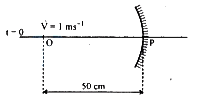 KCET 2019 Easy
 - If a charge on the body is \( 1 \mathrm{nC} \), then how many electrons are present on the body?KCET 2014 Hard
- Two equal and opposite charges of masses \( \mathrm{m}_{1} \) and \( \mathrm{m}_{2} \) are accelerated in an uniform electric field through the same distance. What is the ratio of their accelerations if their mi ratio of masses is \( \frac{\mathrm{m}_{1}}{\mathrm{~m}_{2}}=0.5 \) ?KCET 2014 Medium
- In the circuit shown in the figure, the potential difference across the \(4 \mu\text{F}\) capacitor is
 KCET 2026 Medium
More PYQs from KCET
- Suppose \( f(x)=(x+1)^{2} \) for \( x \geq-1 \). If \( g(x) \) is a function whose graph is the reflection of the
graph of \( f(x) \) in the line \( y=x \), then \( g(x)= \)KCET 2014 Medium - Replacement of \( \mathrm{Cl} \) of Chlorobenzene to give phenol requires drastic conditions, but \( \mathrm{Cl} \) of \( 2,4 \) -
dinitro chlorobenzene is readily replaced. This is because,KCET 2016 Hard - The value of \(\int_{-1}^{2} \frac{|x|}{x} d x\), isKCET 2013 Easy
- If \(a_{1} a_{2} a_{3} \ldots a_{9}\) are in \(\mathrm{AP}\), then the value of \(\left|\begin{array}{lll}a_{1} & a_{2} & a_{3} \\ a_{4} & a_{5} & a_{6} \\ a_{7} & a_{8} & a_{9}\end{array}\right|\) isKCET 2020 Medium
- \(\int \mathrm{e}^{\tan ^{-1} \mathrm{x}}\left(1+\frac{\mathrm{x}}{1+\mathrm{x}^{2}}\right) \mathrm{dx}\) is equal toKCET 2009 Easy
- Which of the following property is true for the given sequence? \(\mathrm{NH}_{3}>\mathrm{PH}_{3}>\mathrm{AsH}_{3}>\mathrm{SbH}_{3}>\mathrm{BiH}_{3}\) ?KCET 2021 Easy