


KCET · Physics · Electrostatics
Two equal and opposite charges of masses \( \mathrm{m}_{1} \) and \( \mathrm{m}_{2} \) are accelerated in an uniform electric field through the same distance. What is the ratio of their accelerations if their mi ratio of masses is \( \frac{\mathrm{m}_{1}}{\mathrm{~m}_{2}}=0.5 \) ?
- A \( \frac{a_{1}}{a_{2}}=0.5 \)
- B \( \frac{a_{1}}{a_{2}}=1 \)
- C \( \frac{a_{1}}{a_{2}}=2 \)
- D \( \frac{a_{1}}{a_{2}}=3 \)
Answer & Solution
Correct Answer
(C) \( \frac{a_{1}}{a_{2}}=2 \)
Step-by-step Solution
Detailed explanation
Since both the masses are accelerated in an uniform electric field through same distance, therefore, force acting on both
the masses is same.
We know \( F= \) ma
\( \Rightarrow F_{1}=F_{2} \Rightarrow m_{1} a_{1}=m_{2} a_{2} \Rightarrow \frac{a_{1}}{a_{2}}=\frac{m_{2}}{m_{1}} \)
Using \( \frac{m_{1}}{m_{2}}=0.5 \), we get
\( \frac{a_{1}}{a_{2}}=\frac{1}{0.5} \Rightarrow \frac{a_{1}}{a_{2}}=2 \)
the masses is same.
We know \( F= \) ma
\( \Rightarrow F_{1}=F_{2} \Rightarrow m_{1} a_{1}=m_{2} a_{2} \Rightarrow \frac{a_{1}}{a_{2}}=\frac{m_{2}}{m_{1}} \)
Using \( \frac{m_{1}}{m_{2}}=0.5 \), we get
\( \frac{a_{1}}{a_{2}}=\frac{1}{0.5} \Rightarrow \frac{a_{1}}{a_{2}}=2 \)
See the Complete Solution
Get step-by-step explanations for this and 2.5 Lakh+ more JEE, NEET & CET questions.
- Unlock all solutions
- Practice the full chapter
- Track accuracy across PYQs
4.8 rated on Google Play · 14,000+ reviews
More questions from Physics
- Two point charges \( A=+3 \mathrm{nC} \) and \( B=+1 \mathrm{nC} \) are placed \( 5 \mathrm{~cm} \) apart in air. The work done to
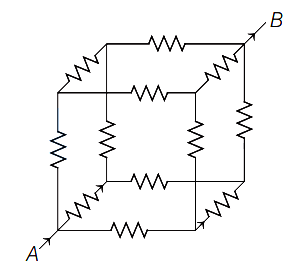
move charge \( B \) towards \( A \) by \( 1 \mathrm{~cm} \) isKCET 2017 Easy - Each resistance in the given cubical network has resistance of \(1 \Omega\) and equivalent resistance between \(A\) and \(B\) is
 KCET 2020 Medium
 - An infinitely long thin straight wire has uniform charge density of \(\frac{1}{4} \times 10^{-2} \mathrm{~cm}^{-1}\).
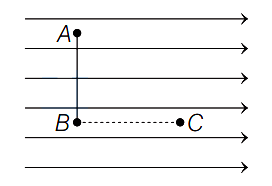
What is the magnitude of electric field at a distance \(20 \mathrm{~cm}\) from the axis of the wire?KCET 2020 Medium - Figure shows three points \(A, B\) and \(C\) in a region of uniform electric field \(\mathbf{E}\). The line \(A B\) is perpendicular and \(B C\) is parallel to the field lines. Then, which of the following holds good ? \(\left(V_{A}, V_{B}\right.\) and \(V_{C}\) represent the electric potential at points \(A, B\) and \(C\), respectively)
 KCET 2020 Easy
 - A \(20 \mathrm{~cm}\) length of a certain solution causes right handed rotation of \(38^{\circ}\). A \(30 \mathrm{~cm}\) length of another solution causes left handed rotation of \(24^{\circ}\). The optical rotation caused by \(30 \mathrm{~cm}\) length of a mixture of the above solutions in the volume ratio \(1: 2\) isKCET 2007 Hard
- In which of the processes, does the internal energy of the system remain constant?KCET 2008 Easy
More PYQs from KCET
- The final image formed by an astronomical telescope isKCET 2024 Easy
- An \(\alpha\)-particle of mass \(6.4 \times 10^{-27} \mathrm{~kg}\) and charge \(3.2 \times 10^{-19} \mathrm{C}\) is situated in a uniform electric field of \(1.6 \times 10^{5} \mathrm{Vm}^{-1}\). The velocity of the particle at the end of \(2 \times 10^{-2} \mathrm{~m}\) path when it starts from rest isKCET 2009 Hard
- \(|\mathbf{a} \times \mathbf{b}|^2+|\mathbf{a} \cdot \mathbf{b}|^2=144\) and \(|\mathbf{a}|=4\), then \(|\mathbf{b}|\) is equal toKCET 2023 Easy
- A body of mass \(10 \mathrm{mg}\) is moving with a velocity of \(100 \mathrm{~ms}^{-1}\). The wavelength of de-Broglie wave associated with it would be ( \(h=6.63 \times 10^{-34} \mathrm{Js}\) )KCET 2007 Medium
- If \(\alpha, \beta\) and \(\gamma\) are the roots of the equation \(x^{3}+4 x+2=0\), then \(\alpha^{3}+\beta^{3}+\gamma^{3}\) is equal toKCET 2012 Easy
- When DNA replication startsKCET 2009 Easy