


KCET · Chemistry · Alcohols Phenols and Ethers
Replacement of \( \mathrm{Cl} \) of Chlorobenzene to give phenol requires drastic conditions, but \( \mathrm{Cl} \) of \( 2,4 \) -
dinitro chlorobenzene is readily replaced. This is because,
- A \( -\mathrm{NO}_{2} \) group makes the ring electron rich at o- and p- positions.
- B \(-\mathrm{NO}_{2} \) group withdraws electrons from \( \mathrm{m} \)-position.
- C \( -\mathrm{NO}_{2} \) donate electrons at \( \mathrm{m} \) - position.
- D \( -\mathrm{NO}_{2} \) withdraws electrons from o- and p-positions.
Answer & Solution
Correct Answer
(D) \( -\mathrm{NO}_{2} \) withdraws electrons from o- and p-positions.
Step-by-step Solution
Detailed explanation
The reaction involved is
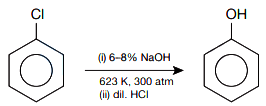
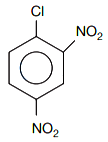
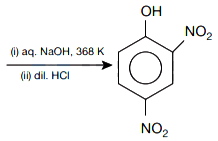
The presence of \( -\mathrm{NO}_{2} \) group at o- and p- positions withdraws electron density from the benzene ring, therefore,
facilitates the attack of the nucleophile on haloarenes. Thus, the carbanion formed, is stabilized through resonance as
shown below:
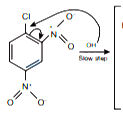
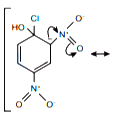
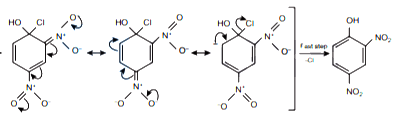
The presence of \( -\mathrm{NO}_{2} \) group at o- and p- positions withdraws electron density from the benzene ring, therefore,
facilitates the attack of the nucleophile on haloarenes. Thus, the carbanion formed, is stabilized through resonance as
shown below:
See the Complete Solution
Get step-by-step explanations for this and 2.5 Lakh+ more JEE, NEET & CET questions.
- Unlock all solutions
- Practice the full chapter
- Track accuracy across PYQs
4.8 rated on Google Play · 14,000+ reviews
More questions from Chemistry
- The correct statement regarding defects in solid isKCET 2021 Easy
- Identify the reaction that does not take place in a blast furnace.KCET 2008 Medium
- The equilibrium constant for the reaction
\( \mathrm{N}_{2}(g)+\mathrm{O}_{2}(g) \rightleftharpoons 2 N O(g) \) is \( 4 \times 10^{-4} \) at \( 2000 \mathrm{~K} \). In presence of a catalyst the equilibrium is
attained ten times faster. Therefore the equilibrium constant in presence of catalyst of \( 2000 \mathrm{~K} \)
isKCET 2017 Easy - The number of optical isomers of the compound \(\mathrm{CH}_{3}-\mathrm{CHBr}-\mathrm{CHBr}-\mathrm{COOH}\) isKCET 2013 Medium
- The hydrolysis of optically active \( 2 \)-bromobutane with aqueous \( \mathrm{NaOH} \) result in the formation ofKCET 2015 Easy
- The rms velocity of molecules of a gas of density \(4 \mathrm{~kg} \mathrm{~m}^{-3}\) and pressure \(1.2 \times 10^{5} \mathrm{Nm}^{-2}\) isKCET 2009 Easy
More PYQs from KCET
- Formation of coloured solution is possible when metal ion in the compound containsKCET 2007 Medium
- The equation of the plane through the points \((2,1,0),(3,2,-2)\) and \((3,1,7)\) isKCET 2023 Easy
- If \(P\) is any point on the ellipse \(\frac{x^{2}}{36}+\frac{y^{2}}{16}=1\) and \(S\) and \(S^{\prime}\) are the foci, then \(P S+P S^{\prime}\) is equal toKCET 2007 Easy
- Respiratory quotient of glucose isKCET 2022 Hard
- The technique of bombarding plant cells with high velocity microparticles of gold or tungsten, coated with DNA, isKCET 2018 Medium
- For spontaneity of a cell, which is correct?KCET 2022 Easy