


KCET · Maths · Indefinite Integration
\(\int \mathrm{e}^{\tan ^{-1} \mathrm{x}}\left(1+\frac{\mathrm{x}}{1+\mathrm{x}^{2}}\right) \mathrm{dx}\) is equal to
- A \(x e^{\tan ^{-1} x}+c\)
- B \(\mathrm{e}^{\tan ^{-1} \mathrm{x}}+\mathrm{c}\)
- C \(\frac{1}{2} \mathrm{e}^{\tan ^{-1} \mathrm{x}}+\mathrm{c}\)
- D \(\frac{1}{2} \mathrm{xe}^{\tan ^{-1} \mathrm{x}}+\mathrm{c}\)
Answer & Solution
Correct Answer
(A) \(x e^{\tan ^{-1} x}+c\)
Step-by-step Solution
Detailed explanation
Let \(I=\int e^{\tan ^{-1} x}\left(1+\frac{x}{1+x^{2}}\right) d x\)
\(=\int e^{\tan ^{-1} x} d x+\int \frac{x e^{\tan ^{-1} x}}{1+x^{2}} d x\)
\(=x e^{\tan ^{-1} x}-\int \frac{x e^{\tan ^{-1} x}}{1+x^{2}} d x+\int \frac{x e^{\tan ^{-1} x}}{1+x^{2}} d x+c\)
\(=x e^{\tan ^{-1} x}+c\)
\(=\int e^{\tan ^{-1} x} d x+\int \frac{x e^{\tan ^{-1} x}}{1+x^{2}} d x\)
\(=x e^{\tan ^{-1} x}-\int \frac{x e^{\tan ^{-1} x}}{1+x^{2}} d x+\int \frac{x e^{\tan ^{-1} x}}{1+x^{2}} d x+c\)
\(=x e^{\tan ^{-1} x}+c\)
See the Complete Solution
Get step-by-step explanations for this and 2.5 Lakh+ more JEE, NEET & CET questions.
- Unlock all solutions
- Practice the full chapter
- Track accuracy across PYQs
4.8 rated on Google Play · 14,000+ reviews
More questions from Maths
- In a simultaneous throw of a pair of dice, the probability of getting a total more than \( 7 \) isKCET 2018 Easy
- If \(y=\sin ^{n} x \cos n x\), then \(\frac{d y}{d x}\) isKCET 2009 Easy
- The real value of ' \(\alpha\) ' for which \(\frac{1-i \sin \alpha}{1+2 i \sin \alpha}\) is purely real isKCET 2024 Medium
- The general solution of the differential equation \(\sqrt{1-x^{2} y^{2}} \cdot d x=y \cdot d x+x \cdot d y\) isKCET 2013 Medium
- The corner points of the feasible region of an LPP are \((0,2),(3,0),(6,0),(6,8)\) and \((0,5)\), then the minimum value of \(z=4 x+6 y\) occurs atKCET 2022 Medium
- The focus of the parabola \(y=2 x^{2}+x\) isKCET 2007 Medium
More PYQs from KCET
- The straight line \(2 x+3 y-k=0, k>0\) cuts the \(x\) and \(y\)-axes at \(\mathrm{A}\) and \(\mathrm{B}\). The area of \(\triangle \mathrm{OAB}\), where \(\mathrm{O}\) is the origin, is 12 sq unit. The equation of the circle having \(A B\) as diameter isKCET 2010 Hard
- Read the statements A and B and identify the correct choice from those given.
Statement A: Women are at the peak of conception on the 14th day of menstrual cycle.
Statement B: Vasectomy is the method normally employed to avoid conception in femalesKCET 2013 Easy - Which one of the following is \(v_{m}-T\) graph for perfectly black body? \(v_{m}\) is the frequency of radiation with maximum intensity. \(T\) is the absolute temperature.
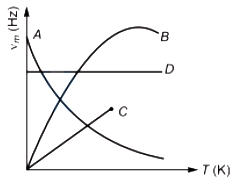 KCET 2011 Medium
 - Which one of the following groups of three animals each is correctly matched with their one characteristic morphological features?KCET 2013 Hard
- A gas expands from a volume of \(1 \mathrm{~m}^{3}\) to a volume of \(2 \mathrm{~m}^{3}\) against an external pressure of \(10^{5} \mathrm{Nm}^{-2}\). The work done by the gas will beKCET 2012 Medium
- Let \(P(x, y)\) be the mid point of the line joining \((1,0)\) to a point on the curve \(\mathrm{y}^{2}=\left|\begin{array}{ll}\mathrm{x}+1 & \mathrm{x}+2 \\ \mathrm{x}+3 & \mathrm{x}+5\end{array}\right|\). Then, locus of \(\mathrm{P}\) is symmetrical aboutKCET 2010 Medium