


JEE Mains · Maths · STD 12 - 6. Application of derivatives
Let \(S=(-1, \infty)\) and \(f: S \rightarrow \mathbb{R}\) be defined as \(f(x)=\int_{-1}^x\left(e^1-1\right)^{11}(2 t-1)^5(t-2)^7(t-3)^{12}(2 t-10)^{61} d t\) Let \(p=\) Sum of square of the values of \(x\), where \(\mathrm{f}(\mathrm{x})\) attains local maxima on \(\mathrm{S}\). and \(\mathrm{q}=\) Sum of the values of \(x\), where \(f(x)\) attains local minima on \(S\). Then, the value of \(p^2+2 q\) is
- A \(28\)
- B \(27\)
- C \(25\)
- D \(24\)
Answer & Solution
Correct Answer
(B) \(27\)
Step-by-step Solution
Detailed explanation
\(f^{\prime}(x)=\left(e^x-1\right)^{11}(2 x-1)^5(x-2)^7(x-3)^{12}(2 x-10)^{61}\) Local minima at \(\mathrm{x}=\frac{1}{2}, \mathrm{x}=5\) Local maxima at \(\mathrm{x}=0, \mathrm{x}=2\) \(\therefore \mathrm{p}=0+4=4, \mathrm{q}=\frac{1}{2}+5=\frac{11}{2}\) Then…
See the Complete Solution
Get step-by-step explanations for this and 2.5 Lakh+ more JEE, NEET & CET questions.
- Unlock all solutions
- Practice the full chapter
- Track accuracy across PYQs
4.8 rated on Google Play · 14,000+ reviews
More questions from Maths
- The coefficient of \(x^{50}\) in the binomial expansion of \({\left( {1 + x} \right)^{1000}} + x{\left( {1 + x} \right)^{999}} + {x^2}{\left( {1 + x} \right)^{998}} + ..... + {x^{1000}}\) isJEE Mains 2014 Hard
- The value of \(\lim _{x \rightarrow 0^{+}} \frac{\cos ^{-1}\left(x-[x]^{2}\right) \cdot \sin ^{-1}\left(x-[x]^{2}\right)}{x-x^{3}},\) where \([ x ]\) denotes the greatest integer \(\leq x\) isJEE Mains 2021 Hard
- The maximum value of the function \(f\,(x)\, = 3{x^3} - 18{x^2} + 27x\,\, - 40\) on the set \(S = \{ x\, \in \,R\,:\,{x^2}\, + \,30\, \le \,11x\} \) isJEE Mains 2019 Hard
- If \(\alpha, \beta,\) where \(\alpha<\beta\), are the roots of the equation \(\lambda x^{2}-(\lambda+3)x+3=0\) such that \(\frac{1}{\alpha}-\frac{1}{\beta}=\frac{1}{3},\) then the sum of all possible values of \(\lambda\) is:JEE Mains 2026 Medium
- Let \((\lambda, 2,1)\) be a point on the plane which passes through the ponit \((4,-2,2) .\) If the plane is perpendicular to the line joining the points \((-2,-21,29)\) and \((-1,-16,23),\) then \(\left(\frac{\lambda}{11}\right)^{2}-\frac{4 \lambda}{11}-4\) is equal toJEE Mains 2021 Hard
- If all the words, with or without meaning, are written using the letters of the word \(QUEEN\) and are arranged as in English dictionary, then the position of the word \(QUEEN\) isJEE Mains 2017 Hard
More PYQs from JEE Mains
- A line passing through the point \(\mathrm{P}(\sqrt{5}, \sqrt{5})\) intersects the ellipse \(\frac{\mathrm{x}^2}{36}+\frac{\mathrm{y}^2}{25}=1\) at \(A\) and \(B\) such that \((P A) .(P B)\) is maximum. Then \(5\left(P A^2+P B^2\right)\) is equal to :JEE Mains 2025 Hard
- The value of \(\int_0^1\left(2 x^3-3 x^2-x+1\right)^{\frac{1}{3}} d x\) is equal to :JEE Mains 2024 Medium
- Let \(v\) be the solution of the differential equation \(\left(1-x^{2}\right) d y=\left(xy+\left(x^{3}+2\right) \sqrt{1-x^{2}}\right) d x,-1 < x < 1\) and \(y(0)=0\) if \(\int\limits_{-\frac{1}{2}}^{\frac{1}{2}} \sqrt{1-x^{2}} y(x) d x=k\) then \(k^{-1}\) is equal to:JEE Mains 2022 Hard
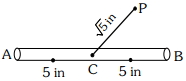
- A \(10\, inches\) long pencil \(\mathrm{AB}\) with mid point \(\mathrm{C}\) and a small eraser \(\mathrm{P}\) are placed on the horizontal top of a table such that \(\mathrm{PC}=\sqrt{5}\) inches and \(\angle \mathrm{PCB}=\tan ^{-1}(2)\). The acute angle through which the pencil must be rotated about \(\mathrm{C}\) so that the perpendicular distance between eraser and pencil becomes exactly \(1\, inch\) is:
 JEE Mains 2021 Hard
 - If the area of the region bounded by the curves \(y=4-\frac{x^2}{4}\) and \(y=\frac{x-4}{2}\) is equal to \(\alpha\), then \(6 \alpha\) equalsJEE Mains 2025 Medium
- If all the words with or without meaning made using all the letters of the word "NAGPUR" are arranged as in a dictionary, then the word at \(315^{\text {th }}\) position in this arrangement is :JEE Mains 2024 Medium