


JEE Advanced · Physics · 26. Dual Nature
The graph between \(1 / \lambda\) and stopping potential \((V)\) of three metals having work function \(\phi_1, \phi_2\) and \(\phi_3\) in an experiment of photoelectric effect is plotted as shown in the figure. Which of the following statement(s) is/are correct? [Here \(\lambda\) is the wavelength of the incident ray].
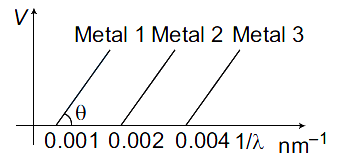
- A Ratio of work functions \(\phi_1: \phi_2: \phi_3=1: 2: 4\).
- B Ratio of work functions \(\phi_1: \phi_2: \phi_3=4: 2: 1\).
- C \(\tan \theta\) is directly proportional to \(h c / e\), where \(h\) is Planck's constant and \(c\) is the speed of light.
- D The violet colour light can eject photoelectrons from metals 2 and 3.
Answer & Solution
Correct Answer
(C) \(\tan \theta\) is directly proportional to \(h c / e\), where \(h\) is Planck's constant and \(c\) is the speed of light.
Step-by-step Solution
Detailed explanation
From the relation, \(e V=\frac{h c}{\lambda}-\phi\) or \(V=\left(\frac{h c}{e}\right)\left(\frac{1}{\lambda}\right)-\frac{\phi}{e}\) This is equation of straight line.
Slope is \(\tan \theta=\frac{h c}{e}\)
\(\phi_1: \phi_2: \phi_3 =\frac{h c}{\lambda_{01}}: \frac{h c}{\lambda_{02}}: \frac{h c}{\lambda_{03}}=\frac{1}{\lambda_{01}}: \frac{1}{\lambda_{02}}:\) \(\frac{1}{\lambda_{03}}=1: 2: 4 \)
\( \frac{1}{\lambda_{01}} =0.001 \mathrm{~nm}^{-1} \text { or } \lambda_{01}=10000 Å \)
\( \frac{1}{\lambda_{02}} =0.002 \mathrm{~nm}^{-1} \text { or } \lambda_{02}=5000 Å \)
\( \frac{1}{\lambda_{03}} =0.004 \mathrm{~nm}^{-1} \text { or } \lambda_{03}=25000 Å\)
Violet colour has wavelength \(4000 Å\).
So, violet colour can eject photoelectrons from metal-1 and metal-2.
Slope is \(\tan \theta=\frac{h c}{e}\)
\(\phi_1: \phi_2: \phi_3 =\frac{h c}{\lambda_{01}}: \frac{h c}{\lambda_{02}}: \frac{h c}{\lambda_{03}}=\frac{1}{\lambda_{01}}: \frac{1}{\lambda_{02}}:\) \(\frac{1}{\lambda_{03}}=1: 2: 4 \)
\( \frac{1}{\lambda_{01}} =0.001 \mathrm{~nm}^{-1} \text { or } \lambda_{01}=10000 Å \)
\( \frac{1}{\lambda_{02}} =0.002 \mathrm{~nm}^{-1} \text { or } \lambda_{02}=5000 Å \)
\( \frac{1}{\lambda_{03}} =0.004 \mathrm{~nm}^{-1} \text { or } \lambda_{03}=25000 Å\)
Violet colour has wavelength \(4000 Å\).
So, violet colour can eject photoelectrons from metal-1 and metal-2.
See the Complete Solution
Get step-by-step explanations for this and 2.5 Lakh+ more JEE, NEET & CET questions.
- Unlock all solutions
- Practice the full chapter
- Track accuracy across PYQs
4.8 rated on Google Play · 14,000+ reviews
More questions from Physics
- Paragraph:
A small block of mass \(M\) moves on a frictionless surface of an inclined plane, as shown in figure. The angle of the incline suddenly changes from \(60^{\circ}\) to \(30^{\circ}\) at point \(B\). The block is initially at rest at \(A\). Assume that collisions between the block and the incline are totally inelastic \(\left(g=10 \mathrm{~m} / \mathrm{s}^2\right)\)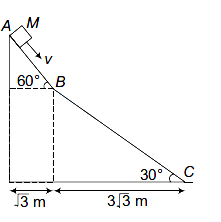
Question:
The speed of the block at point \(B\) immediately after it strikes the second incline isJEE Advanced 2008 Medium - Paragraph:
The figure shows a circular loop of radius \(a\) with two long parallel wires (numbered \(1\) and \(2\) ) all in the plane of the paper. The distance of each wire from the centre of the loop is \(d\). The loop and the wires are carrying the same current \(I\). The current in the loop is in the counterclockwise direction if seen from above.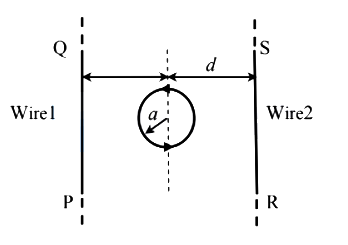
Question:
When \(d \approx a\) but wires are not touching the loop, it is found that the net magnetic field on the axis of the loop is zero at a height \(h\) above the loop. In that caseJEE Advanced 2014 Medium - Paragraph:
A small spherical monoatomic ideal gas bubble \(\left(\gamma=\frac{5}{3}\right)\) is trapped inside a liquid of density \(\rho_1\) (see figure). Assume that the bubble does not exchange any heat with the liquid. The bubble contains \(n\) moles of gas. The temperature of the gas when the bubble is at the bottom is \(T_0\), the height of the liquid is \(H\) and the atmospheric pressure is \(p_0\) (Neglect surface tension).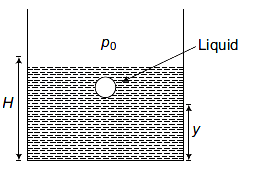
Question:
As the bubble moves upwards, besides the buoyancy force the following forces are acting on it.JEE Advanced 2008 Medium - Three plane mirrors form an equilateral triangle with each side of length . There is a small hole at a distance from one of the corners as shown in the figure. A ray of light is passed through the hole at an angle and can only come out through the same hole. The cross section of the mirror configuration and the ray of light lie on the same plane.
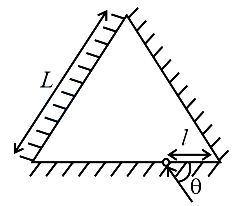
Which of the following statement(s) is(are) correct?JEE Advanced 2022 Medium - A projectile is thrown from a point \(\mathrm{O}\) on the ground at an angle \(45^{\circ}\) from the vertical and with a speed \(5 \sqrt{2} \mathrm{~m} / \mathrm{s}\). The projectile at the highest point of its trajectory splits into two equal parts. One part falls vertically down to the ground, \(0.5 \mathrm{~s}\) after the splitting. The other part, \(t\) seconds after the splitting, falls to the ground at a distance \(x\) meters from the point O. The acceleration due to gravity \(g=10 \mathrm{~m} / \mathrm{s}^{2}\).
The value of is ________.JEE Advanced 2021 Easy - The instantaneous voltages at three terminals marked and are given by
and
An ideal voltmeter is configured to read rms value of the potential difference between its terminals. It is connected between points and and then between and . The reading(s) of the voltmeter will beJEE Advanced 2017 Hard
More PYQs from JEE Advanced
- List-I includes starting materials and reagents of selected chemical reactions. List-II gives structures of compounds that may be formed as intermediate products and/or final products from the reactions of List-I.
List-I List-II
(I)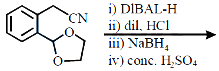
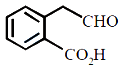
(II)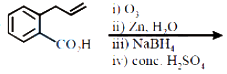
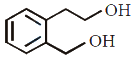
(III)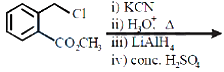

(IV)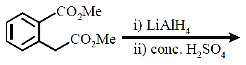
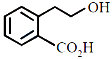
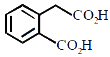

Which of the following options has correct combination considering List-I and List-II?JEE Advanced 2019 Hard - Consider a body of mass at rest at the origin at time . A force is applied on the body, where . The torque acting on the body about the origin at time . Which of the following statements is (are) true?JEE Advanced 2018 Medium
- The focal length of a thin biconvex lens is \(20 \mathrm{~cm}\). When an object is moved from a distance of \(25 \mathrm{~cm}\) in front of it to \(50 \mathrm{~cm}\), the magnification of its image changes from \(m_{25}\) to \(m_{50}\). The ratio \(\frac{m_{25}}{m_{50}}\) isJEE Advanced 2010 Easy
- A light source, which emits two wavelengths and , is used in a Young's double slit experiment. If recorded fringe widths for and are and and the number of fringes for them within a distance y on one side of the central maximum are and , respectively, thenJEE Advanced 2014 Hard
- Two bodies, each of mass , are kept fixed with a separation of . A particle of mass is projected from the midpoint of the line joining their centers, perpendicular to the line. The gravitational constant is . The correct statement (s) is (are) :JEE Advanced 2013 Medium
- Paragraph:
The figure shows a surface \(X Y\) separating two transparent media, medium-1 and medium-2. The lines \(a b\) and \(c d\) represent wavefronts of a light wave travelling in medium-1 and incident on \(X Y\). The lines ef and \(g h\) represent wavefronts of the light wave in medium-2 after refraction.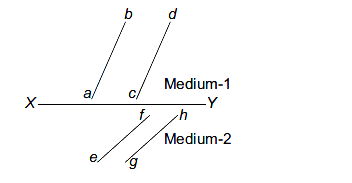
Question:
The phases of the light wave at \(c, d, e\) and \(f\) are \(\phi_c, \phi_d, \phi_e\) and \(\phi_f\), respectively. It is given that \(\phi_c \neq \phi_f\).JEE Advanced 2007 Medium