


JEE Advanced · Physics · 4. Motion in 2D
A projectile is thrown from a point \(\mathrm{O}\) on the ground at an angle \(45^{\circ}\) from the vertical and with a speed \(5 \sqrt{2} \mathrm{~m} / \mathrm{s}\). The projectile at the highest point of its trajectory splits into two equal parts. One part falls vertically down to the ground, \(0.5 \mathrm{~s}\) after the splitting. The other part, \(t\) seconds after the splitting, falls to the ground at a distance \(x\) meters from the point O. The acceleration due to gravity \(g=10 \mathrm{~m} / \mathrm{s}^{2}\).
The value of is ________.
- A 7.5
- B 7.6
- C 7.7
- D 7.8
Answer & Solution
Correct Answer
(A) 7.5
Step-by-step Solution
Detailed explanation
So,
See the Complete Solution
Get step-by-step explanations for this and 2.5 Lakh+ more JEE, NEET & CET questions.
- Unlock all solutions
- Practice the full chapter
- Track accuracy across PYQs
4.8 rated on Google Play · 14,000+ reviews
More questions from Physics
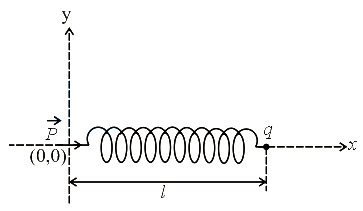
- One end of a spring of negligible unstretched length and spring constant is fixed at the origin . A point particle of mass carrying a positive charge is attached at its other end. The entire system is kept on a smooth horizontal surface. When a point dipole pointing towards the charge is fixed at the origin, the spring gets stretched to a length and attains a new equilibrium position (see figure below). If the point mass is now displaced slightly by from its equilibrium position and released, it is found to oscillate at frequency The value of is _______.
 JEE Advanced 2020 Hard
 - Paragraph:
\(\mathbf{P}_{17 \text { - } 19}\) : Paragraph for Questions Nos. 17 to 19 Two discs \(A\) and \(B\) are mounted coaxially on a vertical axle. The discs have moments of inertia I and 2I, respectively about the common axis. Disc \(A\) is imparted an initial angular velocity \(2 \omega\) using the entire potential energy of a spring compressed by a distance \(x_1\). Disc \(B\) is imparted an angular velocity \(\omega\) by a spring having the same spring constant and compressed by a distance \(x_2\). Both the discs rotate in the clockwise direction.Question:
The ratio \(\frac{x_1}{x_2}\) isJEE Advanced 2007 Easy - The work done on a particle of mass m by a force (K being a constant of appropriate dimensions, when the particle is taken from the point (a,0) to the point (0,a) along a circular path of radius a about the origin in the x-y plane isJEE Advanced 2013 Medium
- Two solid cylinders \(P\) and \(Q\) of same mass and same radius start rolling down a fixed inclined plane from the same height at the same time. Cylinder \(P\) has most of its mass concentrated near its surface, while \(Q\) has most of its mass concentrated near the axis. Which statement(s) is(are) correct?JEE Advanced 2012 Medium
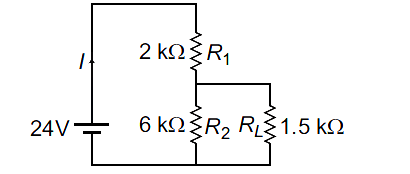
- For the circuit shown in the figure
 JEE Advanced 2009 Hard
 - List- shows different radioactive decay processes and List- provides possible emitted particles. Match each entry in List- with an appropriate entry from List-, and choose the correct option.
List- List- one particle and one particle three particles and one particle two particles and one particle one particle and one particle one particle and two particles JEE Advanced 2023 Easy
More PYQs from JEE Advanced
- Paragraph:
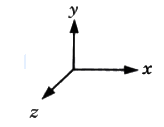
In a thin rectangular metallic strip a constant current \(I\) flows along the positive \(x\)-direction, as shown in the figure. The length, width and thickness of the strip are \(l, w\) and \(d\), respectively.
A uniform magnetic field \(\vec{B}\) is applied on the strip along the positive \(y\)-direction. Due to this, the charge carriers experience a net deflection along the \(z\)-direction. This results in accumulation of charge carriers on the surface \(P Q R S\) and appearance of equal and opposite charges on the face opposite to \(P Q R S\). A potential difference along the \(z\)-direction is thus developed. Charge accumulation continues until the magnetic force is balanced by the electric force. The current is assumed to be uniformly distributed on the cross section of the strip and carried by electrons.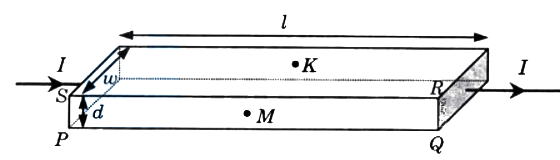
Question:
Consider two different metallic strips (\(1\) and \(2\)) of same dimensions (length \(l\), width \(w\) and thickness \(d\) ) with carrier densities \(n_{1}\) and \(n_{2}\), respectively. Strip \(1\) is placed in magnetic field \(B_{1}\) and strip \(2\) is placed in magnetic field \(B_{2}\), both along positive \(y\)-directions. Then \(V_{1}\) and \(V_{2}\) are the potential differences developed between \(K\) and \(M\) in strips \(1\) and \(2\), respectively. Assuming that the current \(I\) is the same for both the strips, the correct option(s) is(are)JEE Advanced 2015 Medium - The number of all possible values of \(\theta\), where \(0 < \theta < \pi\), for which the system of equations
\((y+z) \cos 3 \theta=(x y z) \sin 3 \theta \) \( x \sin 3 \theta=\frac{2 \cos 3 \theta}{y}+\frac{2 \sin 3 \theta}{z}\) and \((x y z) \sin 3 \theta=(y+2 z) \cos 3 \theta\) \(+y \sin 3 \theta\) have a solution \(\left(x_0, y_0, z_0\right)\) with \(\quad y_0 z_0 \neq 0\), isJEE Advanced 2010 Medium - For the equation hasJEE Advanced 2014 Medium
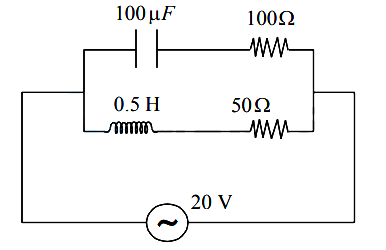
- In the given circuit, the \(\mathrm{AC}\) source has \(\omega=100 \mathrm{rad} / \mathrm{s}\). Considering the inductor and capacitor to be ideal, the correct choice(s) is (are)
 JEE Advanced 2012 Hard
 - Let be non-zero complex numbers and be the set of solutions of the equation , where . Then, which of the following statement(s) is (are) TRUE?JEE Advanced 2018 Medium
- A disk of radius \(\frac{a}{4}\) having a uniformly distributed charge \(6 \mathrm{C}\) is placed in the \(x-y\) plane with its centre at \(\left(\frac{-a}{2}, 0,0\right)\). A rod of length a carrying a uniformly distributed charge \(8 \mathrm{C}\) is placed on the \(x\)-axis from \(x=\frac{a}{4}\) to \(x=\frac{5 a}{4}\). Two point charges \(-7 \mathrm{C}\) and \(3 \mathrm{C}\) are placed at \(\left(\frac{a}{4}, \frac{-a}{4}, 0\right)\) and \(\left(\frac{-3 a}{4}, \frac{3 a}{4}, 0\right)\), respectively. Consider a cubical surface formed by six surfaces \(x=\pm \frac{a}{2}, y=\pm \frac{a}{2}, z=\pm \frac{a}{2}\).
The electric flux through this cubical surface is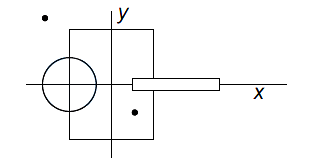 JEE Advanced 2009 Hard