


JEE Advanced · Physics · 8. Rotational Motion
Consider a body of mass at rest at the origin at time . A force is applied on the body, where . The torque acting on the body about the origin at time . Which of the following statements is (are) true?
- A
- B The torque is in the direction of the unit vector
- C The velocity of the body at
- D The magnitude of displacement of the body at
Answer & Solution
Correct Answer
(C) The velocity of the body at
Step-by-step Solution
Detailed explanation
On integrating
On integrating
At
At
See the Complete Solution
Get step-by-step explanations for this and 2.5 Lakh+ more JEE, NEET & CET questions.
- Unlock all solutions
- Practice the full chapter
- Track accuracy across PYQs
4.8 rated on Google Play · 14,000+ reviews
More questions from Physics
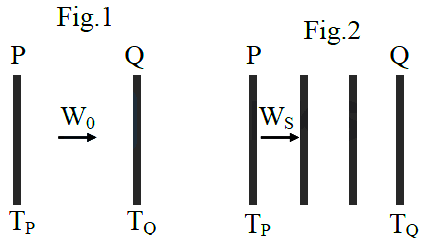
- Two identical plates P and Q , radiating as perfect black bodies, are kept in vacuum at constant absolute temperatures \(\mathrm{T}_{\mathrm{P}}\) and \(\mathrm{T}_{\mathrm{Q}}\), respectively, with \(\mathrm{T}_{\mathrm{Q}}<\mathrm{T}_{\mathrm{P}}\), as shown in Fig. 1. The radiated power transferred per unit area from P to Q is \(W_0\). Subsequently, two more plates, identical to P and Q, are introduced between P and Q, as shown in Fig. 2. Assume that heat transfer takes place only between adjacent plates. If the power transferred per unit area in the direction from P to Q (Fig. 2) in the steady state is \(W_S\), then the ratio \(\frac{W_0}{W_S}\) is ________.
 JEE Advanced 2025 Easy
 - Consider two solid spheres P and Q each of density 8 gm and diameters 1 cm and 0.5 cm, respectively. Sphere P is dropped into a liquid of density 0.8 gm and viscosity poiseulles. Sphere Q is dropped into a liquid of density 1.6 gm and viscosity poiseulles. the ratio of the terminal velocities of P and Q is.JEE Advanced 2016 Hard
- Paragraph :
One twirls a circular ring (of mass \(M\) and radius \(R\) ) near the tip of one's finger as shown in Figure 1 . In the process the finger never loses contact with the inner rim of the ring. The finger traces out the surface of a cone, shown by the dotted line. The radius of the path traced out by the point where the ring and the finger is in contact is \(r\). The finger rotates with an angular velocity \(\omega_{0}\). The rotating ring rolls without slipping on the outside of a smaller circle described by the point where the ring and the finger is in contact (Figure 2). The coefficient of friction between the ring and the finger is \(\mu\) and the acceleration due to gravity is \(g\).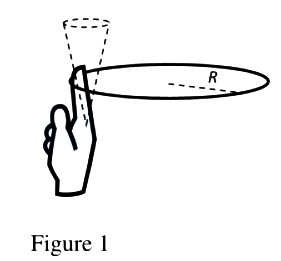
Question :
The total kinetic energy of the ring isJEE Advanced 2017 Medium - The general motion of a rigid body can be considered to be a combination of (i) a motion of its centre of mass about an axis, and (ii) its motion about an instantaneous axis passing through the centre of mass.
These axes need not be stationary. Consider, for example, a thin uniform disc welded (rigidly fixed) horizontally at its rim to a massless, stick, as shown in the figure. When the disc-stick system is rotated about the origin on a horizontal frictionless plane with angular speed \(\omega\), the motion at any instant can be taken as a combination of (i) a rotation of the centre of mass of the disc about the \(z\)-axis and (ii) a rotation of the disc through an instantaneous vertical axis passing through its centre of mass (as is seen from the changed orientation of points \(P\) and \(Q\) ). Both these motions have the same angular speed \(\omega\) in this case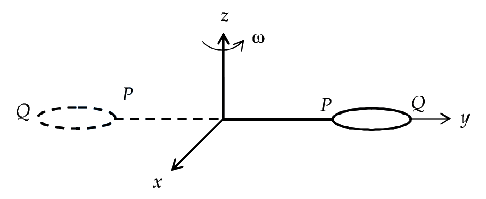
Now consider two similar systems as shown in the figure: Case
(a) the disc with its face vertical and parallel to \(x-z\) plane; Case
(b) the disc with its face making an angle of
\(45^{\circ}\) with \(x-y\) plane and its horizontal diameter parallel to \(x\)-axis. In both the cascs, the disc is welded at point \(\mathrm{P}\), and the systems are rotated with constant angular speed \(\omega\) about the \(z\) axis.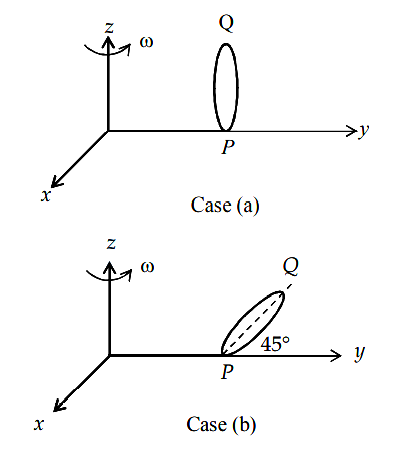
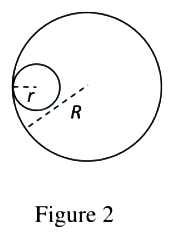
Question : Which of the following statements about the instantaneous axis (passing through the centre of mass) is correct?JEE Advanced 2012 Medium - A lamina is made by removing a small disc of diameter \(2 R\) from a bigger disc of uniform mass density and radius \(2 R\), as shown in the figure. The moment of inertia of this lamina about axes passing though \(O\) and \(P\) is \(I_{O}\) and \(I_{P}\) respectively. Both these axes are perpendicular to the plane of the lamina. The ratio \(I_{P} / I_{O}\) to the nearest integer is
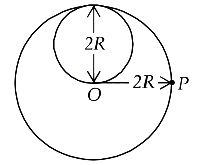 JEE Advanced 2012 Medium
 - Paragraph:
A small block of mass \(M\) moves on a frictionless surface of an inclined plane, as shown in figure. The angle of the incline suddenly changes from \(60^{\circ}\) to \(30^{\circ}\) at point \(B\). The block is initially at rest at \(A\). Assume that collisions between the block and the incline are totally inelastic \(\left(g=10 \mathrm{~m} / \mathrm{s}^2\right)\)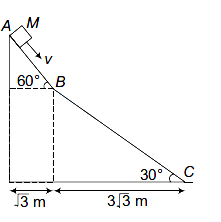
Question:
The speed of the block at point \(B\) immediately after it strikes the second incline isJEE Advanced 2008 Medium
More PYQs from JEE Advanced
- The largest wavelength in the ultraviolet region of the hydrogen spectrum is \(122 \mathrm{~nm}\). The smallest wavelength in the infrared region of the hydrogen spectrum (to the nearest integer) isJEE Advanced 2007 Hard
- Two moles of ideal helium gas are in a rubber balloon at \(30^{\circ} \mathrm{C}\). The balloon is fully expandable and can be assumed to require no energy in its expansion. The temperature of the gas in the balloon is slowly changed to \(35^{\circ} \mathrm{C}\). The amount of heat required in raising the temperature is nearly (take \(R=8.31 \mathrm{~J} / \mathrm{mol} . \mathrm{K}\) )JEE Advanced 2012 Easy
- Let the eccentricity of the hyperbola \(\frac{x^2}{a^2}-\frac{y^2}{b^2}=1\) be reciprocal to that of the ellipse \(x^2+4 y^2=4\). If the hyperbola passes through a focus of the ellipse, thenJEE Advanced 2011 Medium
- Choose the correct statement(s) among the following.JEE Advanced 2020 Easy
- Let \(A B C\) and \(A B C^{\prime}\) be two non-congruent triangles with sides \(A B=4\), \(A C=A C^{\prime}=2 \sqrt{2}\) and angle \(B=30^{\circ}\). The absolute value of the difference between the areas of these triangles isJEE Advanced 2009 Medium
- Let \(I=\left(\begin{array}{ll}1 & 0 \\ 0 & 1\end{array}\right)\) and \(P=\left(\begin{array}{ll}2 & 0 \\ 0 & 3\end{array}\right)\). Let \(Q=\left(\begin{array}{ll}\mathrm{x} & \mathrm{y} \\ \mathrm{z} & 4\end{array}\right)\) for some non-zero real numbers \(x, y\), and \(z\), for which there is \(2 \times 2\) matrix \(R\) with all entries being non-zero real numbers, such that \(Q R=R P\). Then which of the following statements is (are) TRUE?JEE Advanced 2025 Medium