


JEE Advanced · Physics · 11. Properties of Fluids
Paragraph:
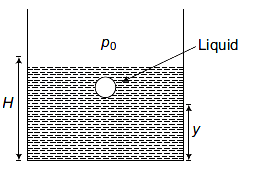
A small spherical monoatomic ideal gas bubble \(\left(\gamma=\frac{5}{3}\right)\) is trapped inside a liquid of density \(\rho_1\) (see figure). Assume that the bubble does not exchange any heat with the liquid. The bubble contains \(n\) moles of gas. The temperature of the gas when the bubble is at the bottom is \(T_0\), the height of the liquid is \(H\) and the atmospheric pressure is \(p_0\) (Neglect surface tension).
Question:
As the bubble moves upwards, besides the buoyancy force the following forces are acting on it.
- A Only the force of gravity
- B The force due to gravity and the force due to pressure of the liquid
- C The force due to gravity, the force due to the pressure of the liquid and the force due to viscosity of the liquid
- D The force due to gravity and the force due to viscosity of the liquid
Answer & Solution
Correct Answer
(D) The force due to gravity and the force due to viscosity of the liquid
Step-by-step Solution
Detailed explanation
As the bubble moves upwards, besides the buoyancy force (cause of which is pressure difference) only force of gravity and force of viscosity will act.
\(\therefore\) correct option is (d).
\(\therefore\) correct option is (d).
See the Complete Solution
Get step-by-step explanations for this and 2.5 Lakh+ more JEE, NEET & CET questions.
- Unlock all solutions
- Practice the full chapter
- Track accuracy across PYQs
4.8 rated on Google Play · 14,000+ reviews
More questions from Physics
- A pulse of light of duration 100 ns is absorbed completely by a small object initially at rest. Power of the pulse is 30 mW and the speed of light is 3 ×10⁸ ms-1. The final momentum of the object isJEE Advanced 2013 Easy
- Let and be the respective electric fields at a distance r from a point charge Q, an infinitely long wire with constant linear charge density , and an infinite plane with uniform surface charge density . If at a given distance , thenJEE Advanced 2014 Medium
- A particle of mass \(m\) is under the influence of the gravitational field of a body of mass \(M(\gg m)\). The particle is moving in a circular orbit of radius \(r_0\) with time period \(T_0\) around the mass \(M\). Then, the particle is subjected to an additional central force, corresponding to the potential energy \(V_{\mathrm{c}}(r)=m \alpha / r^3\), where \(\alpha\) is a positive constant of suitable dimensions and \(r\) is the distance from the center of the orbit. If the particle moves in the same circular orbit of radius \(r_0\) in the combined gravitational potential due to \(M\) and \(V_{\mathrm{c}}(r)\), but with a new time period \(T_1\), then \(\left(T_1^2-T_0^2\right) / T_1^2\) is given by
[ \(G\) is the gravitational constant.]JEE Advanced 2024 Medium - A pendulum consists of a bob of mass \(m=0.1 \mathrm{~kg}\) and a massless inextensible string of length \(L=1.0 \mathrm{~m}\). It is suspended from a fixed point at height \(H=0.9 \mathrm{~m}\) above a frictionless horizontal floor. Initially, the bob of the pendulum is lying on the floor at rest vertically below the point of suspension. A horizontal impulse \(P=0.2 \mathrm{~kg}-\mathrm{m} / \mathrm{s}\) is imparted to the bob at some instant. After the bob slides for some distance, the string becomes taut and the bob lifts off the floor. The magnitude of the angular momentum of the pendulum about the point of suspension just before the bob lifts off is \(J \mathrm{~kg}-\mathrm{m}^{2} / \mathrm{s}\). The kinetic energy of the pendulum just after the liftoff is \(K\) Joules.
The value of is ____.JEE Advanced 2021 Medium - Consider an expanding sphere of instantaneous radius whose total mass remains constant. The expansion is such that the instantaneous density remains uniform throughout the volume. The rate of fractional change in density is constant. The velocity of any point on the surface of the expanding sphere is proportional toJEE Advanced 2017 Medium
- A table tennis ball has radius \((3 / 2) \times 10^{-2} \mathrm{~m}\) and mass \((22 / 7) \times 10^{-3} \mathrm{~kg}\). It is slowly pushed down into a swimming pool to a depth of \(d=0.7 \mathrm{~m}\) below the water surface and then released from rest. It emerges from the water surface at speed \(v\), without getting wet, and rises up to a height \(H\). Which of the following option(s) is(are) correct?
[Given: \(\pi=22 / 7, g=10 \mathrm{~m} \mathrm{~s}^{-2}\), density of water \(=1 \times 10^3 \mathrm{~kg} \mathrm{~m}^{-3}\), viscosity of water \(=1 \times 10^{-3} \mathrm{~Pa}\)-s.]JEE Advanced 2024 Hard
More PYQs from JEE Advanced
- A particle of mass is attached to one end of a massless spring of force constant , lying on a frictionless horizontal plane. The other end of the spring is fixed. The particle starts moving horizontally from its equilibrium position at time with an initial velocity . When the speed of the particle is , it collides elastically with a rigid wall. After this collision :JEE Advanced 2013 Medium
- Consider the functions defined by and
If is the area of the region , then the value of is _____ .JEE Advanced 2022 Hard - Let \(\mathbb{N}\) denote the set of all natural numbers, and \(\mathbb{Z}\) denote the set of all integers. Consider the functions \(f: \mathbb{N} \rightarrow \mathbb{Z}\) and \(g: \mathbb{Z} \rightarrow \mathbb{N}\) defined by
\(f(n)= \begin{cases}(n+1) / 2 & \text { if } n \text { is odd } \\ (4-n) / 2 & \text { if } n \text { is even }\end{cases}\) And
\(g(n)=\left\{\begin{array}{cc}3+2 n & \text { if } n \geq 0 \\ -2 n & \text { if } n <0\end{array}\right.\)
Define \((g \circ f)(n)=g(f(n))\) for all \(n \in \mathbb{N}\), and \((f \circ g)(n)=f(g(n))\) for all \(n \in \mathbb{Z}\).
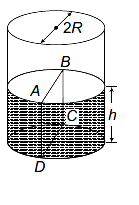
Then which of the following statements is (are) TRUE?JEE Advanced 2025 Hard - Water is filled up to a height \(h\) in a beaker of radius \(R\) as shown in the figure. The density of water is \(\rho\), the surface tension of water is \(T\) and the atmospheric pressure is \(p_0\). Consider a vertical section \(A B C D\) of the water column through a diameter of the beaker. The force on water on one side of this section by water on the other side of this section has magnitude.
 JEE Advanced 2007 Hard
 - A gas is enclosed in a cylinder with a movable frictionless piston. Its initial thermodynamic state at pressure changes to a final state at in an adiabatic quasi - static process, such that constant. Consider another thermodynamic process that brings the system from the same initial state to the same final state in two steps: an isobaric expansion at followed by an isochoric (isovolumetric) process at volumes . The amount of heat supplied to the system in the two step process is approximatelyJEE Advanced 2016 Medium
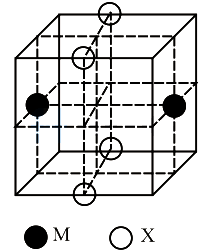
- The cubic unit cell structure of a compound containing cation and anion is shown below. When compared to the anion, the cation has smaller ionic radius. Choose the correct statement(s).
 JEE Advanced 2020 Medium