


JEE Advanced · Physics · 12. Thermal Properties
A composite block is made of slabs \(A, B, C, D\) and \(E\) of different thermal conductivities (given in terms of a constant, \(K\) ) and sizes (given in terms of length, \(L\) ) as shown in the figure. All slabs are of same width. Heat \(Q\) flows only from left to right through the blocks. Then, in steady state
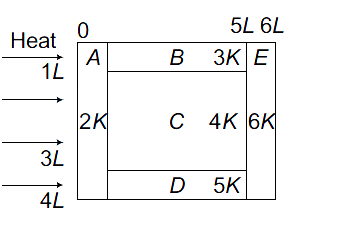
- A heat flow through \(A\) and \(E\) slabs are same
- B heat flow through slab \(E\) is maximum
- C temperature difference across slab \(E\) is smallest
- D heat flow through \(C=\) heat flow through \(B\) + heat flow through \(D\)
Answer & Solution
Correct Answer
(A) heat flow through \(A\) and \(E\) slabs are same
Step-by-step Solution
Detailed explanation
Thermal resistance
\(
\begin{aligned}
& R=\frac{l}{K A} \\
& \therefore \quad R_A=\frac{L}{(2 K)(4 L w)}=\frac{1}{8 K w} \\
& \text { (Here, } w=\text { width) } \\
& R_B=\frac{4 L}{3 K(L w)}=\frac{4}{3 K w} \\
& R_C=\frac{4 L}{(4 K)(2 L w)}=\frac{1}{2 K w} \\
& R_D=\frac{4 L}{(5 K)(L w)}=\frac{4}{5 K w} \\
& R_E=\frac{L}{(6 K)(L w)}=\frac{1}{6 K w} \\
& R_A: R_B: R_C: R_D: R_E \\
&=15: 160: 60: 96: 12
\end{aligned}
\)
So, let us write, \(R_A=15 R, R_B=160 R\) etc and draw a simple electrical circuit as shown in figure.
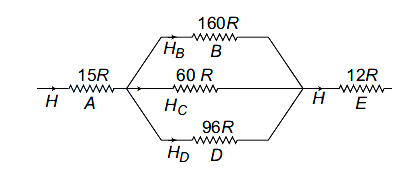
\(H=\) Heat current \(=\) Rate of heat flow.
\(
H_A=H_E=H
\)
[let]
\(\therefore\) Option (a) is correct.
In parallel, current distributes in inverse ratio of resistance.
\(
\begin{aligned}
& \therefore H_B: H_C: H_D=\frac{1}{R_B}: \frac{1}{R_C}: \frac{1}{R_D} \\
& =\frac{1}{160}: \frac{1}{60}: \frac{1}{96} \\
& =9: 24: 15 \\
& \therefore \quad H_B=\left(\frac{9}{9+24+15}\right) H=\frac{3}{16} H \\
& H_C=\left(\frac{24}{9+24+15}\right) H=\frac{1}{2} H \\
& \text { and } \quad H_D=\left(\frac{15}{9+24+15}\right) H=\frac{5}{16} H \\
&
\end{aligned}
\)
\(
H_C=H_B+H_D
\)
\(\therefore\) Option (d) is correct.
Temperature difference (let us call it \(T\) )
\(=(\) Heat current \() \times(\) Thermal resistance \()\)
\(T_A=H_A R_A=(H)(15 R)=15 \mathrm{HR}\)
\(T_B=H_B R_B=\left(\frac{3}{16} H\right)(160 R)=30 H R\)
\(T_C=H_C R_C=\left(\frac{1}{2} H\right)(60 R)=30 H R\)
\(T_D=H_D R_D=\left(\frac{5}{16} H\right)(96 R)=30 H R\)
\(T_E=H_E R_E=(H)(12 R)=12 \mathrm{HR}\)
Here, \(T_E\) is minimum. Therefore, option
(c) is also correct.
\(\therefore\) Correct options are (a), (c) and (d).
Analysis of Question
(i) From calculation point of view, question is difficult otherwise question is simple.
(ii) In heat transfer, questions are mainly asked from conduction and radiation topic.
\(
\begin{aligned}
& R=\frac{l}{K A} \\
& \therefore \quad R_A=\frac{L}{(2 K)(4 L w)}=\frac{1}{8 K w} \\
& \text { (Here, } w=\text { width) } \\
& R_B=\frac{4 L}{3 K(L w)}=\frac{4}{3 K w} \\
& R_C=\frac{4 L}{(4 K)(2 L w)}=\frac{1}{2 K w} \\
& R_D=\frac{4 L}{(5 K)(L w)}=\frac{4}{5 K w} \\
& R_E=\frac{L}{(6 K)(L w)}=\frac{1}{6 K w} \\
& R_A: R_B: R_C: R_D: R_E \\
&=15: 160: 60: 96: 12
\end{aligned}
\)
So, let us write, \(R_A=15 R, R_B=160 R\) etc and draw a simple electrical circuit as shown in figure.
\(H=\) Heat current \(=\) Rate of heat flow.
\(
H_A=H_E=H
\)
[let]
\(\therefore\) Option (a) is correct.
In parallel, current distributes in inverse ratio of resistance.
\(
\begin{aligned}
& \therefore H_B: H_C: H_D=\frac{1}{R_B}: \frac{1}{R_C}: \frac{1}{R_D} \\
& =\frac{1}{160}: \frac{1}{60}: \frac{1}{96} \\
& =9: 24: 15 \\
& \therefore \quad H_B=\left(\frac{9}{9+24+15}\right) H=\frac{3}{16} H \\
& H_C=\left(\frac{24}{9+24+15}\right) H=\frac{1}{2} H \\
& \text { and } \quad H_D=\left(\frac{15}{9+24+15}\right) H=\frac{5}{16} H \\
&
\end{aligned}
\)
\(
H_C=H_B+H_D
\)
\(\therefore\) Option (d) is correct.
Temperature difference (let us call it \(T\) )
\(=(\) Heat current \() \times(\) Thermal resistance \()\)
\(T_A=H_A R_A=(H)(15 R)=15 \mathrm{HR}\)
\(T_B=H_B R_B=\left(\frac{3}{16} H\right)(160 R)=30 H R\)
\(T_C=H_C R_C=\left(\frac{1}{2} H\right)(60 R)=30 H R\)
\(T_D=H_D R_D=\left(\frac{5}{16} H\right)(96 R)=30 H R\)
\(T_E=H_E R_E=(H)(12 R)=12 \mathrm{HR}\)
Here, \(T_E\) is minimum. Therefore, option
(c) is also correct.
\(\therefore\) Correct options are (a), (c) and (d).
Analysis of Question
(i) From calculation point of view, question is difficult otherwise question is simple.
(ii) In heat transfer, questions are mainly asked from conduction and radiation topic.
See the Complete Solution
Get step-by-step explanations for this and 2.5 Lakh+ more JEE, NEET & CET questions.
- Unlock all solutions
- Practice the full chapter
- Track accuracy across PYQs
4.8 rated on Google Play · 14,000+ reviews
More questions from Physics
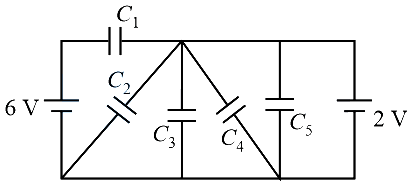
- In the following circuit and . The charge stored in is
 JEE Advanced 2022 Easy
 - Consider an expanding sphere of instantaneous radius whose total mass remains constant. The expansion is such that the instantaneous density remains uniform throughout the volume. The rate of fractional change in density is constant. The velocity of any point on the surface of the expanding sphere is proportional toJEE Advanced 2017 Medium
- A pendulum consists of a bob of mass \(m=0.1 \mathrm{~kg}\) and a massless inextensible string of length \(L=1.0 \mathrm{~m}\). It is suspended from a fixed point at height \(H=0.9 \mathrm{~m}\) above a frictionless horizontal floor. Initially, the bob of the pendulum is lying on the floor at rest vertically below the point of suspension. A horizontal impulse \(P=0.2 \mathrm{~kg}-\mathrm{m} / \mathrm{s}\) is imparted to the bob at some instant. After the bob slides for some distance, the string becomes taut and the bob lifts off the floor. The magnitude of the angular momentum of the pendulum about the point of suspension just before the bob lifts off is \(J \mathrm{~kg}-\mathrm{m}^{2} / \mathrm{s}\). The kinetic energy of the pendulum just after the liftoff is \(K\) Joules.
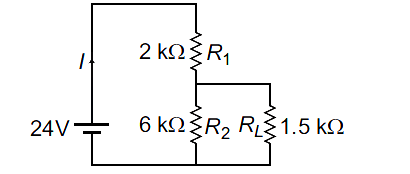
The value of is ____.JEE Advanced 2021 Medium - For the circuit shown in the figure
 JEE Advanced 2009 Hard
 - Four point charges, each of \(+q\), are rigidly fixed at the four corners of a square planar soap film of side \(a\). The surface tension of the soap film is \(\gamma\). The system of charges and planar film are in equilibrium, and \(a=k\left[\frac{q^2}{\gamma}\right]^{1 / N}\), where \(k\) is a constant. Then, \(N\) isJEE Advanced 2011 Hard
- Paragraph:
Scientists are working hard to develop nuclear fusion reactor. Nuclei of heavy hydrogen, \({ }_1^2 \mathrm{H}\) known as deuteron and denoted by \(D\) can be thought of as a candidate for fusion reactor. The \(D\) - \(D\) reaction is \({ }_1^2 \mathrm{H}+{ }_1^2 \mathrm{H} \rightarrow{ }_2^3 \mathrm{He}+n+\) energy. In the core of fusion reactor. A gas of heavy hydrogen is fully ionized into deuteron nuclei and electrons. This collection of \({ }_1^4 \mathrm{H}\) nuclei and electrons is known as plasma. The nuclei move randomly in the reactor core and occasionally come close enough for nuclear fusion to take place. Usually, the temperatures in the reactor core are too high and no material wall can be used to confine the plasma. Special techniques are used which confine the plasma for a time \(t_0\) before the particles fly away from the core. If n is the density (number/volume) of deutrons, the product t \(_0\) is called Lawson number. In one of the criteria, \(a\) reactor is termed successful if Lawson number is greater than \(5 \times 10^{14} \mathrm{scm}^{-3}\).
It may be helpful to use the following : Boltzmann constant \(k=8.6 \times 10^{-5} \mathrm{eV} / \mathrm{K}\); \(\frac{e^2}{4 \pi \varepsilon_0}=1.44 \times 10^{-9} \mathrm{eVm}\)
Question:
Assume that two deuteron nuclei in the core of fusion reactor at temperature \(T\) are moving towards each other, each with kinetic energy \(1.5 \mathrm{kT}\), when the separation between them is large enough to neglect Coulomb potential energy. Also neglect any interaction from other particles in the core. The minimum temperature \(T\) required for them to reach a separation of \(4 \times 10^{-15} \mathrm{~m}\) is in the rangeJEE Advanced 2009 Medium
More PYQs from JEE Advanced
- Paragraph:
\(RCONH _2\) is converted into \(RNH _2\) by means of Hofmann bromamide degradation.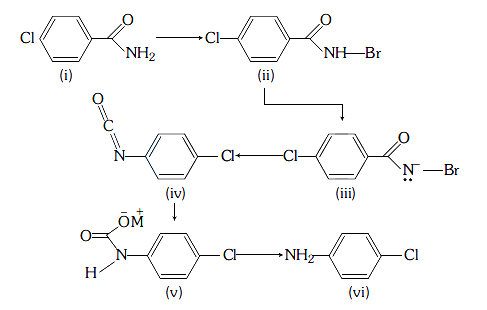
In this reaction, \(R \mathrm{CONHBr}\) is formed from which this reaction has derived its name. Electron donating group at phenyl activates the reaction. Hofmann degradation reaction is an intramolecular reaction.
Question:
How can the conversion of (i) to (ii) be brought about?JEE Advanced 2006 Easy - In an electrochemicalcell, dichromate ions in aqueous acidic medium are reduced to \(\mathrm{Cr}^{3+}\). The current (in amperes) that flows through the cell for 48.25 minutes to produce 1 mole of \(\mathrm{Cr}^{3+}\) is _____ .
Use: 1 Faraday \(=96500 \mathrm{C} \mathrm{mol}^{-1}\)JEE Advanced 2025 Easy - For , let . Then the minimum value of the function defined by isJEE Advanced 2023 Easy
- Let \(\mathbb{R}^2\) denote \(\mathbb{R} \times \mathbb{R}\). Let \(S=\left\{(a, b, c): a, b, c \in \mathbb{R} \text { and } a x^2+2 b x y+c y^2>0 \text { for all }(x, y) \in \mathbb{R}^2-\{(0,0)\}\right\} .\)
Then which of the following statements is (are) TRUE?JEE Advanced 2024 Easy - The carbon-based reduction method is NOT used for the extraction ofJEE Advanced 2013 Easy
- Let , for all . ThenJEE Advanced 2016 Hard