


JEE Advanced · Physics · 17. Electrostatics
The electric field E is measured at a point , generated due to various charge distributions and the dependence of E on d is found to be different for different charge distributions. List-I contains different relations between E and d. List-II describes different electric charge distributions, along with their locations. Match the functions in List-I with the related charge distributions in List-II.
| LIST -I | LIST -II | ||
| A) | is independent of d | P) | A point charge at the origin |
| B) | \(E \propto \frac{1}{d}\) | Q) | A small dipole with point charges \(Q\) at \((0,0, l)\) and \(-\operatorname{Qat}(0,0, l)\). Take \(2 l \ll d\) |
| C) | \(E \propto \frac{1}{d^2}\) | R) | An infinite line charge coincident with the \(x\)-axis, with uniform linear charge density \(\lambda\) |
| D) | \(E \propto \frac{1}{d^3}\) | S) | Two infinite wires carrying uniform linear charge density parallel to the \(x\) - axis. The one along \((y-0, z=l)\) has a charge density \(+\lambda\) and the one along \((y=0, z=-l)\) has a charge density \(-\lambda\). Take \(2 l \ll d\) |
| T) | Infinite plane charge coincident with the \(x y\) - plane with uniform surface charge density |
- A a-q,r;b-r,s;c-s,t;d-q,r;
- B a-r;b-t;c-r;d-q,r,s,t;
- C a-t;b-s;c-r,s,t;d-t;
- D a-t;b-r;c-p,s;d-q;
Answer & Solution
Correct Answer
(D) a-t;b-r;c-p,s;d-q;
Step-by-step Solution
Detailed explanation
(i) Point charge
Dipole
for dipole
For line charge
(iv) Two line charge
(v) Electric field due to sheet
is independent of r
Dipole
for dipole
For line charge
(iv) Two line charge
(v) Electric field due to sheet
is independent of r
See the Complete Solution
Get step-by-step explanations for this and 2.5 Lakh+ more JEE, NEET & CET questions.
- Unlock all solutions
- Practice the full chapter
- Track accuracy across PYQs
4.8 rated on Google Play · 14,000+ reviews
More questions from Physics
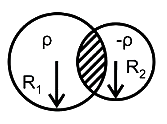
- Two non-conducting spheres of radii and and carrying uniform volume charge densities and , respectively, are placed such that they partially overlap, as shown in the figure. At all points in the overlapping region,
 JEE Advanced 2013 Hard
 - An electron in a hydrogen atom undergoes a transition from an orbit with a quantum number to another quantum number . are the initial and final potential energies of the electron. If then the smallest isJEE Advanced 2017 Medium
- The image of an object, formed by a plano - convex lens at a distance of 8 m behind the lens, is real and is one-third the size of the object. The wavelength of light inside the lens is times the wavelength in free space. The radius of the curved surface of the lens isJEE Advanced 2013 Medium
- The minimum kinetic energy needed by an alpha particle to cause the nuclear reaction in a laboratory frame is (in ). Assume that is at rest in the laboratory frame. The masses of and can be taken to be , and , respectively, where . The value of is
If the numerical value has more than two decimal places, truncate/round-off the value to TWO decimal places.JEE Advanced 2022 Medium - Statement 1 For an observer looking out through the window of a fast moving train, the nearby objects appear to move in the opposite direction to the train, while the distant objects appear to be stationary.
and Statement 2 If the observer and the object are moving at velocities \(\overrightarrow{\mathbf{v}}_{\mathbf{1}}\) and \(\overrightarrow{\mathbf{v}_2}\) respectively with reference to a laboratory frame, the velocity of the object with respect to the observer is \(\overrightarrow{\mathbf{v}_2}-\overrightarrow{\mathbf{v}_1}\).JEE Advanced 2008 Easy - The isotope having a mass 12.014 u undergoes - decay to has an excited state of the nucleus at 4.041 MeV above its ground state. If decays to the maximum kinetic energy of the - particle in units of MeV is ( where c is the speed of light in vacuum).JEE Advanced 2016 Medium
More PYQs from JEE Advanced
- Let and be two events such that , and ThenJEE Advanced 2017 Easy
- of is combusted in a fixed volume bomb calorimeter with excess of at and into . During the reaction, temperature increases from to . If heat capacity of the bomb calorimeter and enthalpy of formation of are and at , respectively, the calculated standard molar enthalpy of formation of at is . The value of is___[Given: Gas constant ]JEE Advanced 2022 Hard
- When the following aldohexose exists in its D-configuration, the total number of stereoisomers in its pyranose form is :
\(\mathrm{CHO}-\mathrm{CH}_{2}-\mathrm{CHOH}-\mathrm{CHOH}-\mathrm{CHOH}\) \(-~\mathrm{CH}_{2} \mathrm{OH}\)JEE Advanced 2012 Hard - A metal is heated in a furnace where a sensor is kept above the metal surface to read the power radiated () by the metal. The sensor has a scale that displays , where is a constant. When the metal surface is at a temperature of , the sensor shows a value . Assume that the emissivity of the metallic surface remains constant. What is the value displayed by the sensor when the temperature of the metal surface is raised to ?JEE Advanced 2016 Hard
- Two satellites and are moving in different circular orbits around the Earth(radius ). The heights of and from the Earth surface are and , respectively, where . The accelerations of and due to Earth’s gravity are and , respectively. If , what is the value of ?JEE Advanced 2023 Easy
- Consider a helium atom that absorbs a photon of wavelength . The change in the velocity (in ) of atom after the photon absorption is ______ .
(Assume: Momentum is conserved when photon is absorbed.
Use: Planck constant , Avocados number , Molar mass of )JEE Advanced 2021 Medium