


JEE Advanced · Mathematics · 25. AOD
The tangent to the curve \(y=e^x\) drawn at the point \(\left(c, e^c\right)\) intersects the line joining the points \(\left(c-1, e^{c-1}\right)\) and \(\left(c+1, e^{c+1}\right)\)
- A
on the left of \(x=c\)
- B
on the right of \(x=c\)
- C
at no point
- D
at all points
Answer & Solution
Correct Answer
(A)
on the left of \(x=c\)
Step-by-step Solution
Detailed explanation
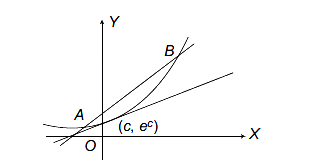
Slope of the line joining the points \(\left(c-1, e^{c-1}\right)\) and \(\left(c+1, e^{c+1}\right)\) is equal to \(\frac{e^{c+1}-e^{c-1}}{2}>e^c\)
\[
\text { Tangent to the curve } y=e^x \text { will intersect the given line to the left of the line } x=c \text {. }
\]
ALITER
The equation of the tangent to the curve \(y=e^x\) at \(\left(c, e^c\right)\) is
\[
y-e^c=e^c(x-c)
\]
Equation of the line joining the given points is
\[
y-e^{c-1}=\frac{e^c\left(e-e^{-1}\right)}{2}[x-(c-1)]
\]
Eliminating \(y\) from Eqs. (i) and (ii), we get
\[
\begin{aligned}
{[x-(c-1)]\left[2-\left(e-e^{-1}\right)\right] } & =2 e^{-1} \\
x-c & =\frac{e+e^{-1}-2}{2-\left(e-e^{-1}\right)} < 0 \Rightarrow x < c .
\end{aligned}
\]
\[
\text { Tangent to the curve } y=e^x \text { will intersect the given line to the left of the line } x=c \text {. }
\]
ALITER
The equation of the tangent to the curve \(y=e^x\) at \(\left(c, e^c\right)\) is
\[
y-e^c=e^c(x-c)
\]
Equation of the line joining the given points is
\[
y-e^{c-1}=\frac{e^c\left(e-e^{-1}\right)}{2}[x-(c-1)]
\]
Eliminating \(y\) from Eqs. (i) and (ii), we get
\[
\begin{aligned}
{[x-(c-1)]\left[2-\left(e-e^{-1}\right)\right] } & =2 e^{-1} \\
x-c & =\frac{e+e^{-1}-2}{2-\left(e-e^{-1}\right)} < 0 \Rightarrow x < c .
\end{aligned}
\]
See the Complete Solution
Get step-by-step explanations for this and 2.5 Lakh+ more JEE, NEET & CET questions.
- Unlock all solutions
- Practice the full chapter
- Track accuracy across PYQs
4.8 rated on Google Play · 14,000+ reviews
More questions from Mathematics
- The value of is equal toJEE Advanced 2016 Medium
- Paragraph:
Let \(F: \mathbb{R} \rightarrow \mathbb{R}\) be a thrice differentiable function. Suppose that \(F(1)=0, F(3)=-4\) and \(F^{\prime}(x)<0\) for all \(x \in(1 / 2,3)\). Let \(f(x)=x F(x)\) for all \(x \in \mathbb{R}\).
Question:
The correct statement(s) is(are)JEE Advanced 2015 Medium - A line L : meets at E(0,3) and the arc of the parabola at the point .The tangent to the parabola at intersects the y-axis at .The slope m of the line L is chosen such that the area of the triangle EFG has a local maximum.
Match List I with List II and select the correct answer using the code given below the lists :
List I List II A. m = P. B. Maximum area of ΔEFG is Q. 4 C. y0 = R. 2 D. y1 = S. 1 JEE Advanced 2013 Medium - Let the curve C be the mirror image of the parabola with respect to the line If A and B are the points of intersection of C with the line then the distance between A and B isJEE Advanced 2015 Medium
- Let \(S_n=\sum_{k=0}^n \frac{n}{n^2+k n+k^2}\) and \(T_n=\sum_{k=0}^{n-1} \frac{n}{n^2+k n+k^2}\), for \(n=1,2,3, \ldots\), thenJEE Advanced 2008 Medium
- Perpendiculars are drawn from points on the line to the plane . The feet of perpendiculars lie on the lineJEE Advanced 2013 Easy
More PYQs from JEE Advanced
- Which of the following is (are) NOT the square of a matrix with real entries?JEE Advanced 2017 Easy
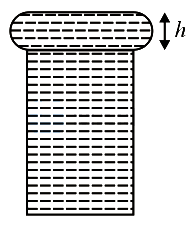
- When water is filled carefully in a glass, one can fill it to a height above the rim of the glass due to the surface tension of water. To calculate just before water starts flowing, model the shape of the water above the rim as a disc of thickness having semicircular edges, as shown schematically in the figure. When the pressure of water at the bottom of this disc exceeds what can be withstood due to the surface tension, the water surface breaks near the rim and water starts flowing from there. If the density of water, its surface tension and the acceleration due to gravity are and respectively, the value of (in )is ________.
 JEE Advanced 2020 Hard
 - The number of distinct solutions of the equation in the interval isJEE Advanced 2015 Medium
- A sample initially contains only U-238 isotope of uranium. With time, some of the U-238 radioactively decays into \(\mathrm{Pb}-206\) while the rest of it remains undisintegrated.
When the age of the sample is \(\mathbf{P} \times 10^8\) years, the ratio of mass of \(\mathrm{Pb}-206\) to that of \(\mathrm{U}-238\) in the sample is found to be 7 . The value of \(\mathbf{P}\) is ______
[Given: Half-life of U-238 is \(4.5 \times 10^9\) years; \(\log _c 2=0.693\) ]JEE Advanced 2024 Hard - For (the set of all real numbers), , Then a =JEE Advanced 2013 Hard
- Let \((x, y)\) be any point on the parabola \(y^2=4 x\). Let \(P\) be the point that divides the line segment from \((0,0)\) to \((x, y)\) in the ratio \(1: 3\). Then, the locus of \(P\) isJEE Advanced 2011 Medium