


JEE Advanced · Mathematics · 10. Pair of Lines
Let \(a\) and \(b\) be non-zero and real numbers. Then, the equation \(\left(a x^2+b y^2+c\right)\left(x^2-5 x y+6 y^2\right)=0\) represents
- A
Four straight lines, when \(c=0\) and \(a, b\) are of the same sign
- B
Two straight lines and a circle, when \(a=b\) and \(c\) is of sign opposite to that of \(a\)
- C
Two straight lines and a hyperbola, when \(a\) and \(b\) are of the same sign and \(c\) is of sign opposite to that of \(a\)
- D
A circle and an ellipse, when \(a\) and \(b\) are of the same sign and \(c\) is of sign opposite to that of \(a\)
Answer & Solution
Correct Answer
(B)
Two straight lines and a circle, when \(a=b\) and \(c\) is of sign opposite to that of \(a\)
Step-by-step Solution
Detailed explanation
Let \(a\) and \(b\) be non- zero real numbers.
Therefore, the given equation \(\left(a x^2+b y^2+c\right)\left(x^2-5 x y+6 y^2\right)=0\) implies either
\[
\begin{array}{rc}
& x^2-5 x y+6 y^2=0 \\
\Rightarrow & (x-2 y)(x-3 y)=0 \\
\Rightarrow & x=2 y \text { and } x=3 y
\end{array}
\]
represent two straight lines passing through origin.
Or \(\quad a x^2+b y^2+c=0\)
When \(c=0\) and \(a\) and \(b\) are of same signs, then
\[
\begin{aligned}
& a x^2+b y^2+c=0 \\
\Rightarrow & x=0 \text { and } y=0
\end{aligned}
\]
which is a point specified as the origin.
When \(a=b\) and \(c\) is of sign opposite to that of \(a, a x^2+b y^2+c=0\) represents a circle.
Hence, the given equation \(\left(a x^2+b y^2+c\right)\left(x^2-5 x y+6 y^2\right)=0\)
may represent two straight lines and a circle.
Therefore, the given equation \(\left(a x^2+b y^2+c\right)\left(x^2-5 x y+6 y^2\right)=0\) implies either
\[
\begin{array}{rc}
& x^2-5 x y+6 y^2=0 \\
\Rightarrow & (x-2 y)(x-3 y)=0 \\
\Rightarrow & x=2 y \text { and } x=3 y
\end{array}
\]
represent two straight lines passing through origin.
Or \(\quad a x^2+b y^2+c=0\)
When \(c=0\) and \(a\) and \(b\) are of same signs, then
\[
\begin{aligned}
& a x^2+b y^2+c=0 \\
\Rightarrow & x=0 \text { and } y=0
\end{aligned}
\]
which is a point specified as the origin.
When \(a=b\) and \(c\) is of sign opposite to that of \(a, a x^2+b y^2+c=0\) represents a circle.
Hence, the given equation \(\left(a x^2+b y^2+c\right)\left(x^2-5 x y+6 y^2\right)=0\)
may represent two straight lines and a circle.
See the Complete Solution
Get step-by-step explanations for this and 2.5 Lakh+ more JEE, NEET & CET questions.
- Unlock all solutions
- Practice the full chapter
- Track accuracy across PYQs
4.8 rated on Google Play · 14,000+ reviews
More questions from Mathematics
- Let \(k\) be a positive real number and let \(\begin{aligned} A & =\left[\begin{array}{ccc}2 k-1 & 2 \sqrt{k} & 2 \sqrt{k} \\ 2 \sqrt{k} & 1 & -2 k \\ -2 \sqrt{k} & 2 k & -1\end{array}\right] \text { and } \\ B & =\left[\begin{array}{ccc}0 & 2 k-1 & \sqrt{k} \\ 1-2 k & 0 & 2 \sqrt{k} \\ -\sqrt{k} & -2 \sqrt{k} & 0\end{array}\right]\end{aligned}\)
If \(\operatorname{det}(\operatorname{adj} A)+\operatorname{det}(\operatorname{adj} B)=10^6\), then \([k]\) is equal to
[Note : adj \(M\) denotes the adjoint of a square matrix \(M\) and \([k]\) denotes the largest integer less than or equal to \(k\) ].JEE Advanced 2010 Easy - Let be a quadrilateral in a plane, where and . If and , then the interval(s) that contain(s) the value of is/areJEE Advanced 2022 Medium
- Paragraph:
Let \(O\) be the origin, and \(\overrightarrow{O X}, \overrightarrow{O Y}, \overrightarrow{O Z}\) be three unit vectors in the directions of the sides \(\overrightarrow{Q R}, \overrightarrow{R P}\), \(\overrightarrow{P Q}\), respectively, of a triangle \(P Q R\).
Question:
\(|\overrightarrow{O X} \times \overrightarrow{O Y}|=\)JEE Advanced 2017 Easy - Let denote the set of all the terms of an infinite arithmetic progression with first term a and common difference If then equals ____JEE Advanced 2019 Medium
- Six cards and six envelopes are numbered 1, 2, 3, 4, 5, 6 and cards are to be placed in envelopes so that each envelope contains exactly one card and no card is placed in the envelope bearing the same number and more over the card numbered 1 is always placed in envelope numbered 2. Then the number of ways it can be done isJEE Advanced 2014 Medium
- Circle(s) touching -axis at a distance from the origin and having an intercept of length on -axis is (are)JEE Advanced 2013 Easy
More PYQs from JEE Advanced
- A cylindrical furnace has height and diameter both . It is maintained at temperature . The air gets heated inside the furnace at constant pressure and its temperature becomes . The hot air with density rises up a vertical chimney of diameter and height above the furnace and exits the chimney (see the figure). As a result, atmospheric air of density , pressure and temperature enters the furnace. Assume air as an ideal gas, neglect the variations in and inside the chimney and the furnace. Also ignore the viscous effects.
[Given: The acceleration due to gravity and ]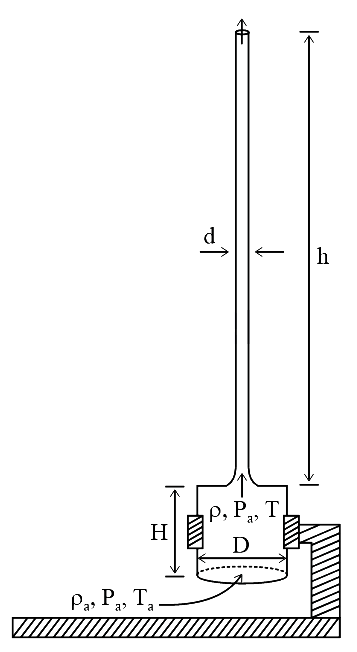
Considering the air flow to be streamline, the steady mass flow rate of air exiting the chimney is _____ .JEE Advanced 2023 Medium - In a radioactive decay chain reaction, nucleus decays into nucleus. The ratio of the number of to number of particles emitted in this process is _______.JEE Advanced 2022 Easy
- An incompressible liquid is kept in a container having a weightless piston with a hole. A capillary tube of inner radius is dipped vertically into the liquid through the airtight piston hole, as shown in the figure. The air in the container is isothermally compressed from its original volume towith the movable piston.Considering air as an ideal gas, the height of the liquid column in the capillary above the liquid level in is _____.
[Given: Surface tension of the liquid is , atmospheric pressure is , acceleration due to gravity is , density of the liquid is and contact angle of capillary surface with the liquid is zero]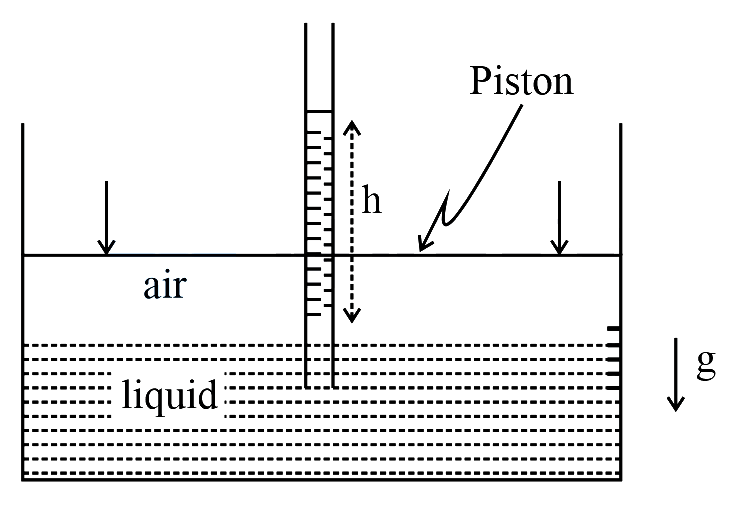 JEE Advanced 2023 Hard
 - Let M and N be two matrices such that MN = NM. Further, if and , thenJEE Advanced 2014 Medium
- A particle of mass is moving in the -plane such that its velocity at a point is given as where is a non-zero constant. What is the force acting on the particle?JEE Advanced 2023 Hard
- One mole of an ideal monoatomic gas undergoes two reversible processes and as shown in the given figure:
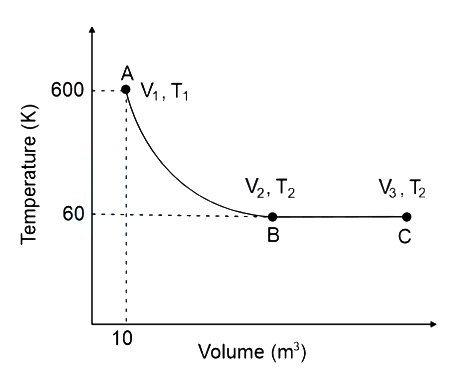
is an adiabatic process. If the total heat absorbed in the entire process and is , the value of is
[Use molar heat capacity of the gas at constant pressure, ]JEE Advanced 2023 Medium