


JEE Advanced · Physics · 28. Nuclear Physics
The \(\beta\)-decay process, discovered around 1900 , is basically the decay of a neutron \((n)\). In the laboratory, a proton \((p)\) and an electron \(\left(e^{-}\right)\)are observed as the decay products of the neutron. Therefore, considering the decay of a neutron as a two-body decay process, it was predicted theoretically that the kinetic energy of the electron should be a constant. But experimentally, it was observed that the electron kinetic energy has continuous spectrum. Considering a three-body decay process, i.e.
\(n \rightarrow p+e^{-}+\bar{v}_{e}\), around 1930, Pauli explained the observed electron energy spectrum. Assuming the anti-neutrino \(\left(\bar{v}_{e}\right)\) to be massless and possessing negligible energy, and the neutron to be at rest, momentum and energy conservation principles are applied. From this calculation, the maximum kinetic energy of the electron is \(0.8 \times 10^{6} \mathrm{eV}\). The kinetic energy carried by the proton is only the recoil energy.
Question:
If the anti-neutrino had a mass of \(3 \mathrm{eV} / \mathrm{c}^{2}\) (where \(\mathrm{c}\) is the speed of light) instead of zero mass, what should be the range of the kinetic energy, \(K\), of the electron?
- A \(0 \leq K \leq 0.8 \times 10^{6} \mathrm{eV}\)
- B \(3.0 \mathrm{eV} \leq K \leq 0.8 \times 10^{6} \mathrm{eV}\)
- C \(3.0 \mathrm{eV} \leq K < 0.8 \times 10^{6} \mathrm{eV}\)
- D \(0 \leq K < 0.8 \times 10^{6} \mathrm{eV}\)
Answer & Solution
Correct Answer
(D) \(0 \leq K < 0.8 \times 10^{6} \mathrm{eV}\)
Step-by-step Solution
Detailed explanation
Kinetic energy \((K)\) of electron will be minimum or zero when total energy is shared by proton and anti-neutrino \(\therefore 0 \leq \mathrm{K} < 0.8 \times 10^{6} \mathrm{eV}\)
See the Complete Solution
Get step-by-step explanations for this and 2.5 Lakh+ more JEE, NEET & CET questions.
- Unlock all solutions
- Practice the full chapter
- Track accuracy across PYQs
4.8 rated on Google Play · 14,000+ reviews
More questions from Physics
- An incompressible liquid is kept in a container having a weightless piston with a hole. A capillary tube of inner radius is dipped vertically into the liquid through the airtight piston hole, as shown in the figure. The air in the container is isothermally compressed from its original volume towith the movable piston.Considering air as an ideal gas, the height of the liquid column in the capillary above the liquid level in is _____.
[Given: Surface tension of the liquid is , atmospheric pressure is , acceleration due to gravity is , density of the liquid is and contact angle of capillary surface with the liquid is zero]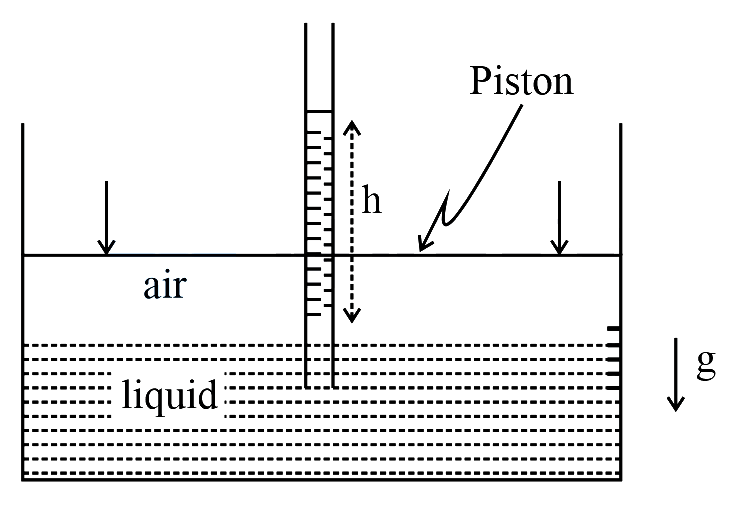 JEE Advanced 2023 Hard
 - Function \(x=A \sin ^2 \omega t+B \cos ^2 \omega t+C\) \(\sin \omega t \cos \omega t\) represents SHM.JEE Advanced 2006 Hard
- An annular disk of mass , inner radius and outer radius is placed on a horizontal surface with coefficient of friction , as shown in the figure. At some time, an impulse is applied at a height above the center of the disk. If then the disk rolls without slipping along the -axis. Which of the following statement(s) is(are) correct?
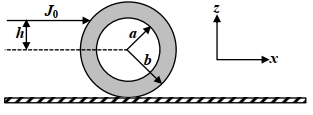 JEE Advanced 2023 Hard
 - A gas is enclosed in a cylinder with a movable frictionless piston. Its initial thermodynamic state at pressure changes to a final state at in an adiabatic quasi - static process, such that constant. Consider another thermodynamic process that brings the system from the same initial state to the same final state in two steps: an isobaric expansion at followed by an isochoric (isovolumetric) process at volumes . The amount of heat supplied to the system in the two step process is approximatelyJEE Advanced 2016 Medium
- List I contains four combinations of two lenses ( 1 and 2 ) whose focal lengths (in cm ) are indicated in the figures. In all cases, the object is placed 20 cm from the first lens on the left, and the distance between the two lenses is 5 cm . List II contains the positions of the final images.
Which one of the following options is correct?List - I List - II (I) 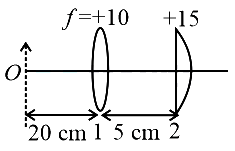
(P) Final image is formed at 7.5 cm on the right side of lens 2. (II) 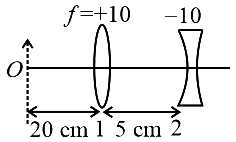
(Q) Final image is formed at 60.0 cm on the right side of lens 2. (III) 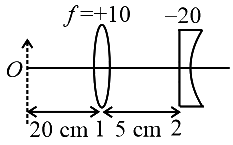
(R) Final image is formed at 30.0 cm on the left side of lens 2. (IV) 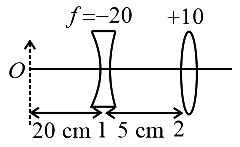
(S) Final image is formed at
6.0 cm on the right side of lens 2.(T) Final image is formed at 30.0 cm on the right side of lens 2. JEE Advanced 2022 Hard - The potential energy of a particle of mass m at a distance r from a fixed point O is given by , where k is a positive constant of appropriate dimensions. This particle is moving in a circular orbit of radius R about the point O. If v is the speed of the particle and L is the magnitude of its angular momentum about O, which of the following statements is (are) true?JEE Advanced 2018 Medium
More PYQs from JEE Advanced
- Let \(S\) denote the locus of the point of intersection of the pair of lines
\(4 x-3 y=12 \alpha\)
\(4 \alpha x+3 \alpha y=12\)
where \(\alpha\) varies over the set of non-zero real numbers. Let \(T\) be the tangent to \(S\) passing through the points \((p, 0)\) and \((0, q), q>0\), and parallel to the line \(4 x-\frac{3}{\sqrt{2}} y=0\).
Then the value of \(p q\) isJEE Advanced 2025 Hard - Paragraph :
In the figure a container is shown to have a movable (without friction) piston on top. The container and the piston are all made of perfectly insulating material allowing no heat transfer between outside and inside the container. The container is divided into two compartments by a rigid partition made of a thermally conducting material that allows slow transfer of heat. The lower compartment of the container is filled with \(2\) moles of an ideal monatomic gas at \(700 K\) and the upper compartment is filled with \(2\) moles of an ideal diatomic gas at \(400 K\). The heat capacities per mole of an ideal monatomic gas are \(C_{V}=\frac{3}{2} R, C_{P}=\frac{5}{2} R\), and those for an ideal diatomic gas are \(C_{V}=\frac{5}{2} R, C_{P}=\frac{7}{2} R\).
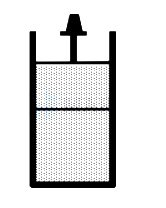
Question :
Consider the partition to be rigidly fixed so that it does not move. When equilibrium is achieved, the final temperature of the gases will beJEE Advanced 2014 Medium - Match the complexes in Column I with their properties listed in Column II. Indicate your answer by darkening the appropriate bubbles of the \(4 \times 4\) matrix given in the ORS.
Column I Column II A. \(\text O _2^{-} \longrightarrow \text{O} _2\) \(+~\text O _2^{2-}\) P. Redox reaction B. \(\text{CrO} _4^{2-}+\text H ^{+} \longrightarrow\) Q. One of the products has trigonal planar structure C. \(\text{MnO} _4^{-}+ \text{NO} _2^{-}\) \(+~ \text H ^{+} \longrightarrow\) R. Dimeric bridged tetrahedral metal ion D. \(\text{NO} _3^{-}+ \text H _2 \text{SO} _4\) \(+~ \text{Fe} ^{2+} \longrightarrow\) S. Disproportionation JEE Advanced 2007 Hard - For any positive integer , let be defined by
where for any and . Then which of the following statements is (are) TRUE ?JEE Advanced 2021 Medium - Look at the drawing given in the figure, which has been drawn with ink of uniform line-thickness.
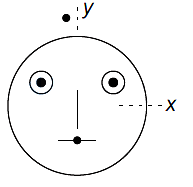
The mass of ink used to draw each of the two inner circles, and each of the two line segments is \(m\). The mass of the ink used to draw the outer circle is \(6 \mathrm{~m}\). The coordinates of the centres of the different parts are, outer circle 10 , \(0)\), left inner circle \((0,0)\), right inner circle \((a, a)\), vertical line \((0,0)\) and horizontal line \((0,-a)\). The \(y\)-coordinate of the centre of mass of the ink in this drawing isJEE Advanced 2009 Medium - Total number of cis bond angles (that is, and bonds in cis positions) present in a molecule of cis- complex is _________JEE Advanced 2019 Medium