


JEE Advanced · Physics · 22. AC Circuits
In a circuit, a metal filament lamp is connected in series with a capacitor of capacitance \(\mathrm{C} \mu F\) across a \(200 \mathrm{~V}, 50 \mathrm{~Hz}\) supply. The power consumed by the lamp is \(500 \mathrm{~W}\) while the voltage drop across it is \(100 \mathrm{~V}\). Assume that there is no inductive load in the circuit. Take \(r m s\) values of the voltages. The magnitude of the phaseangle (in degrees) between the current and the supply voltage is \(\varphi\). Assume, \(\pi \sqrt{3} \approx 5\).
The value of is ____.
- A 100
- B 150
- C 200
- D 250
Answer & Solution
Correct Answer
(A) 100
Step-by-step Solution
Detailed explanation
Given,
See the Complete Solution
Get step-by-step explanations for this and 2.5 Lakh+ more JEE, NEET & CET questions.
- Unlock all solutions
- Practice the full chapter
- Track accuracy across PYQs
4.8 rated on Google Play · 14,000+ reviews
More questions from Physics
- A circuit is connected as shown in the figure with the switch \(S\) open. When the switch is closed, the total amount of charge that flows from \(Y\) to \(X\) is
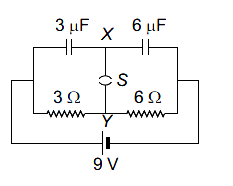 JEE Advanced 2007 Medium
 - In a historical experiment to determine Planck's constant, a metal surface was irradiated with light of different wavelengths. The emitted photoelectron energies were measured by applying a stopping potential. The relevant data for the wavelength \((\lambda)\) of incident light and the corresponding stopping potential (\(V_0\)) are given below:
Given that \(c=3 \times 10^8 m s^{-1}\) and \(e=1.6 \times 10^{-19} C\), Planck's constant (in units of J s) found from such an experiment is :\(\lambda(\mu m)\) Volt 0.3 2.0 0.4 1.0 0.5 0.4 JEE Advanced 2016 Medium - A parallel plate capacitor has a dielectric slab of dielectric constant K between its plates that covers 1/3 of the area of its plates, as shown in the figure. The total capacitance of the capacitor is C while that of the portion with dielectric in between is . When the capacitor is charged, the plate area covered by the dielectric gets charge and the rest of the area gets charge . The electric field in the dielectric is and that in the other portion is . Choose the correct option/options, ignoring edge effects.
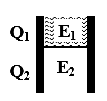 JEE Advanced 2014 Medium
 - Paragraph:
A small block of mass \(M\) moves on a frictionless surface of an inclined plane, as shown in figure. The angle of the incline suddenly changes from \(60^{\circ}\) to \(30^{\circ}\) at point \(B\). The block is initially at rest at \(A\). Assume that collisions between the block and the incline are totally inelastic \(\left(g=10 \mathrm{~m} / \mathrm{s}^2\right)\)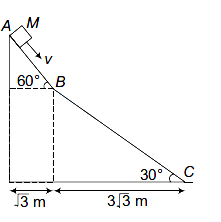
Question:
The speed of the block at point \(C\), immediately before it leaves the second incline isJEE Advanced 2008 Hard - A small circular loop of area and resistance is fixed on a horizontal -plane with the center of the loop always on the axis of a long solenoid. The solenoid has turns per unit length and carries current counter clockwise as shown in the figure. The magnetic field due to the solenoid is in direction. List-I gives time dependences of in terms of a constant angular frequency . List-II gives the torques experienced by the circular loop at time , Let .
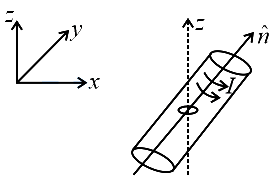
Which one of the following options is correct?List-I List-II (i) (p) (ii) (q) (iii) (r) (iv) (s) (t) JEE Advanced 2022 Hard - An ideal gas is undergoing a cyclic thermodynamic process in different ways as shown in the corresponding P-V diagrams in column 3 of the table. Consider only the path from state 1 to state 2. W denotes the corresponding work done on the system. The equations and plots in the table have standard notations as used in thermodynamic process. Here is the ratio of heat capacities at constant pressure and constant volume. The number of moles in the gas in n.
Which one of the following options correctly represents a thermodynamic process that is used as a correction in the determination of the speed of sound in ideal gas?Column – 1 Column – 2 Column – 3 (I) \(W_{1 \rightarrow 2}=\) \(\frac{1}{\gamma-1}\left(P_2 V_2-P_1 V_1\right)\) (i) Isothermal (P) 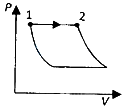
(II) \(W_{1 \rightarrow 2}=\) \(-P V_2+P V_1\) (ii) Isochoric (Q) 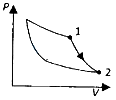
(III) \(W_{1 \rightarrow 2}=0\) (iii) Isobaric (R) 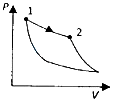
(IV) \(W_{1 \rightarrow 2}=\)\(-n R T \ln \left(\frac{V_2}{V_1}\right)\) (iv) Adiabatic (S) 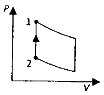 JEE Advanced 2017 Medium
More PYQs from JEE Advanced
- The freezing point (in \({ }^{\circ} \mathrm{C}\) ) of solution containing \(0.1 \mathrm{~g}\) of \(\mathrm{K}_3\left[\mathrm{Fe}(\mathrm{CN})_6\right]\) (molecular weight 329\()\) in \(100 \mathrm{~g}\) of water \(\left(K_f=1.86 \mathrm{~K} \mathrm{~kg} \mathrm{~mol}^{-1}\right)\) isJEE Advanced 2011 Easy
- The \(\beta\)-decay process, discovered around 1900 , is basically the decay of a neutron \((n)\). In the laboratory, a proton \((p)\) and an electron \(\left(e^{-}\right)\)are observed as the decay products of the neutron. Therefore, considering the decay of a neutron as a two-body decay process, it was predicted theoretically that the kinetic energy of the electron should be a constant. But experimentally, it was observed that the electron kinetic energy has continuous spectrum. Considering a three-body decay process, i.e.
\(n \rightarrow p+e^{-}+\bar{v}_{e}\), around 1930, Pauli explained the observed electron energy spectrum. Assuming the anti-neutrino \(\left(\bar{v}_{e}\right)\) to be massless and possessing negligible energy, and the neutron to be at rest, momentum and energy conservation principles are applied. From this calculation, the maximum kinetic energy of the electron is \(0.8 \times 10^{6} \mathrm{eV}\). The kinetic energy carried by the proton is only the recoil energy.
Question:
What is the maximum energy of the anti-neutrino?JEE Advanced 2012 Medium - Match the gases under specified conditions listed in Column I with their properties/laws in Column II. Indicate your answer by darkening the appropriate bubbles of \(4 \times 4\) matrix given in the ORS.
Column I Column II A. Hydrogen gas
\((P=200 atm,\) \(T=273 K)\)p. Compressibility factor \(\neq 1\) B. Hydrogen gas
\((P \sim 0,\) \(T=273 K)\)q. Attractive forces are dominant C. \(CO _2(P=1 atm,\) \(T=273 K)\) r. \(P V=n R T\) D. Real gas with very large molar volume s. \(P(V-n b)=n R T\) JEE Advanced 2007 Medium - The difference in the oxidation numbers of the two types of sulphur atoms in \(\mathrm{Na}_2 \mathrm{~S}_4 \mathrm{O}_6\) isJEE Advanced 2011 Medium
- Which one of the following statement is WRONG in the context of X-rays generated from X-ray tube?JEE Advanced 2008 Hard
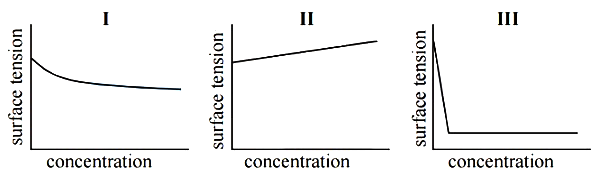
- The qualitative sketches I, II and III given below show the variation of surface tension with molar concentration of three different aqueous solutions of KCl, and at room temperature. The correct assignment of the sketches is -
 JEE Advanced 2016 Hard