


JEE Advanced · Chemistry · 5. States of Matter
Match the gases under specified conditions listed in Column I with their properties/laws in Column II. Indicate your answer by darkening the appropriate bubbles of \(4 \times 4\) matrix given in the ORS.
| Column I | Column II |
| A. Hydrogen gas \((P=200 atm,\) \(T=273 K)\) | p. Compressibility factor \(\neq 1\) |
| B. Hydrogen gas \((P \sim 0,\) \(T=273 K)\) | q. Attractive forces are dominant |
| C. \(CO _2(P=1 atm,\) \(T=273 K)\) | r. \(P V=n R T\) |
| D. Real gas with very large molar volume | s. \(P(V-n b)=n R T\) |
- A A-p; B-q; C-p; D-q, r
- B A-p, q; B-r; C-r, s; D-p, q
- C A-s; B-p; C-p; D-q
- D A-p, s; B-r; C-p, q; D-r
Answer & Solution
Correct Answer
(D) A-p, s; B-r; C-p, q; D-r
Step-by-step Solution
Detailed explanation
(A) \(-p, s(\mathrm{~B})-r\) (C) \(-p, q\) (D) \(-r\)
Explanation van der Waals' equation
\(
\left(p+\frac{n^2 a}{V_m^2}\right)\left(V_m-b\right)=n R T
\)
For hydrogen gas \((p=200 \mathrm{~atm}, T=273 \mathrm{~K})\)
As pressure is large \(V_m\) can be assumed small, thus ' \(b\) ' can not be ignored, while due to high pressure \(a / V_m^2\) can be considered negligible in comparison to \(p\).
\(
p\left(V_m-b\right)=R T \quad \text { and } \quad Z=1+\frac{p b}{R T}
\)
For hydrogen gas \((p \sim 0, T=273 \mathrm{~K})\)
when pressure occurs of low about \(1 \mathrm{~atm}\) or less and temperature is not very close to the point of liquification \(\left[T_c\left(\mathrm{H}_2\right)=33.3 \mathrm{~K}\right]\) gas behaves ideally.
For
\(
P V=n R T
\)
Temperature is close to the point of liquification \(\left[T_C\left(\mathrm{CO}_2\right)=304.2\right]\) thus, deviation from ideality appears very high (due to high attractive force of attraction).
For real gas with very large molar volume.
As molar volume is very large \(a / V_m^2\) will be negligible and at the same time ' \(b\) ' in comparison to \(V_m\) is also considered negligible, thus, \(p V_m=n R T\)
Explanation van der Waals' equation
\(
\left(p+\frac{n^2 a}{V_m^2}\right)\left(V_m-b\right)=n R T
\)
For hydrogen gas \((p=200 \mathrm{~atm}, T=273 \mathrm{~K})\)
As pressure is large \(V_m\) can be assumed small, thus ' \(b\) ' can not be ignored, while due to high pressure \(a / V_m^2\) can be considered negligible in comparison to \(p\).
\(
p\left(V_m-b\right)=R T \quad \text { and } \quad Z=1+\frac{p b}{R T}
\)
For hydrogen gas \((p \sim 0, T=273 \mathrm{~K})\)
when pressure occurs of low about \(1 \mathrm{~atm}\) or less and temperature is not very close to the point of liquification \(\left[T_c\left(\mathrm{H}_2\right)=33.3 \mathrm{~K}\right]\) gas behaves ideally.
For
\(
P V=n R T
\)
Temperature is close to the point of liquification \(\left[T_C\left(\mathrm{CO}_2\right)=304.2\right]\) thus, deviation from ideality appears very high (due to high attractive force of attraction).
For real gas with very large molar volume.
As molar volume is very large \(a / V_m^2\) will be negligible and at the same time ' \(b\) ' in comparison to \(V_m\) is also considered negligible, thus, \(p V_m=n R T\)
See the Complete Solution
Get step-by-step explanations for this and 2.5 Lakh+ more JEE, NEET & CET questions.
- Unlock all solutions
- Practice the full chapter
- Track accuracy across PYQs
4.8 rated on Google Play · 14,000+ reviews
More questions from Chemistry
- Aluminium reacts with sulfuric acid to form aluminium sulfate and hydrogen. What is the volume of hydrogen gas in liters produced at and atm pressure, when of aluminium and of sulfuric acid are combined for the reaction? (Use molar mass of aluminium as , )JEE Advanced 2020 Medium
- Match the thermodynamic processes given under Column I with the expressions given under Column II.
Column I Column II A. Freezing of water at 273 K and 1 atm P. B. Expansion of 1 mol of an ideal gas into a vacuum under isolated conditions Q. C. Mixing of equal volumes of two ideal gases at constant temperature and pressure in an isolated container R. D. Reversible heating of at 1 atm from 300 K to 600 K, followed by reversible cooling to 300 K at 1 atm S. T. JEE Advanced 2015 Hard - Match the rate expressions in LIST-I for the decomposition of \(\mathrm{X}\) with the corresponding profiles provided in LIST-II. \(X_s\) and \(\mathrm{k}\) are constants having appropriate units.
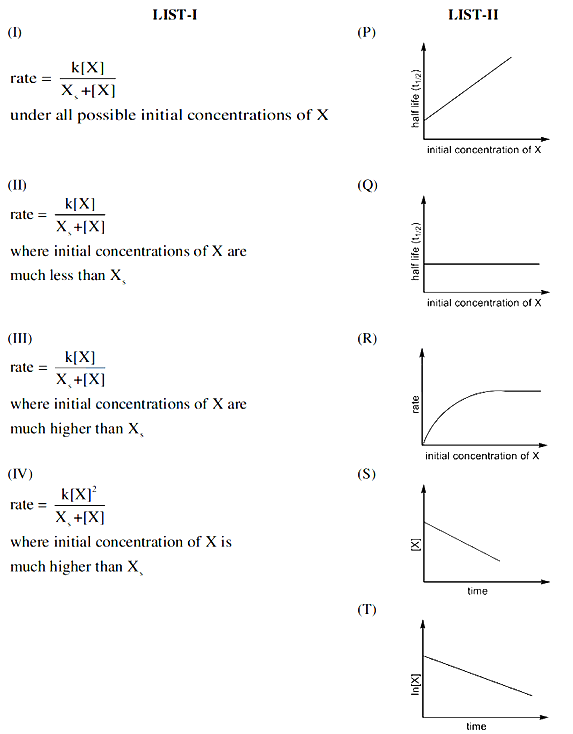 JEE Advanced 2022 Hard
 - The IUPAC name of \(\left[\mathrm{Ni}\left(\mathrm{NH}_3\right)_4\right]\left[\mathrm{NiCl}_4\right]\) isJEE Advanced 2008 Easy
- Paragraph:
Chemical reactions involve interaction of atoms and molecules. A large number of atoms/molecules (approximately \(6.023 \times 10^{23}\) ) are present in a few grams of any chemical compound varying with their atomic/molecular masses. To handle such large numbers conveniently, the mole concept was introduced. This concept has implications in diverse areas such as analytical chemistry, biochemistry, electrochemistry and radiochemistry. The following example illustrates a typical case, involving chemical/electrochemical reaction, which requires a clear understanding of the mole concept.
A \(4.0\) molar aqueous solution of \(\mathrm{NaCl}\) is prepared and \(500 \mathrm{~mL}\) of this solution is electrolysed. This leads to the evolution of chlorine gas at one of electrodes (atomic mass: \(\mathrm{Na}=23, \mathrm{Hg}=200 ; 1\) faraday \(=96500\) coulombs).
Question:
The total charge (coulombs) required for complete electrolysis isJEE Advanced 2007 Medium - With reference to aqua regia, choose the correct option(s).JEE Advanced 2019 Hard
More PYQs from JEE Advanced
- For all \(x>0\), let \(y_1(x), y_2(x)\), and \(y_3(x)\) be the functions satisfying
\(\begin{aligned} & \frac{d y_1}{d x}-(\sin x)^2 y_1=0, y_1(1)=5 \\ & \frac{d y_2}{d x}-(\cos x)^2 y_2=0, y_2(1)=\frac{1}{3} \\ & \frac{d y_3}{d x}-\left(\frac{2-x^3}{x^3}\right) y_3=0, y_3(1)=\frac{3}{5 e}\end{aligned}\)
respectively. Then \(\lim _{x \rightarrow 0^{+}} \frac{y_1(x) y_2(x) y_3(x)+2 x}{e^{3 x} \sin x}\) is equal to _____JEE Advanced 2025 Hard - Suppose denote the distinct real roots of the quadratic polynomial and suppose denote the distinct complex roots of the quadratic polynomial . Then the value ofJEE Advanced 2020 Medium
- A block with mass M is connected by a massless spring with stiffness constant k to a rigid wall and moves without friction on a horizontal surface. The block oscillates with small amplitude A about an equilibrium position . Consider two cases : (i) when the block is at and (ii) when the block is at In both the cases, a particle with mass m is softly placed on the block after which they stick to each other. Which of the following statement(s) is(are) true about the motion after the mass m is placed on the mass M?JEE Advanced 2016 Hard
- A spherical body of radius consists of a fluid of constant density and is in equilibrium under its own gravity. If is the pressure at , then the correct option(s) is (are)JEE Advanced 2015 Hard
- Consider the vectors
\(\vec{x}=\hat{i}+2 \hat{j}+3 \hat{k}, \quad \vec{y}=2 \hat{i}+3 \hat{j}+\hat{k}, \quad \text { and } \quad \vec{z}=3 \hat{i}+\hat{j}+2 \hat{k}\)
For two distinct positive real numbers \(\alpha\) and \(\beta\), define
\(\vec{X}=\alpha \vec{x}+\beta \vec{y}-\vec{z}, \quad \vec{Y}=\alpha \vec{y}+\beta \vec{z}-\vec{x}, \quad \text { and } \quad \vec{Z}=\alpha \vec{z}+\beta \vec{x}-\vec{y}\)
If the vectors \(\vec{X}, \vec{Y}\), and \(\vec{Z}\) lie in a plane, the value of \(\alpha+\beta-3\) is ______ .JEE Advanced 2025 Hard - Match each of the diatomic molecules in Column I with its property/properties in Column II.
Column I Column II A. \(B _2\) p. Paramagnetic B. \(N_2\) q. Undergoes oxidation C. \(O _2^{-}\) r. Undergoes reduction D. \(O _2\) s. Bond order t. Mixing of 's' and 'p' orbitals JEE Advanced 2009 Medium