


JEE Advanced · Physics · 24. Ray Optics
Image of an object approaching a convex mirror of radius of curvature \(20 \mathrm{~m}\) along its optical axis is observed to move from \(\frac{25}{3} \mathrm{~m}\) to \(\frac{50}{7} \mathrm{~m}\) in \(30 \mathrm{~s}\). What is the speed of the object in \(\mathrm{km} \mathrm{h}^{-1}\) ?
- A 2
- B 3
- C 4
- D 5
Answer & Solution
Correct Answer
(B) 3
Step-by-step Solution
Detailed explanation
Using mirror formula twice,
\(\frac{1}{+25 / 3}+\frac{1}{-u_1}=\frac{1}{+10}\)
or \(\quad \frac{1}{u_1}=\frac{3}{25}-\frac{1}{10}\) or \(u_1=50 \mathrm{~m}\)
and, \(\quad \frac{1}{(+50 / 7)}+\frac{1}{-u_2}=\frac{1}{+10}\)
\(\therefore \quad \frac{1}{u_2}=\frac{7}{50}-\frac{1}{10}\) or \(u_2=25 \mathrm{~m}\)
Speed of object \(=\frac{u_1-u_2}{\text { time }}\)
\(=\frac{25}{30} \mathrm{~ms}^{-1}\)
\(=3 \mathrm{kmh}^{-1}\)
\(\therefore\) The answer is 3 .
\(\frac{1}{+25 / 3}+\frac{1}{-u_1}=\frac{1}{+10}\)
or \(\quad \frac{1}{u_1}=\frac{3}{25}-\frac{1}{10}\) or \(u_1=50 \mathrm{~m}\)
and, \(\quad \frac{1}{(+50 / 7)}+\frac{1}{-u_2}=\frac{1}{+10}\)
\(\therefore \quad \frac{1}{u_2}=\frac{7}{50}-\frac{1}{10}\) or \(u_2=25 \mathrm{~m}\)
Speed of object \(=\frac{u_1-u_2}{\text { time }}\)
\(=\frac{25}{30} \mathrm{~ms}^{-1}\)
\(=3 \mathrm{kmh}^{-1}\)
\(\therefore\) The answer is 3 .
See the Complete Solution
Get step-by-step explanations for this and 2.5 Lakh+ more JEE, NEET & CET questions.
- Unlock all solutions
- Practice the full chapter
- Track accuracy across PYQs
4.8 rated on Google Play · 14,000+ reviews
More questions from Physics
- An AC voltage source of variable angular frequency \(\omega\) and fixed amplitude \(V_0\) is connected in series with a capacitance \(C\) and an electric bulb of resistance \(R\) (inductance zero). When \(\omega\) is increasedJEE Advanced 2010 Easy
- A conducting solid sphere of radius \(R\) and mass \(M\) carries a charge \(Q\). The sphere is rotating about an axis passing through its center with a uniform angular speed \(\omega\). The ratio of the magnitudes of the magnetic dipole moment to the angular momentum about the same axis is given as \(\alpha \frac{Q}{2 M}\). The value of \(\alpha\) is _______ .JEE Advanced 2025 Easy
- A soft plastic bottle, filled with water of density \(1 \mathrm{gm} / \mathrm{cc}\), carries an inverted glass test-tube with some air (ideal gas) trapped as shown in the figure. The test-tube has a mass of \(5 \mathrm{gm}\), and it is made of a thick glass of density \(2.5 \mathrm{gm} / \mathrm{cc}\). Initially the bottle is sealed at atmospheric pressure \(p_{0}=10^{5} \mathrm{~Pa}\) so that the volume of the trapped air is \(v_{0}=3.3 \mathrm{cc}\). When the bottle is squeezed from outside at constant temperature, the pressure inside rises and the volume of the trapped air reduces. It is found that the test tube begins to sink at pressure \(p_{0}+\Delta p\) without changing its orientation. At this pressure, the volume of the trapped air is \(v_{0}-\Delta v\).
Let \(\Delta v=X\) cc and \(\Delta p=Y \times 10^{3} \mathrm{~Pa}\).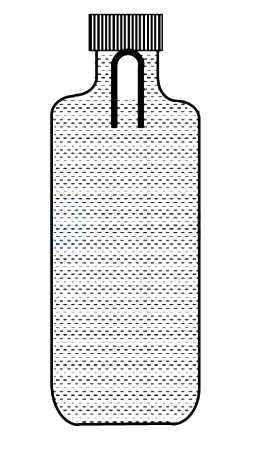
The value of is _____.JEE Advanced 2021 Hard - The \(\beta\)-decay process, discovered around 1900 , is basically the decay of a neutron \((n)\). In the laboratory, a proton \((p)\) and an electron \(\left(e^{-}\right)\)are observed as the decay products of the neutron. Therefore, considering the decay of a neutron as a two-body decay process, it was predicted theoretically that the kinetic energy of the electron should be a constant. But experimentally, it was observed that the electron kinetic energy has continuous spectrum. Considering a three-body decay process, i.e.
\(n \rightarrow p+e^{-}+\bar{v}_{e}\), around 1930, Pauli explained the observed electron energy spectrum. Assuming the anti-neutrino \(\left(\bar{v}_{e}\right)\) to be massless and possessing negligible energy, and the neutron to be at rest, momentum and energy conservation principles are applied. From this calculation, the maximum kinetic energy of the electron is \(0.8 \times 10^{6} \mathrm{eV}\). The kinetic energy carried by the proton is only the recoil energy.
Question:
If the anti-neutrino had a mass of \(3 \mathrm{eV} / \mathrm{c}^{2}\) (where \(\mathrm{c}\) is the speed of light) instead of zero mass, what should be the range of the kinetic energy, \(K\), of the electron?JEE Advanced 2012 Hard - Paragraph : If the measurement errors in all the independent quantities are known, then it is possible to determine the error in any dependent quantity. This is done by the use of series expansion and truncating the expansion at the first power of the error. For example, consider the relation . If the errors in , respectively, then
The series expansion for , to first power in . The relative errors in independent variables are always added. So the error in will be
The above derivation makes the assumption that \(\Delta r / x \ll 1, \Delta y / y < 1\). Therefore, the higher powers of these quantities are neglected.
Question : Consider the ratio \(r=\frac{(1-a)}{(1+a)}\) to be determined by measuring a dimensionless quantity a If the error in the measurement of a is \(\Delta a(\frac{\Delta a}{a}<<1)\), then what is the error \(\Delta r\) in determining \(r\) ?JEE Advanced 2018 Medium - A ball is projected from the ground at an angle of with the horizontal surface. It reaches a maximum height of and returns to the ground. Upon hitting the ground for the first time, it loses half of its kinetic energy. Immediately after the bounce, the velocity of the ball makes an angle of with the horizontal surface. The maximum height it reaches after the bounce (in meters) is _____________.JEE Advanced 2018 Medium
More PYQs from JEE Advanced
- The pair(s) of diamagnetic ions is(are)JEE Advanced 2025 Easy
- Let and be functions defined by and , where denotes the greatest integer less than or equal to for . ThenJEE Advanced 2016 Hard
- Paragraph:
Read the following passage and answer the questions.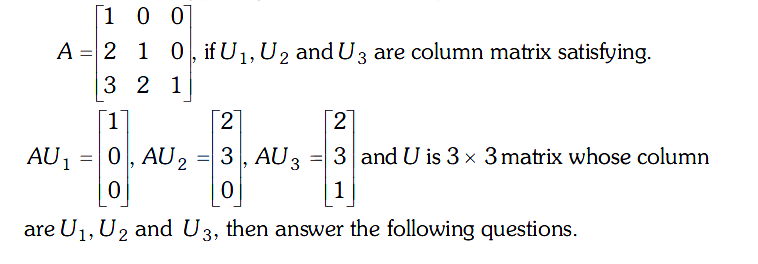
Question:
The value of \(|U|\) isJEE Advanced 2006 Medium - A block of mass \(0.18 \mathrm{~kg}\) is attached to a spring of force constant \(2 \mathrm{~N} / \mathrm{m}\). The coefficient of friction between the block and the floor is 0.1. Initially, the block is at rest and the spring is unstretched. An impulse is given to the block as shown in the figure. The block slides a distance of \(0.06 \mathrm{~m}\) and comes to rest for the first time. The initial velocity of the block in \(\mathrm{m} / \mathrm{s}\) is \(v=\frac{N}{10}\). Then, \(N\) is
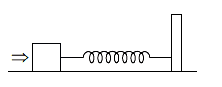 JEE Advanced 2011 Easy
 - Match each of the reactions given in Column I with the corresponding products(s) given in Column II.
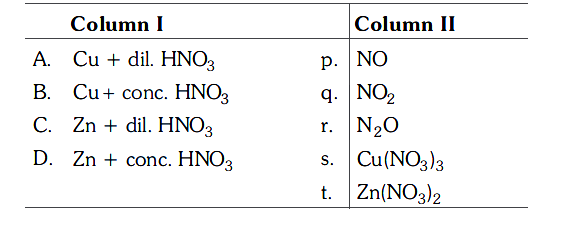 JEE Advanced 2009 Medium
 - Let \(f, g\) and \(h\) be real-valued functions defined on the interval \([0,1]\) by \(f(x)=e^{x^2}+e^{-x^2}, \quad g(x)=x e^{x^2}+e^{-x^2}\) and \(h(x)=x^2 e^{x^2}+e^{-x^2}\). If \(a, b\) and \(c\) denote respectively, the absolute maximum of \(f, g\) and \(h\) on \([0,1]\), thenJEE Advanced 2010 Easy