


JEE Advanced · Physics · 1. Math in Physics
Paragraph : If the measurement errors in all the independent quantities are known, then it is possible to determine the error in any dependent quantity. This is done by the use of series expansion and truncating the expansion at the first power of the error. For example, consider the relation . If the errors in , respectively, then
The series expansion for , to first power in . The relative errors in independent variables are always added. So the error in will be
The above derivation makes the assumption that \(\Delta r / x \ll 1, \Delta y / y < 1\). Therefore, the higher powers of these quantities are neglected.
Question : Consider the ratio \(r=\frac{(1-a)}{(1+a)}\) to be determined by measuring a dimensionless quantity a If the error in the measurement of a is \(\Delta a(\frac{\Delta a}{a}<<1)\), then what is the error \(\Delta r\) in determining \(r\) ?
- A
- B
- C
- D
Answer & Solution
Correct Answer
(B)
Step-by-step Solution
Detailed explanation
See the Complete Solution
Get step-by-step explanations for this and 2.5 Lakh+ more JEE, NEET & CET questions.
- Unlock all solutions
- Practice the full chapter
- Track accuracy across PYQs
4.8 rated on Google Play · 14,000+ reviews
More questions from Physics
- A steel wire of diameter 0.5 mm and Young's modulus \(2 \times 10^{11} Nm ^{-2}\) carries a load of mass M . The length of the wire with the load is 1.0 m . A vernier scale with 10 divisions is attached to the end of this wire. Next to the steel wire is a reference wire to which a main scale, of least count 1.0 mm , is attached. The 10 divisions of the vernier scale correspond to 9 divisions of the main scale. Initially, the zero of vernier scale coincides with the zero of main scale. If the load on the steel wire is increased by \(1.2 k g\), the vernier scale division which coincides with a main scale division is _____________ . Take \(g =10 m s^{-1}\) and \(\pi=3.2\).JEE Advanced 2018 Hard
- \(5.6 \mathrm{~L}\) of helium gas at STP is adiabatically compressed to \(0.7 \mathrm{~L}\). Taking the initial temperature to be \(T_1\), the work done in the process isJEE Advanced 2011 Hard
- Two large, identical water tanks, 1 and 2, kept on the top of a building of height \(H\), are filled with water up to height \(h\) in each tank. Both the tanks contain an identical hole of small radius on their sides, close to their bottom. A pipe of the same internal radius as that of the hole is connected to tank 2 , and the pipe ends at the ground level. When the water flows from the tanks 1 and 2 through the holes, the times taken to empty the tanks are \(t_1\) and \(t_2\), respectively. If \(H=\left(\frac{16}{9}\right) h\), then the ratio \(t_1 / t_2\) is _______ .JEE Advanced 2024 Medium
- An -particle (mass amu) and a singly charged Sulphur ion (mass amu) are initially at rest. They are accelerated through a potential and then allowed to pass into a region of uniform magnetic field which is normal to the velocities of the particles. Within this region, the -particle and the sulphur ion move in circular orbits of radii and , respectively. The ratio is __________ .JEE Advanced 2021 Easy
- A long straight wire carries a current, ampere. A semi-circular conducting rod is placed beside it on two conducting parallel rails of negligible resistance. Both the rails are parallel to the wire. The wire, the rod and the rails lie in the same horizontal plane, as shown in the figure. Two ends of the semi-circular rod are at distances and from the wire. At time , the rod starts moving on the rails with a speed (see the figure). A resistor and a capacitor are connected in series between the rails. At time , is uncharged. Which of the following statement(s) is (are) correct? [ SI units. Take ]
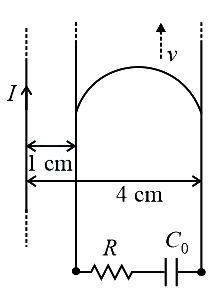 JEE Advanced 2021 Medium
 - A small object is placed at the centre of a large evacuated hollow spherical container. Assume the container is maintained at . At time , the temperature of the object is . The temperature of the object becomes at and at . Assume the object and the container to be ideal black bodies. The heat capacity of the object does not depend on temperature. The ratio _________ .JEE Advanced 2021 Medium
More PYQs from JEE Advanced
- Consider a hydrogen-like ionized atom with atomic number with a single electron. In the emission spectrum of this atom, the photon emitted in the transition has energy higher than the photon emitted in the transition. Given that the ionization energy of the hydrogen atom is , what is the value of ?JEE Advanced 2018 Medium
- Let \(z_k=\cos \left(\frac{2 k \pi}{10}\right)+i \sin \left(\frac{2 k \pi}{10}\right) ; k=1,2, \ldots, 9\)
List - I List - II (A) For each \(z_k\) there exists a \(z_j\) such \(z_k \cdot z_j=1\) (P) True (B) There exists a \(k \in\{1,2, \ldots, 9\}\) such that \(z_1 \cdot z=z_k\) has no solution z in the set of complex numbers (Q) False (C) \(\frac{\left|1-z_1\right|\left|1-z_2\right|\ldots\left|1-z_9\right|}{10}\) equals (R) 1 (D) \(1-\sum_{k=1}^9 \cos \left(\frac{2 k \pi}{10}\right)\) equals (S) 2 JEE Advanced 2014 Hard - Consider the lines given by
\[
L_1: x+3 y-5=0, L_2: 3 x-k y-1=0, L_3: 5 x+2 y-12=0
\]
Match the Statements/Expressions in Column I with the Statements/Expressions in Column II.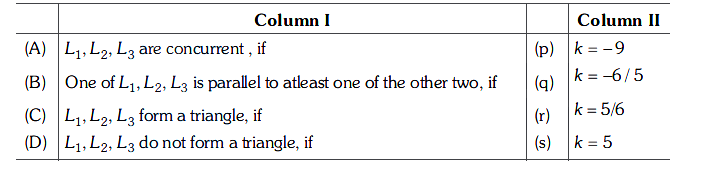 JEE Advanced 2008 Medium
 - \[
\text { Match the conics in Column I with the statements/expressions in Column II. }
\]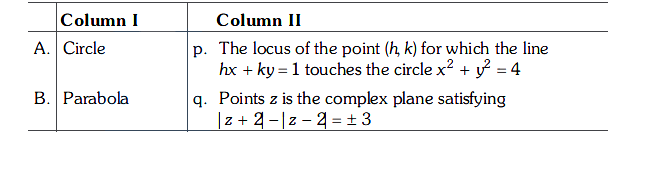
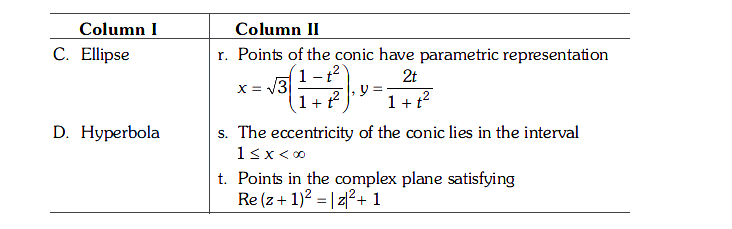 JEE Advanced 2009 Easy
 - Paragraph :
A wooden cylinder of diameter \(4 r\), height \(H\) and density \(\rho / 3\) is kept on a hole of diameter \(2 r\) of a tank, filled with liquid of density \(\rho\) as shown in the figure.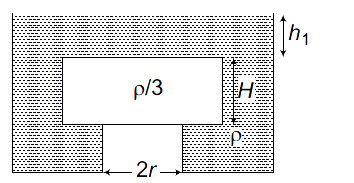
Question :
The block in the above question is maintained at the position by external means and the level of liquid is lowered. The height \(h_2\) when this external force reduces to zero is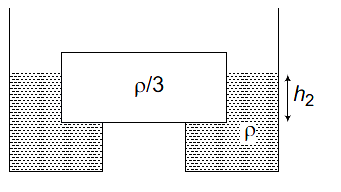 JEE Advanced 2006 Medium
 - At \(400 \mathrm{~K}\), the root mean square (rms) speed of a gas \(X\) (molecular weight \(=40\) ) is equal to the most probable speed of gas \(Y\) at \(60 \mathrm{~K}\). The molecular weight of the gas \(Y\) isJEE Advanced 2009 Easy