


JEE Advanced · Mathematics · 25. AOD
Let \(f, g\) and \(h\) be real-valued functions defined on the interval \([0,1]\) by \(f(x)=e^{x^2}+e^{-x^2}, \quad g(x)=x e^{x^2}+e^{-x^2}\) and \(h(x)=x^2 e^{x^2}+e^{-x^2}\). If \(a, b\) and \(c\) denote respectively, the absolute maximum of \(f, g\) and \(h\) on \([0,1]\), then
- A
\(a=b\) and \(c \neq b\)
- B
\(a=c\) and \(a \neq b\)
- C
\(a \neq b\) and \(c \neq b\)
- D
\(a=b=c\)
Answer & Solution
Correct Answer
(D)
\(a=b=c\)
Step-by-step Solution
Detailed explanation
Given function,
\[
\begin{aligned}
& f(x)=e^{x^2}+e^{-x^2}, \\
& g(x)=x e^{x^2}+e^{-x^2} \text { and } \\
& h(x)=x^2 e^{x^2}+e^{-x^2} \text { are } \quad \text { strictly }
\end{aligned}
\]
increasing on \([0,1]\). Hence, at \(x=1\), the given function attains absolute maximum all equal to \(e+\frac{1}{e}\).
\[
\Rightarrow \quad a=b=c
\]
\[
\begin{aligned}
& f(x)=e^{x^2}+e^{-x^2}, \\
& g(x)=x e^{x^2}+e^{-x^2} \text { and } \\
& h(x)=x^2 e^{x^2}+e^{-x^2} \text { are } \quad \text { strictly }
\end{aligned}
\]
increasing on \([0,1]\). Hence, at \(x=1\), the given function attains absolute maximum all equal to \(e+\frac{1}{e}\).
\[
\Rightarrow \quad a=b=c
\]
See the Complete Solution
Get step-by-step explanations for this and 2.5 Lakh+ more JEE, NEET & CET questions.
- Unlock all solutions
- Practice the full chapter
- Track accuracy across PYQs
4.8 rated on Google Play · 14,000+ reviews
More questions from Mathematics
- Let . Suppose and are the roots of the equation and and are the roots of the equation If and , then equalsJEE Advanced 2016 Medium
- Paragraph:
Read the following passage and answer the questions.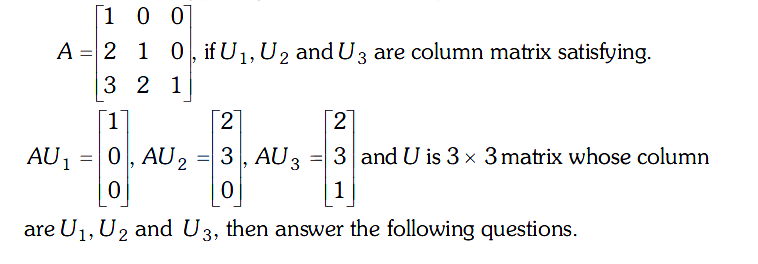
Question:
The value of \(|U|\) isJEE Advanced 2006 Medium - Let be positive integers such that . Then the number of such distinct arrangements is _________JEE Advanced 2014 Hard
- Let \(\omega=e^{i \pi / 3}\) and \(a, b, c, x, y, z\) be non-zero complex numbers such that \(a+b+c=x, a+b \omega+c \omega^2=y, a+b \omega^2+c \omega=z\).
Then, the value of \(\frac{|x|^2+|y|^2+|z|^2}{|a|^2+|b|^2+|c|^2}\) isJEE Advanced 2011 Hard - If \(a, b\) and \(c\) are the sides of a \(\triangle A B C\) such that \(x^2-2(a+b+c) x+3 \lambda(a b+b c+c a)=0\) has real roots, thenJEE Advanced 2006 Hard
- Consider the given data with frequency distribution Match each entry in List-I to the correct entries in List-II.
The correct option isList-I List-II The mean of the above data is The median of the above data is The mean deviation about the
mean of the above data isThe mean deviation about the
median of the above data isJEE Advanced 2023 Easy
More PYQs from JEE Advanced
- Let denote the set of all the terms of an infinite arithmetic progression with first term a and common difference If then equals ____JEE Advanced 2019 Medium
- In the scheme given below, the total number of intramolecular aldol condensation products formed from ' \(Y\) ' is
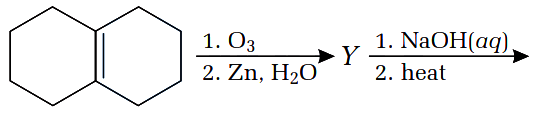 JEE Advanced 2010 Hard
 - The locus of the mid-point of the chord of contact of tangents drawn from points lying on the straight line \(4 x-\) \(5 y=20\) to the circle \(x^{2}+y^{2}=9\) isJEE Advanced 2012 Medium
- Paragraph I: In a Young's double slit experiment, each of the two slits A and B, as shown in the figure, are oscillating about their fixed center and with a mean separation of \(0.8 \mathrm{~mm}\). The distance between the slits at time \(t\) is given by \(d=(0.8+0.04 \sin \omega t) \mathrm{mm}\), where \(\omega=0.08 \mathrm{rad} \mathrm{s}^{-1}\). The distance of the screen from the slits is \(1 \mathrm{~m}\) and the wavelength of the light used to illuminate the slits is \(6000 Ã…\). The interference pattern on the screen changes with time, while the central bright fringe (zeroth fringe) remains fixed at point \(O\).
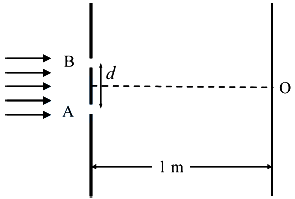
The \(8^{\text {th }}\) bright fringe above the point \(\mathrm{O}\) oscillates with time between two extreme positions. The separation between these two extreme positions, in micrometer \((\mu \mathrm{m})\), is ___________ .JEE Advanced 2024 Medium - Let \(\alpha\) and \(\beta\) be the real numbers such that \(\lim _{x \rightarrow 0} \frac{1}{x^3}\left(\frac{\alpha}{2} \int_0^x \frac{1}{1-t^2} d t+\beta x \cos x\right)=2\). Then the value of \(\alpha+\beta\) is _______JEE Advanced 2025 Hard
- Statement 1 For practical purposes, the earth is used as a reference at zero potential in electrical circuits.
and Statement 2 The electrical potential of a sphere of radius \(R\) with charge \(Q\) uniformly distributed on the surface is given by \(\frac{Q}{4 \pi \varepsilon_0 R}\).JEE Advanced 2008 Easy