


JEE Advanced · Chemistry · 21. p Block (G15-18)
Match each of the reactions given in Column I with the corresponding products(s) given in Column II.
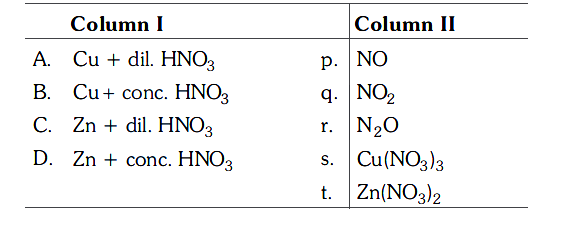
- A (A) p,q,t, (B) p,s,t, (C) r,s, (D) p
- B (A) p,q,s, (B) p,q,t, (C) r, (D) q
- C (A) p,q,s, (B) q,s,t, (C) r,s, (D) p
- D (A) p,q,t, (B) p,q,t, (C) r, (D) q
Answer & Solution
Correct Answer
(A) (A) p,q,t, (B) p,s,t, (C) r,s, (D) p
Step-by-step Solution
Detailed explanation
No Solution Available
See the Complete Solution
Get step-by-step explanations for this and 2.5 Lakh+ more JEE, NEET & CET questions.
- Unlock all solutions
- Practice the full chapter
- Track accuracy across PYQs
4.8 rated on Google Play · 14,000+ reviews
More questions from Chemistry
- Statement 1 There is a natural asymmetry between converting work to heat and converting heat to work.
Statement 2 No process is possible in which the sole result in the absorption of heat from a reservoir and its complete conversion into work.JEE Advanced 2008 Hard - Paragraph:
Carbon-14 is used to determine the age of organic material. The procedure is based on the formation of \({ }^{14} \mathrm{C}\) by neutron capture in the upper atmosphere.
\(
{ }_7^{14} \mathrm{~N}+{ }_0^1 n \longrightarrow{ }_6^{14} \mathrm{C}+{ }_1 n^1
\)
\({ }^{14} \mathrm{C}\) is absorbed by living organisms during photosynthesis. The \({ }^{14} \mathrm{C}\) content is constant in living organism once the plant or animal dies, the uptake of carbon dioxide by it ceases and the level of \({ }^{14} \mathrm{C}\) in the dead being, falls to the decay which \({ }^{14} \mathrm{C}\) undergoes.
\(
{ }_6^{14} \mathrm{C} \longrightarrow{ }_7^{14} \mathrm{~N}+\beta^{-}
\)
The half life period of \({ }^{14} \mathrm{C}\) is 5770 years. The decay constant \((\lambda)\) can be calculated by using the following formula \(\lambda=\frac{0.693}{t_{1 / 2}}\).
The comparison of the \(\beta^{-}\)activity of the dead matter with that of the carbon still in circulation enables measurement of the period of the isolation of the material from the living cycle. The method however, ceases to be accurate over periods longer than 30,000 years. The proportion of \({ }^{14} \mathrm{C}\) to \({ }^{12} \mathrm{C}\) in living matter is \(1: 10^{12}\).
Question:
What should be the age of fossil for meaningful determination of its age?JEE Advanced 2006 Easy - If the value of Avogadro number is and the value of Boltzmann constant is , then the number of significant digits in the calculated value of the universal gas constant isJEE Advanced 2014 Easy
- Paragraph:
Copper is the most noble of the first row transition metals and occurs in small deposits in several countries. Ores of copper include chalcanthite \(\left(\mathrm{CuSO}_4 \cdot 5 \mathrm{H}_2 \mathrm{O}\right)\), atacamite \(\left(\mathrm{Cu}_2 \mathrm{Cl}(\mathrm{OH})_3\right)\), cuprite \(\left(\mathrm{Cu}_2 \mathrm{O}\right)\), copper glance \(\left(\mathrm{Cu}_2 \mathrm{~S}\right)\) and malachite \(\left(\mathrm{Cu}_2(\mathrm{OH})_2 \mathrm{CO}_3\right)\). However, 80\% of the world copper production comes from the ore chalcopyrite \(\left(\mathrm{CuFeS}_2\right)\). The extraction of copper from chalcopyrite involves partial roasting, removal of iron and self-reduction.
Question:
In self-reduction, the reducing species isJEE Advanced 2010 Medium - The kinetic energy of an electron in the second Bohr orbit of a hydrogen atom is \(\left[a_{0}\right.\) is Bohr radius \(]\) :JEE Advanced 2012 Medium
- The correct statement about the following disaccharide is
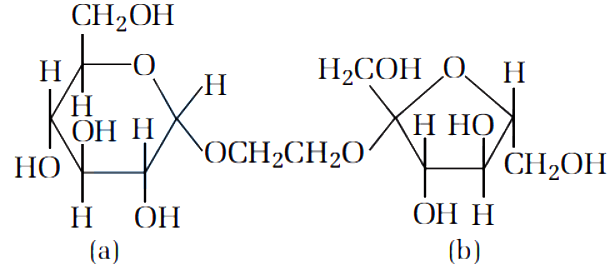 JEE Advanced 2010 Medium
More PYQs from JEE Advanced
- A boy is pushing a ring of mass \(2 \mathrm{~kg}\) and radius \(0.5 \mathrm{~m}\) with a stick as shown in the figure. The stick applies a force of \(2 \mathrm{~N}\) on the ring and rolls it without slipping with an acceleration of \(0.3 \mathrm{~m} / \mathrm{s}^2\). The coefficient of friction between the ground and the ring is large enough that rolling always occurs and the coefficient of friction between the stick and the ring is \(\frac{P}{10}\). The value of \(P\) is
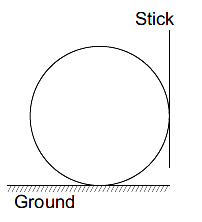 JEE Advanced 2011 Hard
 - Let the straight line \(x=b\) divide the area enclosed by \(y=(1-x)^2, y=0\) and \(x=0\) into two parts \(R_1(0 \leq x \leq b)\) and \(R_2(b \leq x \leq 1)\) such that \(R_1-R_2=\frac{1}{4}\). Then, \(b\) equals toJEE Advanced 2011 Medium
- Paragraph:
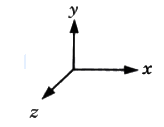
In a thin rectangular metallic strip a constant current \(I\) flows along the positive \(x\)-direction, as shown in the figure. The length, width and thickness of the strip are \(l, w\) and \(d\), respectively.
A uniform magnetic field \(\vec{B}\) is applied on the strip along the positive \(y\)-direction. Due to this, the charge carriers experience a net deflection along the \(z\)-direction. This results in accumulation of charge carriers on the surface \(P Q R S\) and appearance of equal and opposite charges on the face opposite to \(P Q R S\). A potential difference along the \(z\)-direction is thus developed. Charge accumulation continues until the magnetic force is balanced by the electric force. The current is assumed to be uniformly distributed on the cross section of the strip and carried by electrons.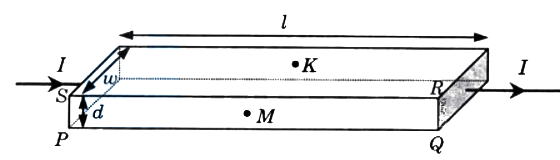
Question:
Consider two different metallic strips (\(1\) and \(2\)) of same dimensions (length \(l\), width \(w\) and thickness \(d\) ) with carrier densities \(n_{1}\) and \(n_{2}\), respectively. Strip \(1\) is placed in magnetic field \(B_{1}\) and strip \(2\) is placed in magnetic field \(B_{2}\), both along positive \(y\)-directions. Then \(V_{1}\) and \(V_{2}\) are the potential differences developed between \(K\) and \(M\) in strips \(1\) and \(2\), respectively. Assuming that the current \(I\) is the same for both the strips, the correct option(s) is(are)JEE Advanced 2015 Medium - The number of real solutions of the equation lying in the interval is____.
(Here, the inverse trigonometric functions assume values in
respectively.)JEE Advanced 2018 Hard - List-I contains various reaction sequences and List-II contains different phenolic compounds.
Match each entry in List-I with the appropriate entry in List-II and choose the correct option.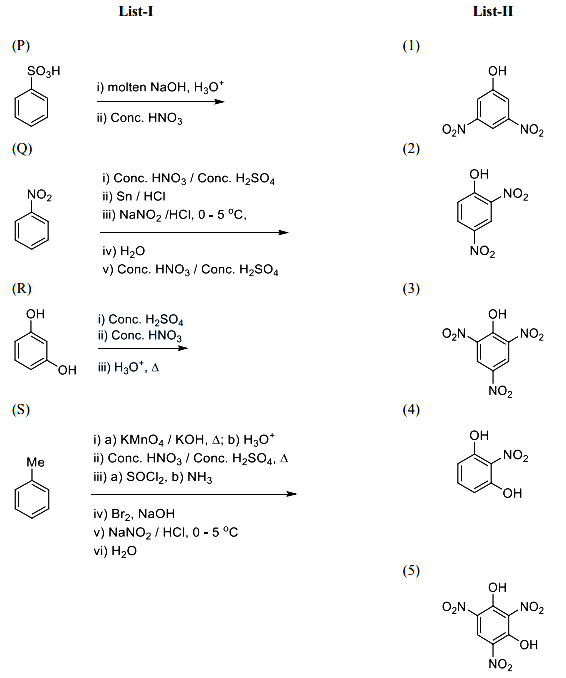 JEE Advanced 2024 Medium
 - Consider two straight lines, each of which is tangent to both the circle and the parabola . Let these lines intersect at the point . Consider the ellipse whose center is at the origin and whose semi-major axis is . If the length of the minor axis of this ellipse is , then the which of the following statement(s) is (are) TRUE?JEE Advanced 2018 Medium