


JEE Advanced · Chemistry · 22. d & f Block
The pair(s) of diamagnetic ions is(are)
- A \(\mathrm{La}^{3+}, \mathrm{Ce}^{4+}\)
- B \(\mathrm{Yb}^{2+}, \mathrm{Lu}^{3+}\)
- C \(\mathrm{La}^{2+}, \mathrm{Ce}^{3+}\)
- D \(\mathrm{Yb}^{3+}, \mathrm{Lu}^{2+}\)
Answer & Solution
Correct Answer
(B) \(\mathrm{Yb}^{2+}, \mathrm{Lu}^{3+}\)
Step-by-step Solution
Detailed explanation
\(\mathrm{La}^{+3} \rightarrow\left[{ }_{54} \mathrm{Xe}\right] 4 \mathrm{f}^0 \text { -diamagnetic } \)
\( \mathrm{Yb}^{+2} \rightarrow\left[{ }_{54} \mathrm{Xe}\right] 4 \mathrm{f}^{14} \text { -diamagnetic } \)
\( \mathrm{Lu}^{+3} \rightarrow\left[{ }_{54} \mathrm{Xe}\right] 4 \mathrm{f}^{14} \text { -diamagnetic } \)
\( \mathrm{La}^{+2} \rightarrow\left[{ }_{54} \mathrm{Xe}\right] 5 \mathrm{~d}^1 \text { -paramagnetic } \)
\( \mathrm{Ce}^{+4} \rightarrow\left[{ }_{54} \mathrm{Xe}\right] 4 \mathrm{f}^0 \text { -diamagnetic } \)
\( \mathrm{Ce}^{+3} \rightarrow\left[{ }_{54} \mathrm{Xe}\right] 4 \mathrm{f}^1 \text { -paramagnetic } \)
\( \mathrm{Yb}^{+3} \rightarrow\left[{ }_{54} \mathrm{Xe}\right] 4 \mathrm{f}^{13} \text { -paramagnetic } \)
\( \mathrm{Lu}^{+2} \rightarrow\left[{ }_{54} \mathrm{Xe}\right] 4 \mathrm{f}^{14} 5 \mathrm{~d}^1 \text { -paramagnetic}\)
\( \mathrm{Yb}^{+2} \rightarrow\left[{ }_{54} \mathrm{Xe}\right] 4 \mathrm{f}^{14} \text { -diamagnetic } \)
\( \mathrm{Lu}^{+3} \rightarrow\left[{ }_{54} \mathrm{Xe}\right] 4 \mathrm{f}^{14} \text { -diamagnetic } \)
\( \mathrm{La}^{+2} \rightarrow\left[{ }_{54} \mathrm{Xe}\right] 5 \mathrm{~d}^1 \text { -paramagnetic } \)
\( \mathrm{Ce}^{+4} \rightarrow\left[{ }_{54} \mathrm{Xe}\right] 4 \mathrm{f}^0 \text { -diamagnetic } \)
\( \mathrm{Ce}^{+3} \rightarrow\left[{ }_{54} \mathrm{Xe}\right] 4 \mathrm{f}^1 \text { -paramagnetic } \)
\( \mathrm{Yb}^{+3} \rightarrow\left[{ }_{54} \mathrm{Xe}\right] 4 \mathrm{f}^{13} \text { -paramagnetic } \)
\( \mathrm{Lu}^{+2} \rightarrow\left[{ }_{54} \mathrm{Xe}\right] 4 \mathrm{f}^{14} 5 \mathrm{~d}^1 \text { -paramagnetic}\)
See the Complete Solution
Get step-by-step explanations for this and 2.5 Lakh+ more JEE, NEET & CET questions.
- Unlock all solutions
- Practice the full chapter
- Track accuracy across PYQs
4.8 rated on Google Play · 14,000+ reviews
More questions from Chemistry
- On dissolving of a non-volatile non-ionic solute to of benzene, its vapor pressure decreases from to The depression of freezing point of benzene (in ) upon addition of the solute is _______
(Given data: Molar mass and the molal freezing point depression constant of benzene are and respectively)JEE Advanced 2019 Hard - The ammonia is prepared by treating ammonium sulphate with calcium hydroxide is completely used by to form a stable coordination compound. Assume that, both the reactions are completed. If of ammonium sulphate and of are used in the preparation, the combined weight (in grams) of gypsum and the nickel ammonia coordination compound produced is ____. Atomic weights in :JEE Advanced 2018 Medium
- Choose the correct statement(s) among the following:JEE Advanced 2020 Medium
- Among the following, intensive property is (properties are)JEE Advanced 2010 Medium
- The total number of distinct naturally occurring amino acids obtained by complete acidic hydrolysis of the peptide shown below is
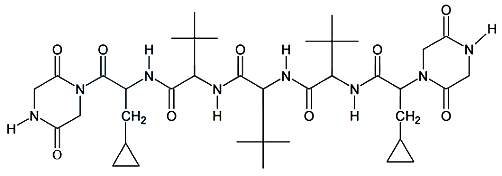 JEE Advanced 2014 Medium
 - If the freezing point of a 0.01 molal aqueous solution of a cobalt (III) chloride-ammonia complex (which behaves as a strong electrolyte) is , the number of chloride(s) in the coordination sphere of the complex isJEE Advanced 2015 Medium
More PYQs from JEE Advanced
- Two vehicles, each moving with speed u on the same horizontal straight road, are approaching each other. Wind blows along the road with velocity w. One of these vehicles blows a whistle of frequency f1. An observer in the other vehicle hears the frequency of the whistle to be f2. The speed of sound in still air is V. The correct statement (s) is (are) :JEE Advanced 2013 Medium
- A silver sphere of radius \(1 \mathrm{~cm}\) and work function \(4.7 \mathrm{eV}\) is suspended from an insulating thread in free-space. It is under continuous illumination of \(200 \mathrm{~nm}\) wavelength light. As photoelectrons are emitted, the sphere gets charged and acquires a potential. The maximum number of photoelectrons emitted from the sphere is \(A \times 10^Z\) (where \(1 < A < 10\) ). The value of \(Z\) isJEE Advanced 2011 Medium
- Two equilateral-triangular prisms \(\mathrm{P}_1\) and \(\mathrm{P}_2\) are kept with their sides parallel to each other, in vacuum, as shown in the figure. A light ray enters prism \(P_1\) at an angle of incidence \(\theta\) such that the outgoing ray undergoes minimum deviation in prism \(P_2\). If the respective refractive indices of \(\mathrm{P}_1\) and \(\mathrm{P}_2\) are \(\sqrt{\frac{3}{2}}\) and \(\sqrt{3}\), then \(\theta=\sin ^{-1}\left[\sqrt{\frac{3}{2}} \sin \left(\frac{\pi}{\beta}\right)\right]\), where the value of \(\beta\) is _______ .
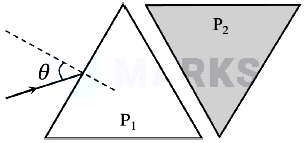 JEE Advanced 2024 Medium
 - For positive integer , define . Then, the value of is equal toJEE Advanced 2022 Hard
- A spherical portion has been removed from a solid sphere having a charge distributed uniformly in its volume as shown in the figure. The electric field inside the emptied space is
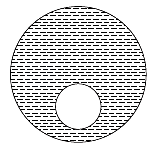 JEE Advanced 2007 Hard
 - Let \(P=\{\theta: \sin \theta-\cos \theta=\sqrt{2} \cos \theta\}\) and \(Q=\{\theta: \sin \theta+\cos \theta=\sqrt{2} \sin \theta\}\) be two sets. Then,JEE Advanced 2011 Easy