


JEE Advanced · Physics · 16. Waves & Sound
Consider a system of three connected strings, \(S_1, S_2\) and \(S_3\) with uniform linear mass densities \(\mu \mathrm{kg} / \mathrm{m}\), \(4 \mu \mathrm{~kg} / \mathrm{m}\) and \(16 \mu \mathrm{~kg} / \mathrm{m}\), respectively, as shown in the figure. \(S_1\) and \(S_2\) are connected at the point \(P\), whereas \(S_2\) and \(S_3\) are connected at the point \(Q\), and the other end of \(S_3\) is connected to a wall. A wave generator O is connected to the free end of \(S_1\). The wave from the generator is represented by \(y=y_0\) \(\cos (\omega t-k x) \mathrm{cm}\), where \(y_0, \omega\) and \(k\) are constants of appropriate dimensions. Which of the following statements is/are correct:

- A When the wave reflects from \(P\) for the first time, the reflected wave is represented by \(y=\alpha_1 \mathrm{y}_0 \cos (\omega t+k x+\pi) \mathrm{cm}\), where \(\alpha_1\) is a positive constant.
- B When the wave transmits through \(P\) for the first time, the transmitted wave is represented by \(y=\alpha_2 \mathrm{y}_0 \cos (\omega t-k x) \mathrm{cm}\), where \(\alpha_2\) is a positive constant.
- C When the wave reflects from \(Q\) for the first time, the reflected wave is represented by \(y=\alpha_3 y_0 \cos (\omega t-k x+\pi) \mathrm{cm}\), where \(\alpha_3\) is a positive constant.
- D When the wave transmits through \(Q\) for the first time, the transmitted wave is represented by \(y=\alpha_4 y_0 \cos (\omega t-4 k x) \mathrm{cm}\), where \(\alpha_4\) is a positive constant.
Answer & Solution
Correct Answer
(D) When the wave transmits through \(Q\) for the first time, the transmitted wave is represented by \(y=\alpha_4 y_0 \cos (\omega t-4 k x) \mathrm{cm}\), where \(\alpha_4\) is a positive constant.
Step-by-step Solution
Detailed explanation
(A)

\(y_1=y_0 \cos (\omega t-k x)\)
when wave going from Rarer to Denser,
\(\begin{aligned} & y_r=A_r \cos (\omega t+k x+\pi) \\ & y_r=a_1 y_0 \cos (\omega t+k x+\pi)\end{aligned}\)
option (A) correct
(B) For transmitted from point P
\(\begin{aligned} & \mathrm{y}_{\mathrm{t}}=\mathrm{A}_{\mathrm{t}} \cos \left[\omega \mathrm{t}-\mathrm{k}_1 \mathrm{x}\right] \\ & \frac{\mathrm{k}_1}{\mathrm{k}}=\sqrt{\frac{\mu_1}{\mu}}=\frac{\mathrm{k}_1}{\mathrm{k}}=\sqrt{\frac{4 \mu}{\mu}} \\ & \mathrm{k}_1=2 \mathrm{k} \\ & \mathrm{y}_{\mathrm{t}}=\mathrm{a}_2 \mathrm{y}_0 \cos [\omega \mathrm{t}-2 \mathrm{kx}]\end{aligned}\)
option (B) incorrect
(C) when reflected from Q
\(\begin{aligned} & y_i=a_2 y_0 \cos [\omega t-2 k x] \\ & y_r=a_3 y_0 \cos [\omega t+2 k x+\pi]\end{aligned}\)
option (C) incorrect
(D) when transmitted from Q
\(\begin{aligned} & y_{\mathrm{t}}=a_4 y_0 \cos \left[\omega \mathrm{t}=k_2 \mathrm{x}\right] \\ & \frac{k_2}{2 \mathrm{k}}=\sqrt{\frac{16 \mu}{4 \mu}} \Rightarrow k_2=4 \mathrm{k} \\ & y_{\mathrm{t}}=a_4 y_0 \cos [\omega \mathrm{t}-4 \mathrm{kx}]\end{aligned}\)
option (D) correct
\(y_1=y_0 \cos (\omega t-k x)\)
when wave going from Rarer to Denser,
\(\begin{aligned} & y_r=A_r \cos (\omega t+k x+\pi) \\ & y_r=a_1 y_0 \cos (\omega t+k x+\pi)\end{aligned}\)
option (A) correct
(B) For transmitted from point P
\(\begin{aligned} & \mathrm{y}_{\mathrm{t}}=\mathrm{A}_{\mathrm{t}} \cos \left[\omega \mathrm{t}-\mathrm{k}_1 \mathrm{x}\right] \\ & \frac{\mathrm{k}_1}{\mathrm{k}}=\sqrt{\frac{\mu_1}{\mu}}=\frac{\mathrm{k}_1}{\mathrm{k}}=\sqrt{\frac{4 \mu}{\mu}} \\ & \mathrm{k}_1=2 \mathrm{k} \\ & \mathrm{y}_{\mathrm{t}}=\mathrm{a}_2 \mathrm{y}_0 \cos [\omega \mathrm{t}-2 \mathrm{kx}]\end{aligned}\)
option (B) incorrect
(C) when reflected from Q
\(\begin{aligned} & y_i=a_2 y_0 \cos [\omega t-2 k x] \\ & y_r=a_3 y_0 \cos [\omega t+2 k x+\pi]\end{aligned}\)
option (C) incorrect
(D) when transmitted from Q
\(\begin{aligned} & y_{\mathrm{t}}=a_4 y_0 \cos \left[\omega \mathrm{t}=k_2 \mathrm{x}\right] \\ & \frac{k_2}{2 \mathrm{k}}=\sqrt{\frac{16 \mu}{4 \mu}} \Rightarrow k_2=4 \mathrm{k} \\ & y_{\mathrm{t}}=a_4 y_0 \cos [\omega \mathrm{t}-4 \mathrm{kx}]\end{aligned}\)
option (D) correct
See the Complete Solution
Get step-by-step explanations for this and 2.5 Lakh+ more JEE, NEET & CET questions.
- Unlock all solutions
- Practice the full chapter
- Track accuracy across PYQs
4.8 rated on Google Play · 14,000+ reviews
More questions from Physics
- A string of length and mass is under tension . When the string vibrates, two successive harmonics are found to occur at frequencies and . The value of tension is _____ newton.JEE Advanced 2023 Easy
- If the wavelength of the \(n^{\text {th }}\) line of Lyman series is equal to the de-Broglie wavelength of electron in initial orbit of a hydrogen like element \((Z=11)\). Find the value of \(n\).JEE Advanced 2006 Medium
- A piece of wire is bent in the shape of a parabola \(y=k x^2\) (y-axis vertical) with a bead of mass \(m\) on it. The bead can slide on the wire without friction. It stays at the lowest point of the parabola when the wire is at rest. The wire is now accelerated parallel to the \(x\)-axis with the constant acceleration \(a\). The distance of the new equilibrium position of the bead, where the bead can stays at rest with respect to the wire, from the \(y\)-axis isJEE Advanced 2009 Medium
- When water is filled carefully in a glass, one can fill it to a height above the rim of the glass due to the surface tension of water. To calculate just before water starts flowing, model the shape of the water above the rim as a disc of thickness having semicircular edges, as shown schematically in the figure. When the pressure of water at the bottom of this disc exceeds what can be withstood due to the surface tension, the water surface breaks near the rim and water starts flowing from there. If the density of water, its surface tension and the acceleration due to gravity are and respectively, the value of (in )is ________.
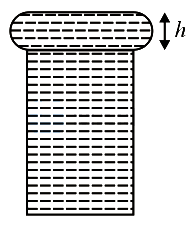 JEE Advanced 2020 Hard
 - Two particles of mass \(m\) each are tied at the ends of a light string of length \(2 a\). The whole system is kept on a frictionless horizontal surface with the string held tight so that each mass is at a distance \(a\) from the centre \(P\) (as shown in the figure). Now, the mid-point of the string is pulled vertically upwards with a small but constant force \(F\). As a result, the particles move towards each other on the surface.
The magnitude of acceleration, when the separation between them becomes \(2 x\), is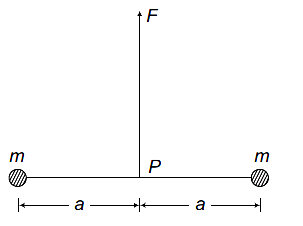 JEE Advanced 2007 Hard
 - Charges Q, 2Q and 4Q are uniformly distributed in three dielectric solid spheres 1, 2 and 3 of radii R/2, R and 2R respectively, as shown in the figure. If magnitudes of the electric fields at point P at a distance R from the centre of spheres 1, 2 and 3 are and respectively, then
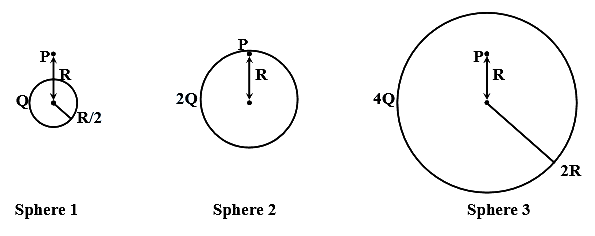 JEE Advanced 2014 Easy
More PYQs from JEE Advanced
- Two non-conducting solid spheres of radii and , having uniform volume charge densities and , respectively, touch each other. The net electric field at a distance from the centre of the smaller sphere, along the line joining the centres of the spheres, is zero. The ratio can beJEE Advanced 2013 Hard
- The number of real solutions of the equation lying in the interval is____.
(Here, the inverse trigonometric functions assume values in
respectively.)JEE Advanced 2018 Hard - A small object is placed 50 cm to the left of thin convex lens of focal length 30 cm. A convex spherical mirror of radius of curvature 100 cm is placed to the right of the lens at a distance of 50 cm. The mirror is tilted such that the axis of the mirror is at an angle to the axis of the lens, as shown in the figure. If the origin of the coordinate system is taken to be at the centre of the lens, the coordinates (in cm) of the point (x, y) at which the image is formed are:
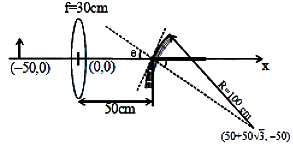 JEE Advanced 2016 Hard
 - A ball of mass \(0.2 \mathrm{~kg}\) rests on a vertical post of height \(5 \mathrm{~m}\). A bullet of mass \(0.01 \mathrm{~kg}\), travelling with a velocity \(v \mathrm{~m} / \mathrm{s}\) in a horizontal direction, hits the centre of the ball. After the collision, the ball and bullet travel independently. The ball hits the ground at a distance of \(20 \mathrm{~m}\) and the bullet at a distance of \(100 \mathrm{~m}\) from the foot of the post. The initial velocity \(v\) of the bullet is
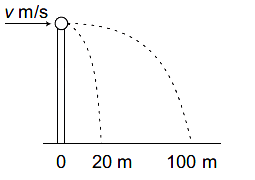 JEE Advanced 2011 Medium
 - A ball of mass \((m) 0.5 \mathrm{~kg}\) is attached to the end of a string having length \((L) 0.5 \mathrm{~m}\). The ball is rotated on a horizontal circular path about vertical axis. The maximum tension that the string can bear is \(324 \mathrm{~N}\). The maximum possible value of angular velocity of ball (in rad/s) is
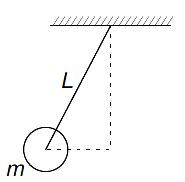 JEE Advanced 2011 Easy
 - Paragraph:
The figure shows a surface \(X Y\) separating two transparent media, medium-1 and medium-2. The lines \(a b\) and \(c d\) represent wavefronts of a light wave travelling in medium-1 and incident on \(X Y\). The lines ef and \(g h\) represent wavefronts of the light wave in medium-2 after refraction.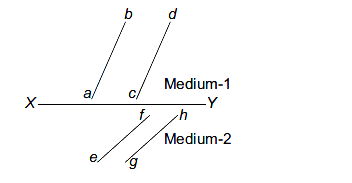
Question:
Speed of light isJEE Advanced 2007 Easy