


JEE Advanced · Physics · 27. Atomic Physics
If the wavelength of the \(n^{\text {th }}\) line of Lyman series is equal to the de-Broglie wavelength of electron in initial orbit of a hydrogen like element \((Z=11)\). Find the value of \(n\).
- A 20
- B 21
- C 22
- D 24
Answer & Solution
Correct Answer
(D) 24
Step-by-step Solution
Detailed explanation
\(n^{\text {th }}\) line of Lyman series means transition from \((n+1)\) th state to first state.
\(\frac{1}{\lambda}=R Z^2\left[1-\frac{1}{(n+1)^2}\right] \)
\( \text { de-Broglie wavelength, } \quad \lambda=\frac{h}{m v}=\frac{h r}{m v r}=\) \(\frac{(2 \pi)(h r)}{(n+1) h}=\frac{2 \pi r}{(n+1)} \)
\( \frac{1}{\lambda}=\frac{(n+1)}{2 \pi r}\)
or
Equating (i) and (ii), we get
\(
\left(\frac{n+1}{2 \pi r}\right)=R Z^2\left[\frac{n(n+2)}{(n+1)^2}\right]
\)
Now, as
\(
\begin{aligned}
& r \propto \frac{n^2}{Z} \\
& r=\frac{(n+1)^2}{11} r_0
\end{aligned}
\)
\(
\therefore \quad r=\frac{(n+1)^2}{11} r_0
\)
Substituting in equations (iii), we get
\(
\frac{11}{2 \pi r_0}=\frac{R(11)^2(n)(n+2)}{(n+1)}
\)
or
\(
(n+1)=\left(1.09 \times 10^7\right)(11)(2 \pi) ~\times\) \(\left(0.529 \times 10^{-10}\right)\left(n^2+2 n\right)
\)
Solving this equation we get, \(n=24\)
\(\frac{1}{\lambda}=R Z^2\left[1-\frac{1}{(n+1)^2}\right] \)
\( \text { de-Broglie wavelength, } \quad \lambda=\frac{h}{m v}=\frac{h r}{m v r}=\) \(\frac{(2 \pi)(h r)}{(n+1) h}=\frac{2 \pi r}{(n+1)} \)
\( \frac{1}{\lambda}=\frac{(n+1)}{2 \pi r}\)
or
Equating (i) and (ii), we get
\(
\left(\frac{n+1}{2 \pi r}\right)=R Z^2\left[\frac{n(n+2)}{(n+1)^2}\right]
\)
Now, as
\(
\begin{aligned}
& r \propto \frac{n^2}{Z} \\
& r=\frac{(n+1)^2}{11} r_0
\end{aligned}
\)
\(
\therefore \quad r=\frac{(n+1)^2}{11} r_0
\)
Substituting in equations (iii), we get
\(
\frac{11}{2 \pi r_0}=\frac{R(11)^2(n)(n+2)}{(n+1)}
\)
or
\(
(n+1)=\left(1.09 \times 10^7\right)(11)(2 \pi) ~\times\) \(\left(0.529 \times 10^{-10}\right)\left(n^2+2 n\right)
\)
Solving this equation we get, \(n=24\)
See the Complete Solution
Get step-by-step explanations for this and 2.5 Lakh+ more JEE, NEET & CET questions.
- Unlock all solutions
- Practice the full chapter
- Track accuracy across PYQs
4.8 rated on Google Play · 14,000+ reviews
More questions from Physics
- A circuit is connected as shown in the figure with the switch \(S\) open. When the switch is closed, the total amount of charge that flows from \(Y\) to \(X\) is
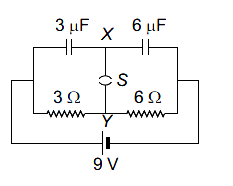 JEE Advanced 2007 Medium
 - Water is filled up to a height \(h\) in a beaker of radius \(R\) as shown in the figure. The density of water is \(\rho\), the surface tension of water is \(T\) and the atmospheric pressure is \(p_0\). Consider a vertical section \(A B C D\) of the water column through a diameter of the beaker. The force on water on one side of this section by water on the other side of this section has magnitude.
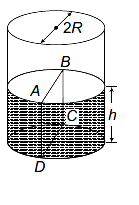 JEE Advanced 2007 Hard
 - Two co-axial conducting cylinders of same length \(\ell\) with radii \(\sqrt{2} R\) and \(2 R\) are kept, as shown in Fig. 1. The charge on the inner cylinder is \(Q\) and the outer cylinder is grounded. The annular region between the cylinders is filled with a material of dielectric constant \(\kappa=5\). Consider an imaginary plane of the same length \(\ell\) at a distance R from the common axis of the cylinders. This plane is parallel to the axis of the cylinders. The cross-sectional view of this arrangement is shown in Fig. 2. Ignoring edge effects, the flux of the electric field through the plane is ( \(\epsilon_0\) is the permittivity of free space):
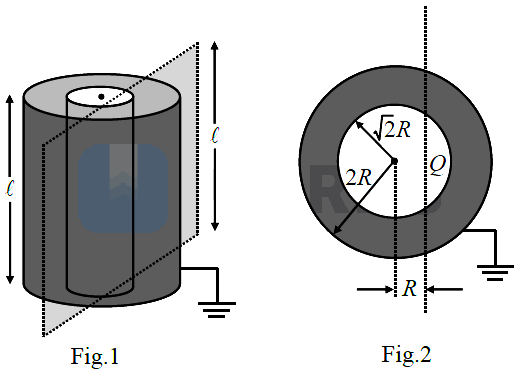 JEE Advanced 2025 Hard
 - A thin stiff insulated metal wire is bent into a circular loop with its two ends extending tangentially from the same point of the loop. The wire loop has mass \(m\) and radius \(r\) and it is in a uniform vertical magnetic field \(B_0\), as shown in the figure. Initially, it hangs vertically downwards, because of acceleration due to gravity \(g\), on two conducting supports at \(\mathrm{P}\) and \(\mathrm{Q}\). When a current \(I\) is passed through the loop, the loop turns about the line \(\mathrm{PQ}\) by an angle \(\theta\) given by
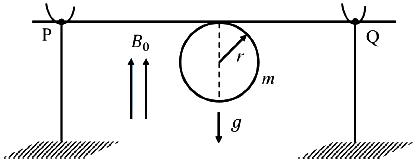 JEE Advanced 2024 Medium
 - For the circuit shown in the figure
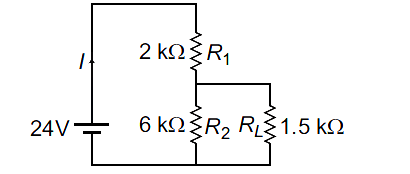 JEE Advanced 2009 Hard
 - The figure shows a system consisting of (i) a ring of outer radius \(3 R\) rolling clockwise without slipping on a horizontal surface with angular speed \(\omega\) and (ii) an inner disc of radius \(2 R\) rotating anti-clockwise with angular speed \(\omega / 2\). The ring and disc are separated by frictionless ball bearings. The point \(P\) on the inner disc is at a distance \(R\) from the origin, where \(O P\) makes an angle of \(30^{\circ}\) with the horizontal. Then with respect to the horizontal surface,
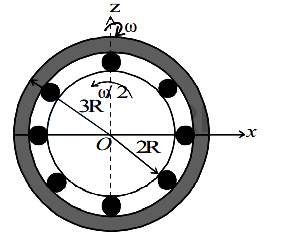 JEE Advanced 2012 Medium
More PYQs from JEE Advanced
- Let and be two ellipse whose centers are at the origin. The major axes of lie along the x - axis and the y - axis, respectively. Let S be the circle The straight line touches the curves and at and respectively. Suppose that If and are the eccentricities of and respectively, then the correct expression(s) is(are)JEE Advanced 2015 Medium
- In the balanced condition, the values of the resistances of the four arms of a Wheatstone bridge are shown in the figure below. The resistance has temperature coefficient . If the temperature of is increased by the voltage developed between and will be __________ volt.
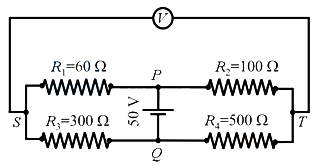 JEE Advanced 2020 Medium
 - A particle of mass \(m\) is moving in a circular orbit under the influence of the central force \(F(r)=-k r\), corresponding to the potential energy \(V(r)=k r^2 / 2\), where \(k\) is a positive force constant and \(r\) is the radial distance from the origin. According to the Bohr's quantization rule, the angular momentum of the particle is given by \(L=n \hbar\), where \(\hbar=h /(2 \pi), h\) is the Planck's constant, and \(n\) a positive integer. If \(v\) and \(E\) are the speed and total energy of the particle, respectively, then which of the following expression(s) is(are) correct?JEE Advanced 2024 Medium
- Geometrical shapes of the complexes formed by the reaction of \(\mathrm{Ni}^{2+}\) with \(\mathrm{Cl}^{-}\), \(\mathrm{CN}^{-}\)and \(\mathrm{H}_2 \mathrm{O}\), respectively, areJEE Advanced 2011 Easy
- Paragraph:
A point charge \(Q\) is moving in a circular orbit of radius \(R\) in the \(x-y\) plane with an angular velocity \(\omega .\) This can be considered as equivalent to a loop carrying a steady current \(\frac{Q \omega}{2 \pi}\). A uniform magnetic field along the positive \(z\)-axis is now switched on, which increases at a constant rate from 0 to \(B\) in one second. Assume that the radius of the orbit remains constant. The application of the magnetic field induces an emf in the orbit. The induced emf is defined as the work done by an induced electric field in moving a unit positive charge around a closed loop. It is known that, for an orbiting charge, the magnetic dipole moment is proportional to the angular momentum with a proportionality constant \(\gamma\).
Question:
The change in the magnetic dipole moment associated with the orbit, at the end of the time interval of the magnetic field change, isJEE Advanced 2013 Medium - The number of hexagonal faces that are present in a truncated octahedron isJEE Advanced 2011 Hard