


JEE Advanced · Physics · 7. COM & Collisions
A ball of mass \(0.2 \mathrm{~kg}\) rests on a vertical post of height \(5 \mathrm{~m}\). A bullet of mass \(0.01 \mathrm{~kg}\), travelling with a velocity \(v \mathrm{~m} / \mathrm{s}\) in a horizontal direction, hits the centre of the ball. After the collision, the ball and bullet travel independently. The ball hits the ground at a distance of \(20 \mathrm{~m}\) and the bullet at a distance of \(100 \mathrm{~m}\) from the foot of the post. The initial velocity \(v\) of the bullet is
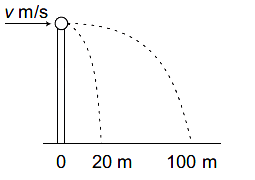
- A \(250 \mathrm{~m} / \mathrm{s}\)
- B \(250 \sqrt{2} \mathrm{~m} / \mathrm{s}\)
- C \(400 \mathrm{~m} / \mathrm{s}\)
- D \(500 \mathrm{~m} / \mathrm{s}\)
Answer & Solution
Correct Answer
(D) \(500 \mathrm{~m} / \mathrm{s}\)
Step-by-step Solution
Detailed explanation
Time taken by the bullet and ball to strike the ground is
\(
t=\sqrt{\frac{2 h}{g}}=\sqrt{\frac{2 \times 5}{10}}=1 \mathrm{~s}
\)
Let \(v_1\) and \(v_2\) are the velocities of ball and bullet after collision.
Then applying
We have, \(20=v_1 \times 1\)
or \(v_1=20 \mathrm{~ms}^{-1}\)
\(
100=v_2 \times 1 \text { or } v_2=100 \mathrm{~m} / \mathrm{s}^{-1}
\)
Now, from conservation of linear momentum before and after collision we have,
\(0.01 v=(0.2 \times 20)+(0.01 \times 100)\)
On solving, we get
\(
v=500 \mathrm{~ms}^{-1}
\)
\(\therefore\) Correct answer is (d).
Analysis of Question
Question is moderately lengthy from calculation point of view, otherwise it is simple.
\(
t=\sqrt{\frac{2 h}{g}}=\sqrt{\frac{2 \times 5}{10}}=1 \mathrm{~s}
\)
Let \(v_1\) and \(v_2\) are the velocities of ball and bullet after collision.
Then applying
We have, \(20=v_1 \times 1\)
or \(v_1=20 \mathrm{~ms}^{-1}\)
\(
100=v_2 \times 1 \text { or } v_2=100 \mathrm{~m} / \mathrm{s}^{-1}
\)
Now, from conservation of linear momentum before and after collision we have,
\(0.01 v=(0.2 \times 20)+(0.01 \times 100)\)
On solving, we get
\(
v=500 \mathrm{~ms}^{-1}
\)
\(\therefore\) Correct answer is (d).
Analysis of Question
Question is moderately lengthy from calculation point of view, otherwise it is simple.
See the Complete Solution
Get step-by-step explanations for this and 2.5 Lakh+ more JEE, NEET & CET questions.
- Unlock all solutions
- Practice the full chapter
- Track accuracy across PYQs
4.8 rated on Google Play · 14,000+ reviews
More questions from Physics
- Paragraph:
When a particle is restricted to move along \(x\)-axis between \(x=0\) and \(x=a\), where \(a\) is of nanometer dimension, its energy can take only certain specific values. The allowed energies of the particle moving in such a restricted region, correspond to the formation of standing waves with nodes at its ends \(x=0\) and \(x=a\). The wavelength of this standing wave is related to the liner momentum \(p\) of the particle according to the de Broglie relation. The energy of the particle of mass \(m\) is related to its linear momentum as \(E=\frac{p^2}{2 m}\). Thus, the energy of the particle can be denoted by a quantum number \(n\) taking values \(1,2,3, \ldots(n=1\), called the ground state) corresponding to the number of loops in the standing wave.
Use the model described above to answer the following three questions for a particle moving in the line \(x=0\) to \(x=a\) [Take \(h=6.6 \times 10^{-34} \mathrm{Js}\) and \(e=1.6 \times 10^{-19} \mathrm{C}\) ]
Question:
The allowed energy for the particle for a particular value of \(n\) is proportional toJEE Advanced 2009 Medium - Consider an circuit, with inductance and capacitance , kept on a plane. The area of the circuit is . It is placed in a constant magnetic field of strength which is perpendicular to the plane of the circuit. At time , the magnetic field strength starts increasing linearly as with . The maximum magnitude of the current in the circuit is____.JEE Advanced 2022 Medium
- An ideal gas is undergoing a cyclic thermodynamic process in different ways as shown in the corresponding P-V diagrams in column 3 of the table. Consider only the path from state 1 to state 2. W denotes the corresponding work done on the system. The equations and plots in the table have standard notations as used in thermodynamic process. Here is the ratio of heat capacities at constant pressure and constant volume. The number of moles in the gas in n.
Which one of the following options correctly represents a thermodynamic process that is used as a correction in the determination of the speed of sound in ideal gas?Column – 1 Column – 2 Column – 3 (I) \(W_{1 \rightarrow 2}=\) \(\frac{1}{\gamma-1}\left(P_2 V_2-P_1 V_1\right)\) (i) Isothermal (P) 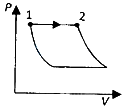
(II) \(W_{1 \rightarrow 2}=\) \(-P V_2+P V_1\) (ii) Isochoric (Q) 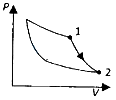
(III) \(W_{1 \rightarrow 2}=0\) (iii) Isobaric (R) 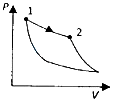
(IV) \(W_{1 \rightarrow 2}=\)\(-n R T \ln \left(\frac{V_2}{V_1}\right)\) (iv) Adiabatic (S) 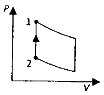 JEE Advanced 2017 Medium
 - The general motion of a rigid body can be considered to be a combination of (i) a motion of its centre of mass about an axis, and (ii) its motion about an instantaneous axis passing through the centre of mass.
These axes need not be stationary. Consider, for example, a thin uniform disc welded (rigidly fixed) horizontally at its rim to a massless, stick, as shown in the figure. When the disc-stick system is rotated about the origin on a horizontal frictionless plane with angular speed \(\omega\), the motion at any instant can be taken as a combination of (i) a rotation of the centre of mass of the disc about the \(z\)-axis and (ii) a rotation of the disc through an instantaneous vertical axis passing through its centre of mass (as is seen from the changed orientation of points \(P\) and \(Q\) ). Both these motions have the same angular speed \(\omega\) in this case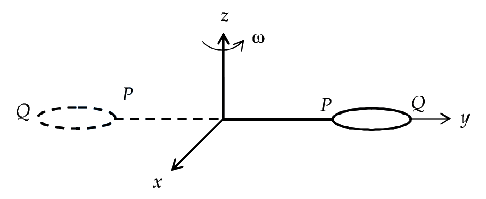
Now consider two similar systems as shown in the figure: Case
(a) the disc with its face vertical and parallel to \(x-z\) plane; Case
(b) the disc with its face making an angle of
\(45^{\circ}\) with \(x-y\) plane and its horizontal diameter parallel to \(x\)-axis. In both the cascs, the disc is welded at point \(\mathrm{P}\), and the systems are rotated with constant angular speed \(\omega\) about the \(z\) axis.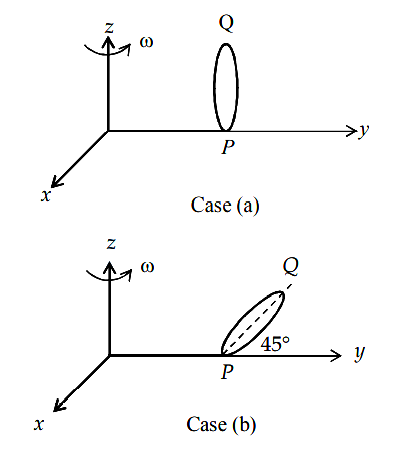
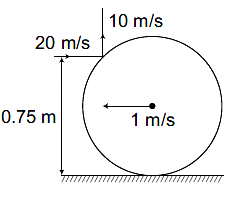
Question : Which of the following statements about the instantaneous axis (passing through the centre of mass) is correct?JEE Advanced 2012 Medium - A thin ring of mass \(2 \mathrm{~kg}\) and radius \(0.5 \mathrm{~m}\) is rolling without slipping on a horizontal plane with velocity 1 \(\mathrm{m} / \mathrm{s}\). A small ball of mass \(0.1 \mathrm{~kg}\), moving with velocity \(20 \mathrm{~m} / \mathrm{s}\) in the opposite directions, hits the ring at a height of \(0.75 \mathrm{~m}\) and goes vertically up with velocity 10 \(\mathrm{m} / \mathrm{s}\). Immediately after the collision
 JEE Advanced 2011 Medium
 - In the Young's double slit experiment using a monochromatic light of wavelength , the path difference ( in terms of an integer ) corresponding to any point having half the peak intensity isJEE Advanced 2013 Medium
More PYQs from JEE Advanced
- The circle with centre at O, intersects the parabola at the point P in the first quadrant. Let the tangent to the circle at P touches other two circles and at and , respectively. Suppose and have equal radii and centres and , respectively. If and lie on the y - axis, thenJEE Advanced 2016 Medium
- Among the following, the correct statement(s) about polymers is(are)JEE Advanced 2022 Easy
- LIST-I contains compounds and LIST-II contains reactions
Match each compound in LIST-I with its formation reaction(s) in LIST-II, and choose the correct optionList - I List - II (I) \(H _2 O _2\) (P) \(Mg \left( HCO _3\right)_2+ Ca\) \((OH)_2 \rightarrow\) (II) \(Mg ( OH )_2\) (Q) \(BaO _2+ H _2 SO _4 \rightarrow\) (III) \(BaCl _2\) (R) \(Ca \left( OH _2\right) 2\) \(+ MgCl _2 \rightarrow\) (IV) \(CaCO _3\) (S) \(BaO _2+ HCl \rightarrow\) (T) \(Ca \left( HCO _3\right)_2\) \(+ Ca ( OH )_2\) JEE Advanced 2022 Easy - Paragraph :
A spray gun is shown in the figure where a piston pushes air out of a nozzle. A thin tube of uniform cross section is connected to the nozzle. The other end of the tube is in a small liquid container. As the piston pushes air through the nozzle, the liquid from the container rises into the nozzle and is sprayed out. For the spray gun shown, the radii of the piston and the nozzle are \(20 \mathrm{~mm}\) and \(1 \mathrm{~mm}\), respectively. The upper end of the container is open to the atmosphere.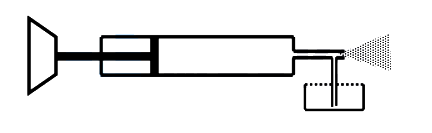
Question :
If the piston is pushed at a speed of \(5 \mathrm{~mms}^{-1}\), the air comes out of the nozzle with a speed ofJEE Advanced 2014 Easy - Let \(\vec{p}=2 \hat{i}+\hat{j}+3 \hat{k}\) and \(\vec{q}=\hat{i}-\hat{j}+\hat{k}\). If for some real numbers \(\alpha, \beta\), and \(\gamma\), we have \(15 \hat{i}+10 \hat{j}+6 \hat{k}=\alpha(2 \vec{p}+\vec{q})+\beta(\vec{p}-2 \vec{q})+\gamma(\vec{p} \times \vec{q})\) then the value of \(\gamma\) isJEE Advanced 2024 Easy
- Paragraph:
Let \(P Q\) be a focal chord of the parabola \(y^{2}=4 a x\). The tangents to the parabola at \(P\) and \(Q\) meet at a point lying on the line \(y=2 x+a, a>0\).
Question:
If chord \(P Q\) subtends an angle \(\theta\) at the vertex of \(y^{2}=4 a x\), then \(\tan \theta=\)JEE Advanced 2013 Medium