


JEE Advanced · Physics · 8. Rotational Motion
Consider a disc rotating in the horizontal plane with a constant angular speed \(\omega\) about its centre \(\mathrm{O}\). The disc has a shaded region on one side of the diameter and an unshaded region on the other side as shown in the figure. When the disc is in the orientation as shown, two pebbles \(P\) and \(Q\) are simultaneously projected at an angle towards \(R\). The velocity of projection is in the \(y\) - \(z\) plane and is same for both pebbles with respect to the disc. Assume that (i) they land back on the disc before the disc has completed \(1 / 8\) rotation, (ii) their range is less than half the disc radius, and (iii) \(\omega\) remains constant throughout. Then
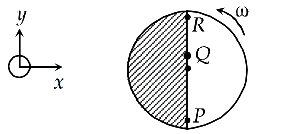
- A \(P\) lands in the shaded region and \(Q\) in the unshaded region.
- B \(P\) lands in the unshaded region and \(Q\) in the shaded region.
- C Both \(P\) and \(Q\) land in the unshaded region.
- D Both \(P\) and \(Q\) land in the shaded region.
Answer & Solution
Correct Answer
(C) Both \(P\) and \(Q\) land in the unshaded region.
Step-by-step Solution
Detailed explanation
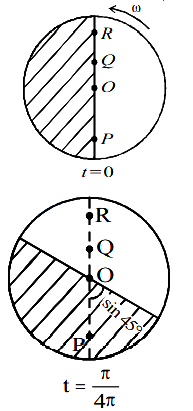
For \(\frac{1}{8}\) of rotation of disc,
\(t=\frac{1}{8} \times \frac{2 \pi}{\omega}=\frac{\pi}{4 \omega} \)
\(x \text {-coordinate of } P =\omega R T \)
\(=\frac{\pi R}{4}>R \sin 45^{\circ}\)
To reach the unshaded part, particle\(P\) needs to travel horizontal range \(>\) \(R \sin 45^{\circ} \simeq 0.7 \mathrm{R}\)
But its range is less than \(\mathrm{R} / 2\) so it will land on shaded part. \(Q\) is near the origin, its velocity will be nearly along QR so it will land in unshaded part.
\(t=\frac{1}{8} \times \frac{2 \pi}{\omega}=\frac{\pi}{4 \omega} \)
\(x \text {-coordinate of } P =\omega R T \)
\(=\frac{\pi R}{4}>R \sin 45^{\circ}\)
To reach the unshaded part, particle\(P\) needs to travel horizontal range \(>\) \(R \sin 45^{\circ} \simeq 0.7 \mathrm{R}\)
But its range is less than \(\mathrm{R} / 2\) so it will land on shaded part. \(Q\) is near the origin, its velocity will be nearly along QR so it will land in unshaded part.
See the Complete Solution
Get step-by-step explanations for this and 2.5 Lakh+ more JEE, NEET & CET questions.
- Unlock all solutions
- Practice the full chapter
- Track accuracy across PYQs
4.8 rated on Google Play · 14,000+ reviews
More questions from Physics
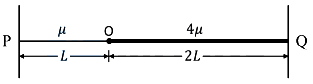
- Two uniform strings of mass per unit length \(\mu\) and \(4 \mu\), and length \(L\) and \(2 L\), respectively, are joined at point \(\mathrm{O}\), and tied at two fixed ends \(\mathrm{P}\) and \(\mathrm{Q}\), as shown in the figure. The strings are under a uniform tension \(T\). If we define the frequency \(v_0=\frac{1}{2 L} \sqrt{\frac{T}{\mu}}\), which of the following statement(s) is(are) correct?
 JEE Advanced 2024 Medium
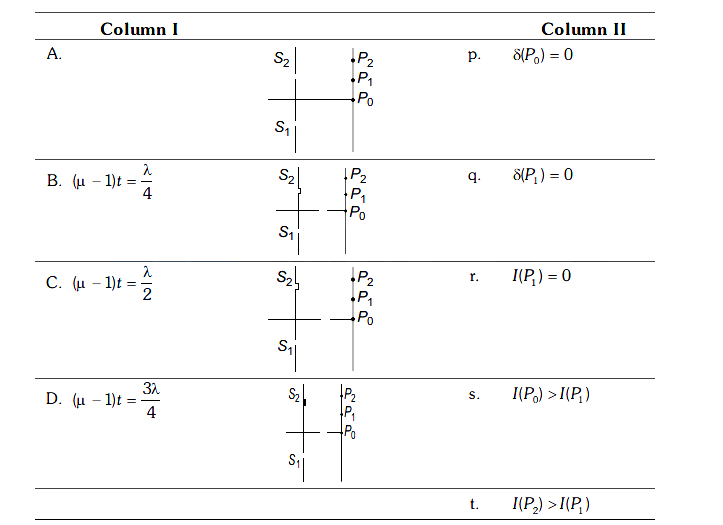
 - Column I shows four situations of standard Young's double slit arrangement with the screen placed far away from the slits \(S_1\) and \(S_2\). In each of these cases \(S_1 P_0=S_2 P_0\), \(S_1 P_1-S_2 P_1=\frac{\lambda}{4}\) and \(S_1 P_2-S_2 P_2=\frac{\lambda}{3}\), where \(\lambda\) is the wavelength of the light used. In the cases \(\mathrm{B}, \mathrm{C}\) and \(\mathrm{D}\), a transparent sheet of refractive index \(\mu\) and thickness \(t\) is pasted on slit \(S_2\). The thickness of the sheets are different in different cases. The phase difference between the light waves reaching a point \(P\) on the screen from the two slits is denoted by \(\delta(P)\) and the intensity by \(I(P)\). Match each situation given in Column-I with the statement(s) in Column-II valid for that situation.
 JEE Advanced 2009 Hard
 - A circular wire loop of radius \(R\) is placed in the \(x-y\) plane centered at the origin \(O\). A square loop of side \(a(a< < R)\) having two turns is placed with its centre at \(z=\sqrt{3} R\) along the axis of the circular wire loop, as shown in figure.
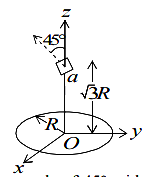
The plane of the square loop makes an angle of \(45^{\circ}\) with respect to the \(z\)-axis. If the mutual inductance between the loops is given by \(\frac{\mu_{0} a^{2}}{2^{p / 2} R}\), then the value of \(p\) isJEE Advanced 2012 Hard - Paragraph :
The capacitor of capacitance \(C\) can be charged (with the help of a resistance \(R\) ) by a voltage source \(V\), by closing switch \(S_1\) while keeping switch \(S_2\) open. The capacitor can be connected in series with an inductor \(L\) by closing switch \(S_2\) and opening \(S_1\).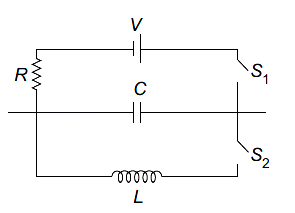
Question :
After the capacitor gets fully charged, \(S_1\) is opened and \(S_2\) is closed so that the inductor is connected in series with the capacitor. Then,JEE Advanced 2006 Easy - Paragraph I: In a Young's double slit experiment, each of the two slits A and B, as shown in the figure, are oscillating about their fixed center and with a mean separation of \(0.8 \mathrm{~mm}\). The distance between the slits at time \(t\) is given by \(d=(0.8+0.04 \sin \omega t) \mathrm{mm}\), where \(\omega=0.08 \mathrm{rad} \mathrm{s}^{-1}\). The distance of the screen from the slits is \(1 \mathrm{~m}\) and the wavelength of the light used to illuminate the slits is \(6000 Ã…\). The interference pattern on the screen changes with time, while the central bright fringe (zeroth fringe) remains fixed at point \(O\).
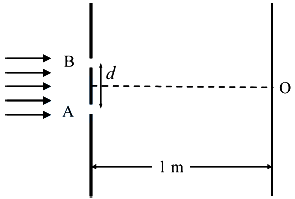
The \(8^{\text {th }}\) bright fringe above the point \(\mathrm{O}\) oscillates with time between two extreme positions. The separation between these two extreme positions, in micrometer \((\mu \mathrm{m})\), is ___________ .JEE Advanced 2024 Medium - The electric field E is measured at a point , generated due to various charge distributions and the dependence of E on d is found to be different for different charge distributions. List-I contains different relations between E and d. List-II describes different electric charge distributions, along with their locations. Match the functions in List-I with the related charge distributions in List-II.
LIST -I LIST -II A) is independent of d P) A point charge at the origin B) \(E \propto \frac{1}{d}\) Q) A small dipole with point charges \(Q\) at \((0,0, l)\) and \(-\operatorname{Qat}(0,0, l)\). Take \(2 l \ll d\) C) \(E \propto \frac{1}{d^2}\) R) An infinite line charge coincident with the \(x\)-axis, with uniform linear charge density \(\lambda\) D) \(E \propto \frac{1}{d^3}\) S) Two infinite wires carrying uniform linear charge density parallel to the \(x\) - axis. The one along \((y-0, z=l)\) has a charge density \(+\lambda\) and the one along \((y=0, z=-l)\) has a charge density \(-\lambda\). Take \(2 l \ll d\) T) Infinite plane charge coincident with the \(x y\) - plane with uniform surface charge density JEE Advanced 2018 Medium
More PYQs from JEE Advanced
- The reagent(s) used for softening the temporary hardness of water is(are)JEE Advanced 2010 Hard
- Extraction for zinc from zinc blende is achieved byJEE Advanced 2007 Medium
- A block is moving on an inclined plane making an angle \(45^{\circ}\) with the horizontal and the coefficient of friction is \(\mu\). The force required to just push it up the inclined plane is 3 times the force required to just prevent it from sliding down. If we define \(N=10 \mu\), then \(N\) isJEE Advanced 2011 Easy
- Extraction of metal from the ore cassiterite involvesJEE Advanced 2011 Medium
- An ideal gas is expanding such that \(p T^2=\) constant. The coefficient of volume expansion of the gas isJEE Advanced 2008 Medium
- Among the following, the correct statement(s) about polymers is(are)JEE Advanced 2022 Easy