


JEE Advanced · Chemistry · 20. Metallurgy
Extraction for zinc from zinc blende is achieved by
- A electrolytic reduction
- B roasting followed by reduction with carbon
- C roasting followed by reduction with another metal
- D roasting followed by self-reduction
Answer & Solution
Correct Answer
(B) roasting followed by reduction with carbon
Step-by-step Solution
Detailed explanation
Zinc blende is roasted and then treated with coke for the reduction.
\(2 \mathrm{ZnS}+3 \mathrm{O}_2 \stackrel{\Delta}{\longrightarrow} 2 \mathrm{ZnO}+2 \mathrm{SO}_2 \uparrow\) \(\mathrm{ZnO}+\mathrm{C} \stackrel{\Delta}{\longrightarrow} \mathrm{Zn}+\mathrm{CO} \uparrow\)
\(2 \mathrm{ZnS}+3 \mathrm{O}_2 \stackrel{\Delta}{\longrightarrow} 2 \mathrm{ZnO}+2 \mathrm{SO}_2 \uparrow\) \(\mathrm{ZnO}+\mathrm{C} \stackrel{\Delta}{\longrightarrow} \mathrm{Zn}+\mathrm{CO} \uparrow\)
See the Complete Solution
Get step-by-step explanations for this and 2.5 Lakh+ more JEE, NEET & CET questions.
- Unlock all solutions
- Practice the full chapter
- Track accuracy across PYQs
4.8 rated on Google Play · 14,000+ reviews
More questions from Chemistry
- Paragraph:
Redox reaction play a pivotal role in chemistry and biology. The values of standard redox potential \(\left(E^{\circ}\right)\) of two half-cell reactions decide which way the reaction is expected to proceed. A simple example is a Daniel cell in which zinc goes into solution and copper gets deposited. Given below are a set of half-cell reactions (acidic medium) along with their \(E^{\circ}(V\) with respect to normal hydrogen electrode) values. Using this data obtain the correct explanations to Questions 14-19.
\(\mathrm{I}_2+2 e^{-} \longrightarrow 2 \mathrm{I}^{-} E^{\circ}=0.54 \)
\( \mathrm{Cl}_2+2 e^{-} \longrightarrow 2 \mathrm{Cl}^{-} E^{\circ}=1.36 \)
\( \mathrm{Mn}^{3+}+e^{-} \longrightarrow \mathrm{Mn}^{2+} E^{\circ}=1.50 \)
\( \mathrm{Fe}^{3+}+e^{-} \longrightarrow \mathrm{Fe}^{2+} E^{\circ}=0.77 \)
\( \mathrm{O}_2+4 \mathrm{H}^{+}+4 e^{-} \longrightarrow 2 \mathrm{H}_2 \mathrm{O} E^{\circ}=1.23\)
Question:
While \(\mathrm{Fe}^{3+}\) is stable, \(\mathrm{Mn}^{3+}\) is not stable in acid solution becauseJEE Advanced 2007 Hard - The boiling point of water in a \(0.1\) molal silver nitrate solution (solution \(\mathbf{A}\) ) is \(\mathbf{x}^{\circ} \mathrm{C}\). To this solution \(\mathbf{A}\), an equal volume of \(0.1\) molal aqueous barium chloride solution is added to make a new solution B. The difference in the boiling points of water in the two solutions \(\mathbf{A}\) and \(\mathbf{B}\) is \(\mathbf{y} \times 10^{-2}{ }^{\circ} \mathrm{C}\).
(Assume: Densities of the solutions \(\mathbf{A}\) and \(\mathbf{B}\) are the same as that of water and the soluble salts dissociate completely.
Use: Molal elevation constant (Ebullioscopic Constant), \(K_{b}=0.5 \mathrm{~K} \mathrm{~kg} \mathrm{~mol}^{-1}\); Boiling point of pure water as \(100^{\circ} \mathrm{C}\).)
The value of is ___.JEE Advanced 2021 Hard - The total number of contributing structures showing hyperconjugation (involving \(\mathrm{C}-\mathrm{H}\) bonds) for the following carbocation is
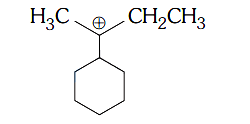 JEE Advanced 2011 Medium
 - At \(298 \mathrm{~K}\), the limiting molar conductivity of a weak monobasic acid is \(4 \times 10^{2} \mathrm{~S} \mathrm{~cm}^{2} \mathrm{~mol}^{-1}\). At \(298 \mathrm{~K}\), for an aqueous solution of the acid the degree of dissociation is \(\boldsymbol{\alpha}\) and the molar conductivity is \(\mathbf{y} \times 10^{2} \mathrm{~S} \mathrm{~cm}^{2} \mathrm{~mol}^{-1}\). At \(298 \mathrm{~K}\), upon 20 times dilution with water, the molar conductivity of the solution becomes \(3 \mathbf{y} \times 10^{2} \mathrm{~S} \mathrm{~cm}^{2} \mathrm{~mol}^{-1}\)
The value of is _________ .JEE Advanced 2021 Hard - The correct option(s) related to adsorption processes is(are)JEE Advanced 2022 Easy
- The monomer (X) involved in the synthesis of Nylon 6,6 gives positive carbylamine test. If 10 moles of \(\mathbf{X}\) are analyzed using Dumas method, the amount (in grams) of nitrogen gas evolved is ______ .
Use: Atomic mass of N (in amu) = 14JEE Advanced 2025 Medium
More PYQs from JEE Advanced
- Total number of isomers, considering both structural and stereoisomers, of cyclic ethers with the molecular formula is ________JEE Advanced 2019 Easy
- Students I, II and III perform an experiment for measuring the acceleration due to gravity \((g)\) using a simple pendulum. They use different lengths of the pendulum and/or record time for different number of oscillations. The observations are shown in the table.
Least count for length \(=0.1 \mathrm{~cm}\)
Least count for time \(=0.1 \mathrm{~s}\)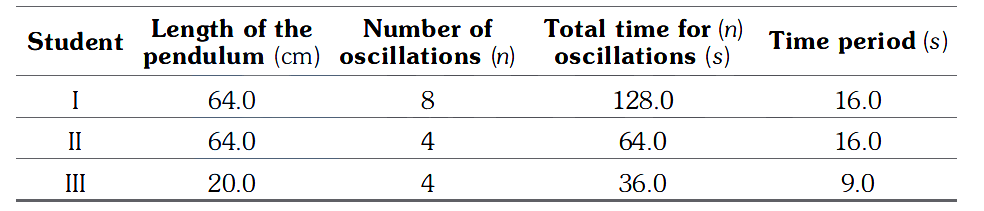
If \(E_{\mathrm{I}}, E_{\mathrm{II}}\) and \(E_{\mathrm{III}}\) are the percentage errors in \(g\), i.e., \(\left(\frac{\Delta g}{g} \times 100\right)\) for students I, II and III, respectively.JEE Advanced 2008 Medium - In the given circuit, a charge of \(+80 \mu C\) is given to the upper plate of the \(4 \mu F\) capacitor. Then in the steady state, the charge on the upper plate of the \(3 \mu F\) capacitor is
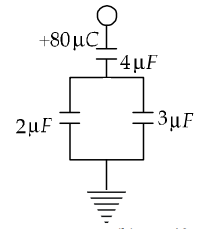 JEE Advanced 2012 Medium
 - For a complex number , let denote the real part of . Let be the set of all complex numbers satisfying where . Then the minimum possible value of where with and is _______JEE Advanced 2020 Medium
- Paragraph:
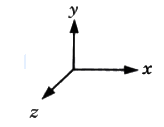
In a thin rectangular metallic strip a constant current \(I\) flows along the positive \(x\)-direction, as shown in the figure. The length, width and thickness of the strip are \(l, w\) and \(d\), respectively.
A uniform magnetic field \(\vec{B}\) is applied on the strip along the positive \(y\)-direction. Due to this, the charge carriers experience a net deflection along the \(z\)-direction. This results in accumulation of charge carriers on the surface \(P Q R S\) and appearance of equal and opposite charges on the face opposite to \(P Q R S\). A potential difference along the \(z\)-direction is thus developed. Charge accumulation continues until the magnetic force is balanced by the electric force. The current is assumed to be uniformly distributed on the cross section of the strip and carried by electrons.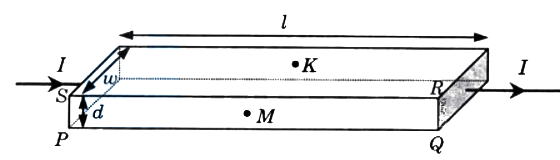
Question:
Consider two different metallic strips (\(1\) and \(2\)) of same dimensions (length \(l\), width \(w\) and thickness \(d\) ) with carrier densities \(n_{1}\) and \(n_{2}\), respectively. Strip \(1\) is placed in magnetic field \(B_{1}\) and strip \(2\) is placed in magnetic field \(B_{2}\), both along positive \(y\)-directions. Then \(V_{1}\) and \(V_{2}\) are the potential differences developed between \(K\) and \(M\) in strips \(1\) and \(2\), respectively. Assuming that the current \(I\) is the same for both the strips, the correct option(s) is(are)JEE Advanced 2015 Medium - In the following reaction sequence in aqueous solution, the species and respectively, are
\(S _2 O _3^{2-} \xrightarrow{ Ag ^{+}} \underset{\substack{\text { Clear } \\ \text { Solution }}}{ X } \xrightarrow{ Ag ^{+}} \underset{\substack{\text { White } \\ \text { Precipitate }}}{ Y }\) \(\xrightarrow{\text { With time }} \underset{\substack{\text { Black } \\ \text { Precipitate }}}{ Z }\)JEE Advanced 2016 Easy