


JEE Advanced · Physics · 25. Wave Optics
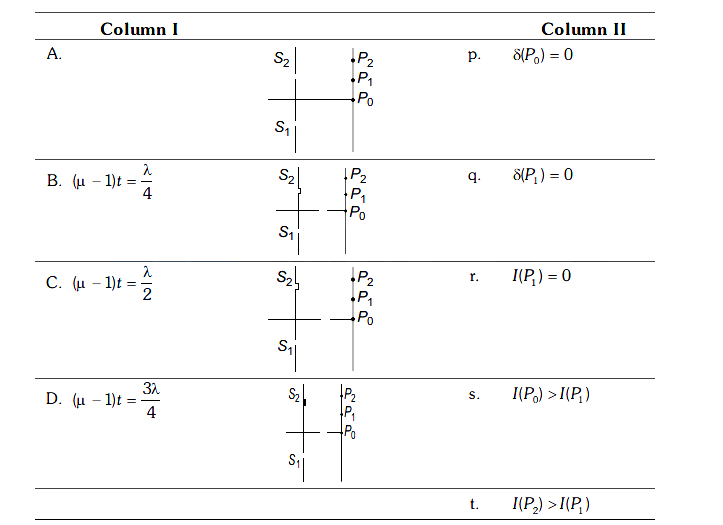
Column I shows four situations of standard Young's double slit arrangement with the screen placed far away from the slits \(S_1\) and \(S_2\). In each of these cases \(S_1 P_0=S_2 P_0\), \(S_1 P_1-S_2 P_1=\frac{\lambda}{4}\) and \(S_1 P_2-S_2 P_2=\frac{\lambda}{3}\), where \(\lambda\) is the wavelength of the light used. In the cases \(\mathrm{B}, \mathrm{C}\) and \(\mathrm{D}\), a transparent sheet of refractive index \(\mu\) and thickness \(t\) is pasted on slit \(S_2\). The thickness of the sheets are different in different cases. The phase difference between the light waves reaching a point \(P\) on the screen from the two slits is denoted by \(\delta(P)\) and the intensity by \(I(P)\). Match each situation given in Column-I with the statement(s) in Column-II valid for that situation.
- A (A) q,t, (B) q, (C) t, (D) r,s,t
- B (A) q,r,s, (B) r, (C) q,r, (D) q,s,t
- C (A) p,s, (B) r, (C) q,t, (D) r,s
- D (A) p,s, (B) q, (C) t, (D) r,s,t
Answer & Solution
Correct Answer
(D) (A) p,s, (B) q, (C) t, (D) r,s,t
Step-by-step Solution
Detailed explanation
(A) \(\rightarrow(\mathrm{p}, \mathrm{s}) \rightarrow\) Intensity at \(P_0\) is maximum. It will continuously decrease from \(P_0\) towards \(P_2\).
\((B) \rightarrow(q) \rightarrow\) Path difference due to slap will be compensated by geometrical path difference. Hence, \(\delta\left(P_1\right)=0\).
\((\mathrm{C}) \rightarrow(\mathrm{t}) \rightarrow \delta\left(P_0\right)=\frac{\lambda}{2}, \delta\left(P_1\right)=\frac{\lambda}{2}-\frac{\lambda}{4}=\frac{\lambda}{4}\) and \(\delta\left(P_2\right)=\frac{\lambda}{2}-\frac{\lambda}{3}=\frac{\lambda}{6}\). When path difference increases from 0 to \(\frac{\lambda}{2}\), intensity will decrease from maximum to zero. Hence, in this case,
\(I\left(P_2\right)>I\left(P_1\right)>I\left(P_0\right)\)
\((\mathrm{D}) \rightarrow(\mathrm{r}, \mathrm{s}, \mathrm{t})\)
\(\delta\left(P_0\right)=\frac{3 \lambda}{4}, \delta\left(P_1\right)=\frac{3 \lambda}{4}-\frac{\lambda}{4}=\frac{\lambda}{2}\)
and \(\delta\left(P_2\right)=\frac{3 \lambda}{4}-\frac{\lambda}{3}=\frac{5 \lambda}{12}\)
In this case \(I\left(P_1\right)=0\)
\((B) \rightarrow(q) \rightarrow\) Path difference due to slap will be compensated by geometrical path difference. Hence, \(\delta\left(P_1\right)=0\).
\((\mathrm{C}) \rightarrow(\mathrm{t}) \rightarrow \delta\left(P_0\right)=\frac{\lambda}{2}, \delta\left(P_1\right)=\frac{\lambda}{2}-\frac{\lambda}{4}=\frac{\lambda}{4}\) and \(\delta\left(P_2\right)=\frac{\lambda}{2}-\frac{\lambda}{3}=\frac{\lambda}{6}\). When path difference increases from 0 to \(\frac{\lambda}{2}\), intensity will decrease from maximum to zero. Hence, in this case,
\(I\left(P_2\right)>I\left(P_1\right)>I\left(P_0\right)\)
\((\mathrm{D}) \rightarrow(\mathrm{r}, \mathrm{s}, \mathrm{t})\)
\(\delta\left(P_0\right)=\frac{3 \lambda}{4}, \delta\left(P_1\right)=\frac{3 \lambda}{4}-\frac{\lambda}{4}=\frac{\lambda}{2}\)
and \(\delta\left(P_2\right)=\frac{3 \lambda}{4}-\frac{\lambda}{3}=\frac{5 \lambda}{12}\)
In this case \(I\left(P_1\right)=0\)
See the Complete Solution
Get step-by-step explanations for this and 2.5 Lakh+ more JEE, NEET & CET questions.
- Unlock all solutions
- Practice the full chapter
- Track accuracy across PYQs
4.8 rated on Google Play · 14,000+ reviews
More questions from Physics
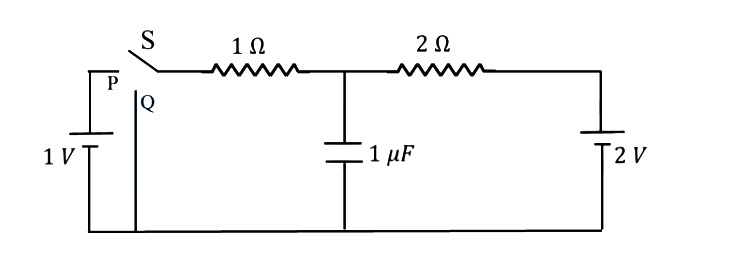
- In the circuit shown below, the switch \(\mathrm{S}\) is connected to position \(\mathrm{P}\) for a long time so that the charge on the capacitor becomes \(q_{1} \mu \mathrm{C}\). Then \(\mathrm{S}\) is switched to position \(\mathrm{Q}\). After a long time, the charge on the capacitor is \(q_{2} \mu \mathrm{C}\).
The magnitude of is _____.JEE Advanced 2021 Medium - A Hydrogen-like atom has atomic number . Photons emitted in the electronic transitions from level to level in these atoms are used to perform photoelectric effect experiment on a target metal. The maximum kinetic energy of the photoelectrons generated is . If the photoelectric threshold wavelength for the target metal is , the value of is _____.
[Given and , where is the Rydberg constant, is the Planck’s constant and is the speed of light in vacuum]JEE Advanced 2023 Medium - A particle of mass is initially at rest in the -plane at a point , where and . The particle is accelerated at time with a constant acceleration along the positive -direction. Its angular momentum and torque with respect to the origin, in SI units, are represented by and , respectively. and are unit vectors along the positive and -directions, respectively. If then which of the following statement(s) is (are) correct?JEE Advanced 2021 Medium
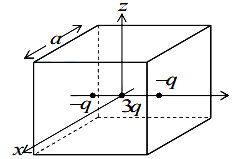
- A cubical region of side \(a\) has its centre at the origin. It encloses three fixed point charges, \(-q\) at \((0,-a / 4,0),+3 q\) at \((0,0,0)\) and \(-q\) at \((0,+a / 4,0)\). Choose the correct options(s)
 JEE Advanced 2012 Medium
 - On a frictionless horizontal plane, a bob of mass is attached to a spring with natural length . The spring constant is when the length of the spring and is when . Initially the bob is released from . Assume that Hooke's law remains valid throughout the motion. If the time period of the full oscillation is , then the integer closest to is _______.JEE Advanced 2022 Easy
- A point mass of \(1 \mathrm{~kg}\) collides elastically with a stationary point mass of \(5 \mathrm{~kg}\). After their collision, the \(1 \mathrm{~kg}\) mass reverses its direction and moves with a speed of \(2 \mathrm{~ms}^{-1}\). Which of the following statement(s) is/are correct for the system of these two masses?JEE Advanced 2010 Medium
More PYQs from JEE Advanced
- For the reaction:
The correct statement(s) in the balanced equation is/are:JEE Advanced 2014 Medium - Let the function \(g:(-\infty, \infty) \rightarrow\left(-\frac{\pi}{2}, \frac{\pi}{2}\right)\) be given by \(g(u)=2 \tan ^{-1}\left(e^u\right)-\frac{\pi}{2}\). Then, \(g\) isJEE Advanced 2008 Medium
- Let be the origin and and for some If then which of the following statements is (are) TRUE?JEE Advanced 2021 Medium
- Let P be the point on the parabola which is at the shortest distance from the center S of the circle Let Q be the point on the circle dividing the line segment SP internally. Then -JEE Advanced 2016 Medium
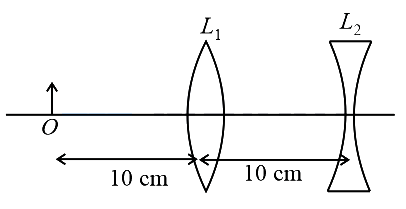
- An extended object is placed at point , in front of a convex lens and a concave lens is placed behind it, as shown in the figure. The radii of curvature of all the curved surfaces in both the lenses are . The refractive index of both the lenses is . The total magnification of this lens system is:
 JEE Advanced 2021 Medium
 - Paragraph:
A circle \(C\) of radius 1 is inscribed in an equilateral \(\triangle P Q R\). The points of contact of \(C\) with the sides \(P Q, Q R, R P\) are \(D, E, F\) respectively. The line \(P Q\) is given by the equation
\(\sqrt{3} x+y-6=0\) and the point \(D\) is \(\left(\frac{3 \sqrt{3}}{2}, \frac{3}{2}\right)\). Further, it is given that the origin and the centre of \(C\) are on the same side of the line \(P Q\).Question:
Equations of the sides \(Q R, R P\) areJEE Advanced 2008 Easy