


JEE Advanced · Physics · 16. Waves & Sound
Two uniform strings of mass per unit length \(\mu\) and \(4 \mu\), and length \(L\) and \(2 L\), respectively, are joined at point \(\mathrm{O}\), and tied at two fixed ends \(\mathrm{P}\) and \(\mathrm{Q}\), as shown in the figure. The strings are under a uniform tension \(T\). If we define the frequency \(v_0=\frac{1}{2 L} \sqrt{\frac{T}{\mu}}\), which of the following statement(s) is(are) correct?
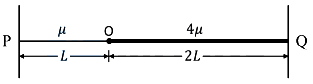
- A With a node at \(\mathrm{O}\), the minimum frequency of vibration of the composite string is \(v_0\).
- B With an antinode at \(\mathrm{O}\), the minimum frequency of vibration of the composite string is \(2 v_0\).
- C When the composite string vibrates at the minimum frequency with a node at \(\mathrm{O}\), it has 6 nodes, including the end nodes.
- D No vibrational mode with an antinode at \(\mathrm{O}\) is possible for the composite string.
Answer & Solution
Correct Answer
(A) With a node at \(\mathrm{O}\), the minimum frequency of vibration of the composite string is \(v_0\).
Step-by-step Solution
Detailed explanation
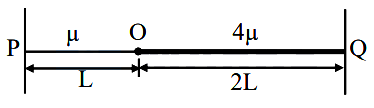
\(\mathrm{C}_1=\sqrt{\frac{\mathrm{T}}{\mu}}, \mathrm{C}_2=\sqrt{\frac{\mathrm{T}}{4 \mu}}=\frac{\mathrm{C}_1}{2}\)
\(\underline{\text { For node at } \mathrm{O} \text { : }}\)
\(\mathrm{L}=\frac{\mathrm{n} \lambda_1}{2}, 2 \mathrm{~L}=\frac{\mathrm{m} \lambda_2}{2}\) ( \(\mathrm{n}, \mathrm{m}\) are integers)
\(\begin{aligned} & \lambda_1=\frac{2 \mathrm{~L}}{\mathrm{n}}, \lambda_2=\frac{4 \mathrm{~L}}{\mathrm{~m}} \\ & \frac{\mathrm{C}_1}{\lambda_1}=\frac{\mathrm{C}_2}{\lambda_2} \\ & \Rightarrow \frac{\mathrm{C}_1}{\frac{2 \mathrm{~L}}{n}}=\frac{\frac{\mathrm{C}_1}{2}}{\frac{4 \mathrm{~L}}{m}} \\ & \Rightarrow 4 \mathrm{n}=\mathrm{m}\end{aligned}\)
For minimum frequency, \(\mathrm{n}=1, \mathrm{~m}=4\)
\(\therefore v_{\min }=\frac{\mathrm{C}_1 \times 1}{2 \mathrm{~L}}=\frac{1}{2 \mathrm{~L}} \sqrt{\frac{\mathrm{T}}{\mu}}=v_0\)
The string will look like

Total no. of nodes \(=6\) including the end nodes \(\underline{\text { For antinode at } \mathrm{O} \text { : }}\)
\(\mathrm{L}=(2 \mathrm{n}+1) \frac{\lambda_1}{4} ; 2 \mathrm{~L}=(2 \mathrm{n}+1) \frac{\lambda_2}{4} \quad\) \(\text { (n, m are integers) } \)
\( \lambda_1=\frac{4 \mathrm{~L}}{(2 \mathrm{n}+1)} ; \lambda_2=\frac{8 \mathrm{~L}}{(2 \mathrm{~m}+1)} \)
\( \frac{\mathrm{C}_1}{\lambda_1}=\frac{\mathrm{C}_2}{\lambda_2} \)
\( \frac{\mathrm{C}_1}{\mathrm{C}_2}=\frac{\lambda_1}{\lambda_2} \)
\( 2=\frac{\frac{4 \mathrm{~L}}{(2 \mathrm{n}+1)}}{\frac{8 \mathrm{~L}}{(2 \mathrm{~m}+1)}} \)
\( 4=\frac{(2 \mathrm{~m}+1)}{(2 \mathrm{n}+1)} \Rightarrow \text { even }=\frac{\text { odd }}{\text { odd }} \Rightarrow\) \(\text { This node is not possible }\)
See the Complete Solution
Get step-by-step explanations for this and 2.5 Lakh+ more JEE, NEET & CET questions.
- Unlock all solutions
- Practice the full chapter
- Track accuracy across PYQs
4.8 rated on Google Play · 14,000+ reviews
More questions from Physics
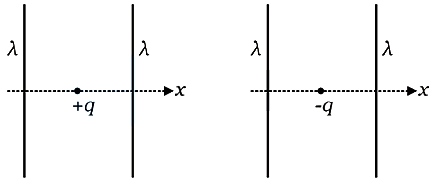
- The figures below depict two situations in which two infinitely long static line charges of constant positive line charge density are kept parallel to each other. In their resulting electric field, point charges and are kept in equilibrium between them. The point charges are confined to move in the direction only. If they are given a small displacement about their equilibrium positions, then the correct statements(s) is (are)
 JEE Advanced 2015 Medium
 - Paragraph:
The nuclear charge \((\mathrm{Ze})\) is non-uniformly distributed within a nucleus of radius \(R\). The charge density \(\rho(r)\) [charge per unit volume] is dependent only on the radial distance \(r\) from the centre of the nucleus as shown in figure. The electric field is only along the radial direction.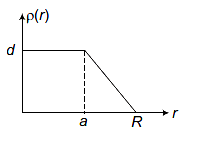
Question:
For \(a=0\), the value of \(d\) (maximum value of \(\rho\) as shown in the figure) isJEE Advanced 2008 Hard - A single slit diffraction experiment is performed to determine the slit width using the equation, \(\frac{b d}{D}=m \lambda\), where \(b\) is the slit width, \(D\) the shortest distance between the slit and the screen, \(d\) the distance between the \(m^{\text {th }}\) diffraction maximum and the central maximum, and \(\lambda\) is the wavelength. \(D\) and \(d\) are measured with scales of least count of 1 cm and 1 mm, respectively. The values of \(\lambda\) and \(m\) are known precisely to be 600 nm and 3, respectively. The maximum absolute error (in \(\mu \mathrm{m}\)) in the value of \(b\) estimated using the diffraction maximum that occurs for \(m=3\) with \(d=5 \mathrm{~mm}\) and \(D=1 \mathrm{~m}\) is ______.JEE Advanced 2025 Medium
- An infinitely long wire, located on the \(z\)-axis, carries a current \(I\) along the \(+z\)-direction and produces the magnetic field \(\vec{B}\). The magnitude of the line integral \(\int \vec{B} \cdot \overrightarrow{d l}\) along a straight line from the point \((-\sqrt{3} a, a, 0)\) to \((a, a, 0)\) is given by
[ \(\mu_0\) is the magnetic permeability of free space.]JEE Advanced 2024 Hard - A loop carrying current \(I\) lies in the \(x-y\) plane as shown in the figure. The unit vector \(\hat{k}\) is coming out of the plane of the paper. The magnetic moment of the current loop is
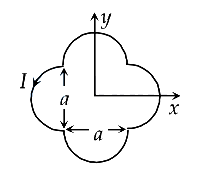 JEE Advanced 2012 Medium
 - Two identical moving coil galvanometer have resistance and full scale deflection at current. One of them is converted into a voltmeter of full scale reading and the other into an Ammeter of full scale current using appropriate resistors. These are then used to measure the voltage and current in the Ohm's law experiment with resistor by using an ideal cell. Which of the following statement(s) is/are correct?JEE Advanced 2019 Hard
More PYQs from JEE Advanced
- The correct stability order for the following species is
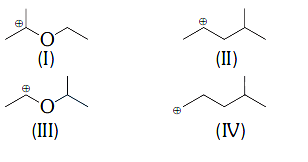 JEE Advanced 2008 Medium
 - Statement I A cloth covers a table. Some dishes are kept on it. The cloth can be pulled out without dislodging the dishes from the table.
Statement II For every action there is an equal and opposite reaction.JEE Advanced 2007 Medium - Paragraph :
Two plane harmonic sound waves are expressed by the equations.
\(\begin{aligned}
& y_1(x, t)=A \cos (0.5 \pi x-100 \pi t) \\
& y_2(x, t)=A \cos (0.46 \pi x-92 \pi t)
\end{aligned}\)
(All parameters are in MKS)
Question :
How many times does an observer hear maximum intensity in one second?JEE Advanced 2006 Medium - Extraction of copper from copper pyrite involvesJEE Advanced 2016 Medium
- The increasing order of atomic radii of the following group elements isJEE Advanced 2016 Easy
- Among the triatomic molecules/ions, and , the total number of linear molecule(s)/ion(s) where the hybridization of the central atom does not have contribution from the d-orbital(s) is
[Atomic number: S = 16, Cl = 17, I = 53 and Xe = 54]JEE Advanced 2015 Medium