


JEE Advanced · Physics · 13. Thermodynamics
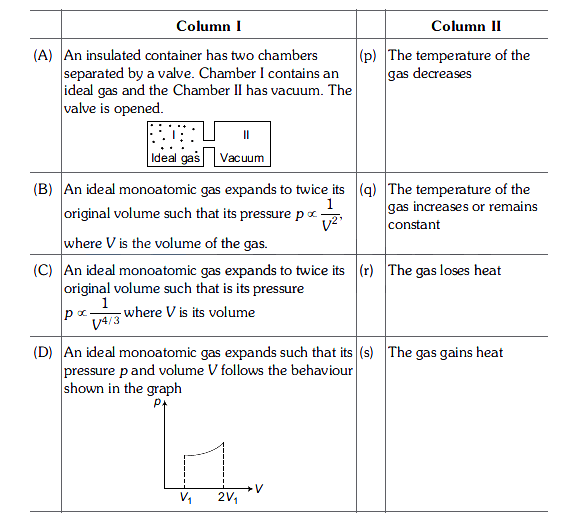
Column I contains a list of processes involving expansion of an ideal gas. Match this with Column II describing the thermodynamic change during this process. Indicate your answer by darkening the appropriate bubbles of the \(4 \times 4\) matrix given in the ORS.
- A (A) q, (B) p,q, (C) p,s, (D) q,s
- B (A) q,r, (B) p,q, (C) s, (D) q
- C (A) p, (B) q, (C) p,r, (D) q,s
- D (A) p,q, (B) q, (C) p,q, (D) q
Answer & Solution
Correct Answer
(A) (A) q, (B) p,q, (C) p,s, (D) q,s
Step-by-step Solution
Detailed explanation
(A) : In case of free expansion under adiabatic conditions, change in internal energy \(\Delta U=0\).
\(\therefore\) Internal energy and temperature will remain constant.
(B) \(p \propto \frac{1}{v^2}\)
\(\therefore p V^2 =\text { constant } \)
\( \text { or } \left(\frac{n R T}{V}\right) V^2=\text { constant } \)
\( \therefore T \propto \frac{1}{V}\)
If volume is doubled, temperature will decrease as per Eq. (ii). Further, molar heat capacity in process \(p V^x=\) constant is
\(
C=C_V+\frac{R}{1-x}
\)
From Eq. (i), \(x=2\)
\(
\therefore \quad C=\frac{3}{2} R+\frac{R}{1-2}=+\frac{R}{2}
\)
Since molar heat capacity is positive, according to \(Q=n C \Delta T, Q\) will be negative it \(\Delta T\) is negative. Or gas loses heat if temperature is decreasing.
(C) :
\(p \propto \frac{1}{V^{1 / 3}} \)
\( P V^{4 / 3} =\text { constant } \)
\( \left(\frac{n R T}{V}\right) V^{4 / 3} =\text { constant } \)
\( T \propto \frac{1}{V^{1 / 3}}\)
Further, with increase in volume temperature will decrease.
Here,
\(\text { Here, } x=4 / 3 \)
\( \therefore C=\frac{3}{2} R+\frac{R}{1-4 / 3}=-1.5 R\)
As molar heat capacity is negative, \(Q\) will be positive, if \(\Delta T\) is negative or gas gains heat with decrease in temperature.
(D) \(T \propto p V\)
In expansion from \(V_1\) or \(2 V_1\), product of \(p V\) is increasing. Therefore, temperature will increase or \(\Delta U=+\) ve.
Further, in expansion work done is also positive.
Hence, \(Q=W+\Delta U=+\) ve
or gas gains heat.
\(\therefore\) Internal energy and temperature will remain constant.
(B) \(p \propto \frac{1}{v^2}\)
\(\therefore p V^2 =\text { constant } \)
\( \text { or } \left(\frac{n R T}{V}\right) V^2=\text { constant } \)
\( \therefore T \propto \frac{1}{V}\)
If volume is doubled, temperature will decrease as per Eq. (ii). Further, molar heat capacity in process \(p V^x=\) constant is
\(
C=C_V+\frac{R}{1-x}
\)
From Eq. (i), \(x=2\)
\(
\therefore \quad C=\frac{3}{2} R+\frac{R}{1-2}=+\frac{R}{2}
\)
Since molar heat capacity is positive, according to \(Q=n C \Delta T, Q\) will be negative it \(\Delta T\) is negative. Or gas loses heat if temperature is decreasing.
(C) :
\(p \propto \frac{1}{V^{1 / 3}} \)
\( P V^{4 / 3} =\text { constant } \)
\( \left(\frac{n R T}{V}\right) V^{4 / 3} =\text { constant } \)
\( T \propto \frac{1}{V^{1 / 3}}\)
Further, with increase in volume temperature will decrease.
Here,
\(\text { Here, } x=4 / 3 \)
\( \therefore C=\frac{3}{2} R+\frac{R}{1-4 / 3}=-1.5 R\)
As molar heat capacity is negative, \(Q\) will be positive, if \(\Delta T\) is negative or gas gains heat with decrease in temperature.
(D) \(T \propto p V\)
In expansion from \(V_1\) or \(2 V_1\), product of \(p V\) is increasing. Therefore, temperature will increase or \(\Delta U=+\) ve.
Further, in expansion work done is also positive.
Hence, \(Q=W+\Delta U=+\) ve
or gas gains heat.
See the Complete Solution
Get step-by-step explanations for this and 2.5 Lakh+ more JEE, NEET & CET questions.
- Unlock all solutions
- Practice the full chapter
- Track accuracy across PYQs
4.8 rated on Google Play · 14,000+ reviews
More questions from Physics
- An ideal gas is in thermodynamic equilibrium. The number of degrees of freedom of a molecule of the gas is . The internal energy of one mole of the gas is and the speed of sound in the gas is . At a fixed temperature and pressure, which of the following is the correct option?JEE Advanced 2023 Easy
- A rocket is launched normal to the surface of the Earth, away from the Sun, along the line joining the Sun and the Earth. The Sun is times heavier than the Earth and is at a distance times larger than the radius of the Earth. The escape velocity from Earth's gravitational field is . The minimum initial velocity required for the rocket to be able to leave the Sun-Earth system is closest to
(Ignore the rotation and revolution of the Earth and the presence of any other planet)JEE Advanced 2017 Medium - Consider a body of mass at rest at the origin at time . A force is applied on the body, where . The torque acting on the body about the origin at time . Which of the following statements is (are) true?JEE Advanced 2018 Medium
- A moving coil galvanometer has 50 turns and each turn has an area . The magnetic field produced by the magnet inside the galvanometer is . The torsional constant of the suspension wire is . When a current flows through the galvanometer, a full scale deflection occurs if the coil rotates by . The resistance of the coil of the galvanometer is . This galvanometer is to be converted into an ammeter capable of measuring current in the range . For this purpose, a shunt resistance is to be added in parallel to the galvanometer. The value of this shunt resistance, in ohms, is __________.JEE Advanced 2018 Hard
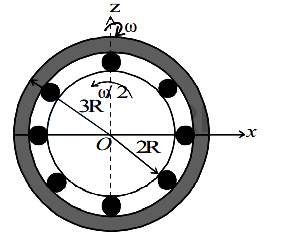
- The figure shows a system consisting of (i) a ring of outer radius \(3 R\) rolling clockwise without slipping on a horizontal surface with angular speed \(\omega\) and (ii) an inner disc of radius \(2 R\) rotating anti-clockwise with angular speed \(\omega / 2\). The ring and disc are separated by frictionless ball bearings. The point \(P\) on the inner disc is at a distance \(R\) from the origin, where \(O P\) makes an angle of \(30^{\circ}\) with the horizontal. Then with respect to the horizontal surface,
 JEE Advanced 2012 Medium
 - Statement I In an elastic collision between two bodies, the relative speed of the bodies after collision is equal to the relative speed before the collision.
Statement II In an elastic collision, the linear momentum of the system is conserved.JEE Advanced 2007 Easy
More PYQs from JEE Advanced
- Among \(H_2, H e_2^{+}, L i_2, B e_2, B_2, C_2, N_2, O_2^{-}\), and \(F_2\), the number of diamagnetic species is -
(Atomic number : \(H=1, H e=2, L i=3, B e=4, B=5,\) \(C=6, N =7, O=8, F=9\) )JEE Advanced 2017 Easy - Consider a system of three connected strings, \(S_1, S_2\) and \(S_3\) with uniform linear mass densities \(\mu \mathrm{kg} / \mathrm{m}\), \(4 \mu \mathrm{~kg} / \mathrm{m}\) and \(16 \mu \mathrm{~kg} / \mathrm{m}\), respectively, as shown in the figure. \(S_1\) and \(S_2\) are connected at the point \(P\), whereas \(S_2\) and \(S_3\) are connected at the point \(Q\), and the other end of \(S_3\) is connected to a wall. A wave generator O is connected to the free end of \(S_1\). The wave from the generator is represented by \(y=y_0\) \(\cos (\omega t-k x) \mathrm{cm}\), where \(y_0, \omega\) and \(k\) are constants of appropriate dimensions. Which of the following statements is/are correct:
 JEE Advanced 2025 Hard
 - Let \(z_k=\cos \left(\frac{2 k \pi}{10}\right)+i \sin \left(\frac{2 k \pi}{10}\right) ; k=1,2, \ldots, 9\)
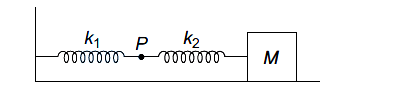
List - I List - II (A) For each \(z_k\) there exists a \(z_j\) such \(z_k \cdot z_j=1\) (P) True (B) There exists a \(k \in\{1,2, \ldots, 9\}\) such that \(z_1 \cdot z=z_k\) has no solution z in the set of complex numbers (Q) False (C) \(\frac{\left|1-z_1\right|\left|1-z_2\right|\ldots\left|1-z_9\right|}{10}\) equals (R) 1 (D) \(1-\sum_{k=1}^9 \cos \left(\frac{2 k \pi}{10}\right)\) equals (S) 2 JEE Advanced 2014 Hard - The mass \(M\) shown in the figure oscillates in simple harmonic motion with amplitude \(A\). The amplitude of the point \(P\) is
 JEE Advanced 2009 Easy
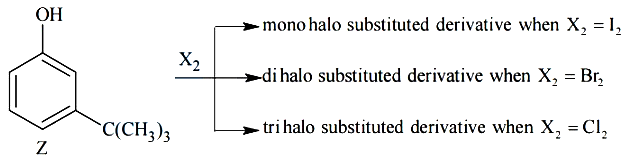
 - The reactivity of compound Z with different halogens under appropriate conditions is given below:
The observed pattern of electrophilic substitution can be explained byJEE Advanced 2014 Hard - In the chemical reaction between stoichiometric quantities of in weakly basic solution, what is the number of moles of released for consumed?JEE Advanced 2020 Easy