


JEE Advanced · Chemistry · 4. Chemical Bonding
Among \(H_2, H e_2^{+}, L i_2, B e_2, B_2, C_2, N_2, O_2^{-}\), and \(F_2\), the number of diamagnetic species is -
(Atomic number : \(H=1, H e=2, L i=3, B e=4, B=5,\) \(C=6, N =7, O=8, F=9\) )
- A 5
- B 10
- C 15
- D 20
Answer & Solution
Correct Answer
(A) 5
Step-by-step Solution
Detailed explanation
| \(H_2 \Rightarrow \sigma 1 s^2\) | (Dia magnetic) |
| \(H e_2^{+} \Rightarrow \sigma 1 s^2 \sigma^* 1 s^1\) | (Para magnetic) |
| \(L i_2 \Rightarrow \sigma 1 s^2 \quad \sigma^* 1 s^2 \quad \sigma 2 s^2\) | (Dia magnetic) |
| \(B e_2 \Rightarrow \sigma 1 s^2 \quad \sigma^* 1 s^2 \quad \sigma 2 s^2 \quad\)\(\sigma^* 2 s^2\) | (Does not exist) |
| \(B_2 \Rightarrow \sigma 1 s^2 \quad \sigma^* 1 s^2 \quad \sigma 2 s^2 \quad\)\( \sigma^* 2 s^2 \quad \pi 2 p_x^1=\pi 2 p_y^1\) | (Para magnetic) |
| \(C_2 \Rightarrow \sigma 1 s^2 \quad \sigma^* 1 s^2 \quad \sigma 2 s^2 \quad\)\( \sigma^* 2 s^2 \quad \pi 2 p_x^2=\pi 2 p_y^2\) | (Dia magnetic) |
| \(N_2 \Rightarrow \sigma 1 s^2 \quad \sigma^* 1 s^2 \quad \sigma 2 s^2 \quad\)\( \sigma^* 2 s^2\quad \pi 2 p_x^2=\pi 2 p_y^2 \quad \sigma 2 p_z^2\) | (Dia magnetic) |
| \(O_2^{\Theta} \Rightarrow\sigma 1 s^2 \quad \sigma^* 1 s^2 \quad \sigma 2 s^2 \quad\)\(\sigma^* 2 s^2 \quad\sigma 2 p_z^2 \quad \pi 2 p_x^2=\pi 2 p_y^2 \quad\)\(\pi^* 2 p_x^2=\pi^* 2 p_y^1\) | (Para magnetic) |
| \(F_2 \Rightarrow \sigma 1 s^2 \quad \sigma^* 1 s^2 \quad \sigma 2 s^2 \quad\)\( \sigma^* 2 s^2 \quad\sigma 2 o_z^2 \quad \pi 2 p_x^2=\pi 2 p_y^2 \quad\)\(\pi^* 2 p_x^2=\pi^* 2 p_y^2\) | (Dia magnetic) |
See the Complete Solution
Get step-by-step explanations for this and 2.5 Lakh+ more JEE, NEET & CET questions.
- Unlock all solutions
- Practice the full chapter
- Track accuracy across PYQs
4.8 rated on Google Play · 14,000+ reviews
More questions from Chemistry
- An organic compound rotates plane-polarized light. It produces pink color with neutral solution. What is the total number of all the possible isomers for this compound?JEE Advanced 2020 Hard
- Reaction of iso-propylbenzene with \(\mathrm{O}_2\) followed by the treatment with \(\mathrm{H}_3 \mathrm{O}^{+}\)forms phenol and a by-product \(\mathbf{P}\). Reaction of \(\mathbf{P}\) with 3 equivalents of \(\mathrm{Cl}_2\) gives compound \(\mathbf{Q}\). Treatment of \(\mathbf{Q}\) with \(\mathrm{Ca}(\mathrm{OH})_2\) produces compound \(\mathbf{R}\) and calcium salt \(\mathbf{S}\).
The correct statement(s) regarding \(\mathbf{P}, \mathbf{Q}, \mathbf{R}\) and \(\mathbf{S}\) is(are)JEE Advanced 2024 Hard - A closed tank has two compartments A and B, both filled with oxygen (assumed to be ideal gas). The partition separating the two compartments is fixed and is a perfect heat insulator (Figure). If the old partition is replaced by a new partition which can slide and conduct heat but does not allow the gas to leak across (Figure ), the volume (in ) of the compartment A after the system attains equilibrium is _________.
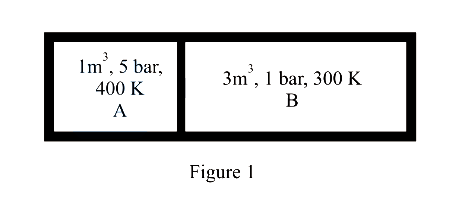
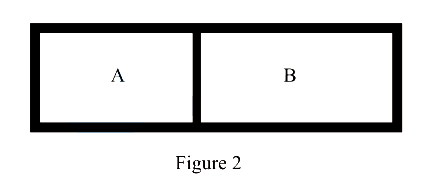 JEE Advanced 2018 Hard
 - Paragraph:
Properties such as boiling point, freezing point and vapour pressure of a pure solvent change when solute molecules are added to get homogeneous solution. These are called colligative properties. Applications of colligative properties are very useful in day-to-day life. One of its examples is the use of ethylene glycol and water mixture as anti-freezing liquid in the radiator automobiles.
A solution \(M\) is prepared by mixing ethanol and water. The mole fraction of ethanol in the mixtrue is \(0.9\)
Given Freezing point depression constant of water \(\left(k^{\text {water }}\right)=1.86 \mathrm{~K} \mathrm{~kg} \mathrm{~mol}^{-1}\)
Freezing point depression constant of ethanol \(\left(k_f^{\text {ethanol }}\right)=2.0 \mathrm{Kkg} \mathrm{mol}^{-1}\)
Boiling point elevation constant of water \(\left(k_b^{\text {water }}\right)=0.52 \mathrm{Kkg} \mathrm{mol}^{-1}\)
Boiling point elevation constant of ethanol \(\left(k_b^{\text {ethanol }}\right)=1.2 \mathrm{Kkg} \mathrm{mol}^{-1}\)
Standard freezing point of water \(=273 \mathrm{~K}\)
Standard freezing point of ethanol \(=155.7 \mathrm{~K}\)
Standard boiling point of water \(=373 \mathrm{~K}\)
Standard boiling point of ethanol \(=351.5 \mathrm{~K}\)
Vapour pressure of pure water \(=328 \mathrm{~mm}\) of \(\mathrm{Hg}\)
Vapour pressure of pure ethanol \(=40 \mathrm{~mm}\) of \(\mathrm{Hg}\)
Molecular weight of water \(=18 \mathrm{~g} \mathrm{~mol}^{-1}\)
Molecular weight of ethanol \(=46 \mathrm{~g} \mathrm{~mol}^{-1}\)
In answering the following questions, consider the solutions to be ideal dilute solutions and solutes to be non-volatile and non-dissociative.
Question:
The freezing point of the solution \(M\) isJEE Advanced 2008 Medium - The spin only magnetic moment value (in Bohr magneton units) of \(\mathrm{Cr}(\mathrm{CO})_6\) isJEE Advanced 2009 Easy
- The total number of cyclic structural as well as stereoisomers possible for a compound with the molecular formula \(=\mathrm{C}_5 \mathrm{H}_{10}\) isJEE Advanced 2009 Medium
More PYQs from JEE Advanced
- The of is at . The solubility (in ) of in a solution isJEE Advanced 2013 Hard
- If where the inverse trigonometric functions take only the principal values, then the correct options(s) is(are)JEE Advanced 2015 Medium
- A thin stiff insulated metal wire is bent into a circular loop with its two ends extending tangentially from the same point of the loop. The wire loop has mass \(m\) and radius \(r\) and it is in a uniform vertical magnetic field \(B_0\), as shown in the figure. Initially, it hangs vertically downwards, because of acceleration due to gravity \(g\), on two conducting supports at \(\mathrm{P}\) and \(\mathrm{Q}\). When a current \(I\) is passed through the loop, the loop turns about the line \(\mathrm{PQ}\) by an angle \(\theta\) given by
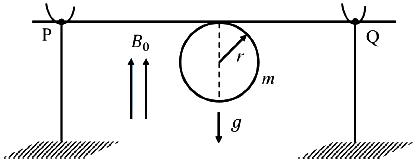 JEE Advanced 2024 Medium
 - A gas described by van der Waals' equationJEE Advanced 2008 Easy
- Consider the following reactions (unbalanced)
\(\text G +\text H _2\text S+ \text{NH} _4 \text{OH} \rightarrow\text Z ~(\)a precipitate\()+\text X +\text Y\)
Choose the correct option(s).JEE Advanced 2019 Medium - For the reaction, \(\mathbf{X}(s) \rightleftharpoons \mathbf{Y}(s)+\mathbf{Z}(g)\), the plot of \(\ln \frac{p_{\mathbf{Z}}}{p^{\theta}}\) versus \(\frac{10^{4}}{T}\) is given below (in solid line), where \(p_{\mathbf{Z}}\) is the pressure (in bar) of the gas \(\mathbf{Z}\) at temperature \(T\) and \(p^{\theta}=1\) bar.
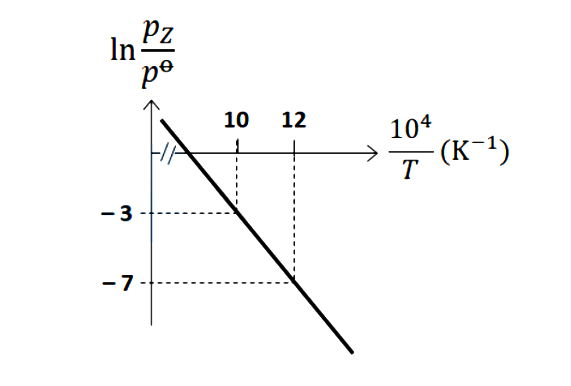
(Given, \(\frac{\mathrm{d}(\ln K)}{\mathrm{d}\left(\frac{1}{T}\right)}=-\frac{\Delta H^{\theta}}{R}\), where the equilibrium constant, \(K=\frac{p_{z}}{p^{\theta}}\) and the gas constant, \(\mathrm{R}=8.314 \mathrm{~J} \mathrm{~K}^{-1} \mathrm{~mol}^{-1}\) )
The value of standard enthalpy, (in ) for the given reaction is ___.JEE Advanced 2021 Hard