


JEE Advanced · Mathematics · 3. Complex Numbers
Let \(z_k=\cos \left(\frac{2 k \pi}{10}\right)+i \sin \left(\frac{2 k \pi}{10}\right) ; k=1,2, \ldots, 9\)
| List - I | List - II |
| (A) For each \(z_k\) there exists a \(z_j\) such \(z_k \cdot z_j=1\) | (P) True |
| (B) There exists a \(k \in\{1,2, \ldots, 9\}\) such that \(z_1 \cdot z=z_k\) has no solution z in the set of complex numbers | (Q) False |
| (C) \(\frac{\left|1-z_1\right|\left|1-z_2\right|\ldots\left|1-z_9\right|}{10}\) equals | (R) 1 |
| (D) \(1-\sum_{k=1}^9 \cos \left(\frac{2 k \pi}{10}\right)\) equals | (S) 2 |
- A a-p;b-s;c-r;d-q;
- B a-p;b-q;c-r;d-s;
- C a-r;b-p;c-q;d-s;
- D a-p;b-r;c-s;d-q;
Answer & Solution
Correct Answer
(B) a-p;b-q;c-r;d-s;
Step-by-step Solution
Detailed explanation
(P) \(z_k\) is \(10^{\text {th }}\) root of unity \(\Rightarrow \overline{z_k}\) will also be \(10^{\text {th }}\) root of unity. Take \(z_j\) as \(\overline{z_k}\)
(Q) \(z_1 \neq 0\) take \(z=\frac{z_k}{z_1}\), we can always find z .
\((R) z^{10}-1=(z-1) \left(z-z_1\right) \ldots\left(z-z_9\right)\)
\(\Rightarrow \left(z-z_1\right) \left(z-z_2\right) \ldots\left(z-z_9\right)=1+z+z^2+\ldots\) \(+~z^9 \forall z \epsilon\) complex number.
Put z = 1
\(\left(1-z_1\right)\left(1-z_2\right) \ldots\left(1-z_9\right)=10 \)
\( (S) \quad 1+z_1+z_2+\ldots+z_9=0 \)
\( \Rightarrow \operatorname{Re}(1)+\operatorname{Re}\left(z_1\right)+\ldots+\operatorname{Re}\left(z_9\right)=0 \)
\( \Rightarrow \operatorname{Re}\left(z_1\right)+\operatorname{Re}\left(z_2\right)+\ldots+\operatorname{Re}\left(z_9\right)=-1 \)
\( \Rightarrow 1-\sum_{k=1}^9 \cos \frac{2 k \pi}{10}=2\)
(Q) \(z_1 \neq 0\) take \(z=\frac{z_k}{z_1}\), we can always find z .
\((R) z^{10}-1=(z-1) \left(z-z_1\right) \ldots\left(z-z_9\right)\)
\(\Rightarrow \left(z-z_1\right) \left(z-z_2\right) \ldots\left(z-z_9\right)=1+z+z^2+\ldots\) \(+~z^9 \forall z \epsilon\) complex number.
Put z = 1
\(\left(1-z_1\right)\left(1-z_2\right) \ldots\left(1-z_9\right)=10 \)
\( (S) \quad 1+z_1+z_2+\ldots+z_9=0 \)
\( \Rightarrow \operatorname{Re}(1)+\operatorname{Re}\left(z_1\right)+\ldots+\operatorname{Re}\left(z_9\right)=0 \)
\( \Rightarrow \operatorname{Re}\left(z_1\right)+\operatorname{Re}\left(z_2\right)+\ldots+\operatorname{Re}\left(z_9\right)=-1 \)
\( \Rightarrow 1-\sum_{k=1}^9 \cos \frac{2 k \pi}{10}=2\)
See the Complete Solution
Get step-by-step explanations for this and 2.5 Lakh+ more JEE, NEET & CET questions.
- Unlock all solutions
- Practice the full chapter
- Track accuracy across PYQs
4.8 rated on Google Play · 14,000+ reviews
More questions from Mathematics
- Paragraph:
Let \(f:[0,1] \rightarrow \mathbb{R}\) (the set of all real numbers) be a function. Suppose the function \(f\) is twice differentiable, \(f(0)=f(1)=0\) and satisfies \(f^{\prime \prime}(x)-2 f^{\prime}(x)+f(x) \geq e^{x}, x \in[0,1] .\)
Question:
Which of the following is true for \(f(x)\) ?JEE Advanced 2013 Hard - Let and be two vectors. Consider a vector If the projection of on the vector is then the minimum value of equalsJEE Advanced 2019 Hard
- Let be a continuous function such that and Then which of the following statements is (are) TRUE?JEE Advanced 2021 Medium
- Let \(p\) and \(q\) be real numbers such that \(p \neq 0, p^3 \neq q\) and \(p^3 \neq-q\). If \(\alpha\) and \(\beta\) are non-zero complex numbers satisfying \(\alpha+\beta=-p\) and \(\alpha^3+\beta^3=q\), then \(a\) quadratic equation having \(\frac{\alpha}{\beta}\) and \(\frac{\beta}{\alpha}\) as its roots isJEE Advanced 2010 Medium
- Let \(g(x)=\log f(x)\), where \(f(x)\) is a twice differentiable positive function on \((0, \infty)\) such that \(f(x+1)=x f(x)\). Then, for \(N=1,2,3, \ldots . g^{\prime \prime}\left(N+\frac{1}{2}\right)-g^{\prime \prime}\left(\frac{1}{2}\right)\) is equal toJEE Advanced 2008 Hard
- The coefficient of in the expansion of isJEE Advanced 2015 Easy
More PYQs from JEE Advanced
- Let \(I=\left(\begin{array}{ll}1 & 0 \\ 0 & 1\end{array}\right)\) and \(P=\left(\begin{array}{ll}2 & 0 \\ 0 & 3\end{array}\right)\). Let \(Q=\left(\begin{array}{ll}\mathrm{x} & \mathrm{y} \\ \mathrm{z} & 4\end{array}\right)\) for some non-zero real numbers \(x, y\), and \(z\), for which there is \(2 \times 2\) matrix \(R\) with all entries being non-zero real numbers, such that \(Q R=R P\). Then which of the following statements is (are) TRUE?JEE Advanced 2025 Medium
- An -particle (mass amu) and a singly charged Sulphur ion (mass amu) are initially at rest. They are accelerated through a potential and then allowed to pass into a region of uniform magnetic field which is normal to the velocities of the particles. Within this region, the -particle and the sulphur ion move in circular orbits of radii and , respectively. The ratio is __________ .JEE Advanced 2021 Easy
- Paragraph:
A small block of mass \(M\) moves on a frictionless surface of an inclined plane, as shown in figure. The angle of the incline suddenly changes from \(60^{\circ}\) to \(30^{\circ}\) at point \(B\). The block is initially at rest at \(A\). Assume that collisions between the block and the incline are totally inelastic \(\left(g=10 \mathrm{~m} / \mathrm{s}^2\right)\)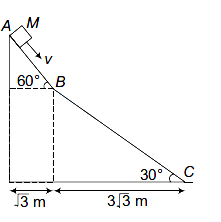
Question:
The speed of the block at point \(B\) immediately after it strikes the second incline isJEE Advanced 2008 Medium - A metal surface is illuminated by light of two different wavelengths 248 nm and 310 nm. The maximum speeds of the photoelectrons corresponding to these wavelengths are u1 and u2, respectively. If the ratio , the work function of the metal is nearlyJEE Advanced 2014 Medium
- Statement I Molecules that are not superimposable on their mirror images are chiral.
Statement II All chiral molecules have chiral centres.JEE Advanced 2007 Easy - The order of the oxidation state of the phosphorus atom in and isJEE Advanced 2017 Easy