


JEE Advanced · Physics · 8. Rotational Motion
The figure shows a system consisting of (i) a ring of outer radius \(3 R\) rolling clockwise without slipping on a horizontal surface with angular speed \(\omega\) and (ii) an inner disc of radius \(2 R\) rotating anti-clockwise with angular speed \(\omega / 2\). The ring and disc are separated by frictionless ball bearings. The point \(P\) on the inner disc is at a distance \(R\) from the origin, where \(O P\) makes an angle of \(30^{\circ}\) with the horizontal. Then with respect to the horizontal surface,
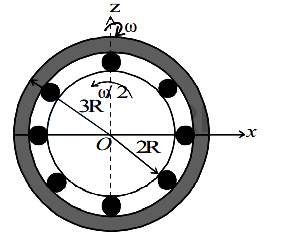
- A the point \(O\) has linear velocity \(3 R \omega \hat{i}\)
- B the point \(P\) has linear velocity \(\frac{11}{4} R \omega \hat{i}+\frac{\sqrt{3}}{4} R \omega \hat{k}\).
- C the point \(P\) has linear velocity \(\frac{13}{4} R \omega \hat{i}-\frac{\sqrt{3}}{4} R \omega \hat{k}\)
- D the point \(P\) has linear velocity
\(\left(3-\frac{\sqrt{3}}{4}\right) R \omega \hat{i}+\frac{1}{4} R \omega \hat{k}\)
Answer & Solution
Correct Answer
(B) the point \(P\) has linear velocity \(\frac{11}{4} R \omega \hat{i}+\frac{\sqrt{3}}{4} R \omega \hat{k}\).
Step-by-step Solution
Detailed explanation
Velocity at centre 'O' \(\quad \therefore \quad \vec{v}_{o}=3 R \omega \hat{i}\)
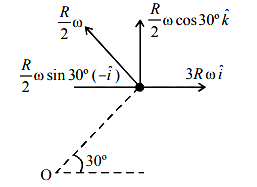
\(\vec{V}_{P}=3 R \omega \hat{i}-\frac{R \omega}{2} \sin 30^{\circ} \hat{i}+\frac{R \omega}{2} \cos 30^{\circ} \hat{k}\)
\(\therefore \quad \vec{V}_{P}=\left[3 R_{\omega} \hat{i}-\frac{R_{\omega}}{4} \hat{i}\right]+\frac{\sqrt{3} R_{\omega}}{4} \hat{k}\)
or, \(\quad \vec{V}_{P}=\frac{11}{4} R_{\omega} \hat{i}+\frac{\sqrt{3}}{4} R_{\omega} \hat{k}\)
\(\vec{V}_{P}=3 R \omega \hat{i}-\frac{R \omega}{2} \sin 30^{\circ} \hat{i}+\frac{R \omega}{2} \cos 30^{\circ} \hat{k}\)
\(\therefore \quad \vec{V}_{P}=\left[3 R_{\omega} \hat{i}-\frac{R_{\omega}}{4} \hat{i}\right]+\frac{\sqrt{3} R_{\omega}}{4} \hat{k}\)
or, \(\quad \vec{V}_{P}=\frac{11}{4} R_{\omega} \hat{i}+\frac{\sqrt{3}}{4} R_{\omega} \hat{k}\)
See the Complete Solution
Get step-by-step explanations for this and 2.5 Lakh+ more JEE, NEET & CET questions.
- Unlock all solutions
- Practice the full chapter
- Track accuracy across PYQs
4.8 rated on Google Play · 14,000+ reviews
More questions from Physics
- A Hydrogen-like atom has atomic number . Photons emitted in the electronic transitions from level to level in these atoms are used to perform photoelectric effect experiment on a target metal. The maximum kinetic energy of the photoelectrons generated is . If the photoelectric threshold wavelength for the target metal is , the value of is _____.
[Given and , where is the Rydberg constant, is the Planck’s constant and is the speed of light in vacuum]JEE Advanced 2023 Medium - Paragraph:
Light guidance in an optical fiber can be understood by considering a structure comprising of thin solid glass cylinder of refractive index \(n_{1}\) surrounded by a medium of lower refractive index \(n_{2}\). The light guidance in the structure takes place due to successive total internal reflections at the interface of the media \(n_{1}\) and \(n_{2}\) as shown in the figure. All rays with the angle of incidence \(i\) less than a particular value \(i_{m}\) are confined in the medium of refractive index \(n_{1}\). The numerical aperture (NA) of the structure is defined as \(\sin i_{m}\).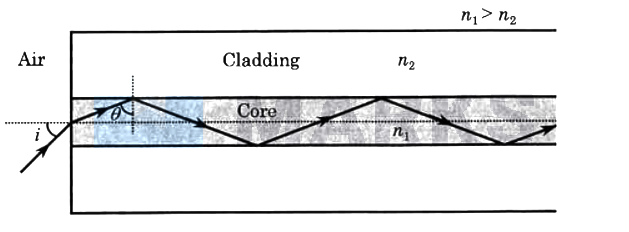
Question:
For two structures namely \(S_{1}\) with \(n_{1}=\sqrt{45} / 4\) and \(n_{2}=3 / 2\), and \(S_{2}\) with \(n_{1}=8 / 5\) and \(n_{2}=7 / 5\) and taking the refractive index of water to be \(4 / 3\) and that of air to be \(1\) , the correct option(s) is(are)JEE Advanced 2015 Medium - The radius of the orbit of an electron in a Hydrogen-like atom is \(4.5 a _0\), where \(a _0\) is the Bohr radius. Its orbital angular momentum is \(\frac{3 h}{2 \pi}\). It is given that \(h\) is Planck's constant and R is Rydberg constant. the possible wavelength \((s)\), when the atom de-excites, is (are)JEE Advanced 2013 Easy
- The work done on a particle of mass m by a force (K being a constant of appropriate dimensions, when the particle is taken from the point (a,0) to the point (0,a) along a circular path of radius a about the origin in the x-y plane isJEE Advanced 2013 Medium
- A free hydrogen atom after absorbing a photon of wavelength gets excited from the state to the state Immediately after that the electron jumps to state by emitting a photon of wavelength Let the change in momentum of atom due to the absorption and the emission are and respectively. If Which of the option(s) is/are correct?
[Use and are Planck's constant and speed of light, respectively]JEE Advanced 2019 Medium - List I describes thermodynamic processes in four different systems. List II gives the magnitudes (either exactly or as a close approximation) of possible changes in the internal energy of the system due to the process.
Which one of the following options is correct?List-I List-II (I) of water is converted to steam at the same temperature, at a pressure of . The volume of the system changes from to in the process. Latent heat of water (P) (II) moles of a rigid diatomic ideal gas with volume at temperature undergoes an isobaric expansion to volume . Assume (Q) (III) One mole of a monoatomic ideal gas is compressed adiabatically from volume and pressure to volume . (R) (IV) Three moles of a diatomic ideal gas whose molecules can vibrate, is given of heat and undergoes isobaric expansion. (S) (T) JEE Advanced 2022 Medium
More PYQs from JEE Advanced
- Consider the given data with frequency distribution Match each entry in List-I to the correct entries in List-II.
The correct option isList-I List-II The mean of the above data is The median of the above data is The mean deviation about the
mean of the above data isThe mean deviation about the
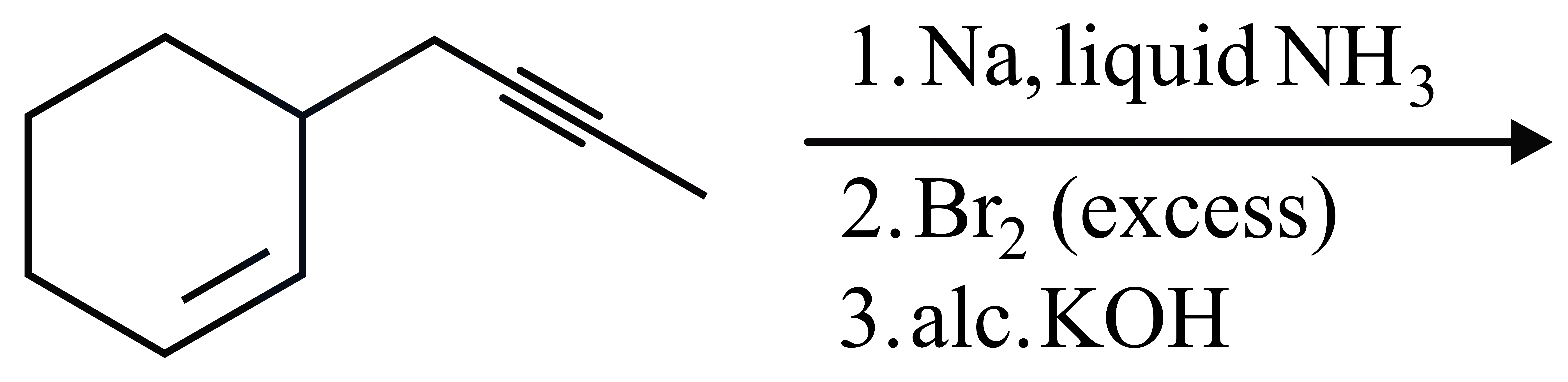
median of the above data isJEE Advanced 2023 Easy - The number of isomeric tetraenes (NOT containing sp-hybridized carbon atoms) that can be formed from the following reaction sequence is _____ .
 JEE Advanced 2022 Hard
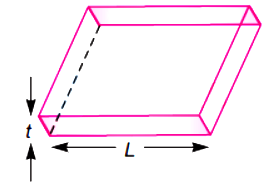
 - Consider a thin square sheet of side \(L\) and thickness \(t\), made of a material of resistivity \(\rho\). The resistance between two opposite faces, shown by the shaded areas in the figure is
 JEE Advanced 2010 Medium
 - Let \(\mathbb{R}^2\) denote \(\mathbb{R} \times \mathbb{R}\). Let \(S=\left\{(a, b, c): a, b, c \in \mathbb{R} \text { and } a x^2+2 b x y+c y^2>0 \text { for all }(x, y) \in \mathbb{R}^2-\{(0,0)\}\right\} .\)
Then which of the following statements is (are) TRUE?JEE Advanced 2024 Easy - Let be two non-constant differentiable functions. If , and then which of the following statement(s) is (are) TRUE?JEE Advanced 2018 Medium
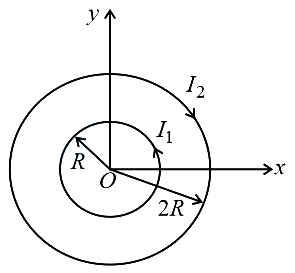
- Two concentric circular loops, one of radius and the other of radius , lie in the -plane with the origin as their common center, as shown in the figure. The smaller loop carries current in the anti-clockwise direction and the larger loop carries current in the clockwise direction, with denotes the magnetic field at a point in the -plane. Which of the following statement(s) is (are) correct?
 JEE Advanced 2021 Hard