


JEE Advanced · Physics · 22. AC Circuits
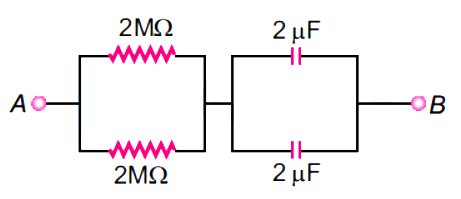
At time \(t=0\), a battery of \(10 \mathrm{~V}\) is connected across points \(A\) and \(B\) in the given circuit. If the capacitors have no charge initially, at what time (in second) does the voltage across them become \(4 \mathrm{~V}\) ?
[Take \(: \ln 5=1.6, \ln 3=1.1]\)
- A 1
- B 2
- C 3
- D 4
Answer & Solution
Correct Answer
(B) 2
Step-by-step Solution
Detailed explanation
Voltage across the capacitors will increase from 0 to \(10 \mathrm{~V}\) exponentially. The voltage at time \(t\) will be given by
\(
\begin{aligned}
& V=10\left(1-e^{-t / \tau} \mathrm{C}\right) \\
& \text { Here } \tau_c=C_{\text {net }} R_{\text {net }} \\
& =\left(1 \times 10^6\right)\left(4 \times 10^{-6}\right)=4 \mathrm{~s} \\
& \therefore V=10\left(1-e^{-t / 4}\right)\end{aligned}
\)
Substituting \(V=4\) volt we have,
\(
4=10\left(1-e^{-t / 4}\right)
\)
Substituting \(V=4\) volt we have,
\(
4=10\left(1-e^{-t / 4}\right)
\)
or \(e^{-t / 4}=0.6=\frac{3}{5}\)
Taking \(\log\) both sides we have,
\(
-\frac{t}{4}=\ln 3-\ln 5
\)
or \(\quad t=4(\ln 5-\ln 3)=2 \mathrm{~s}\).
Hence, the answer is 2 .
\(
\begin{aligned}
& V=10\left(1-e^{-t / \tau} \mathrm{C}\right) \\
& \text { Here } \tau_c=C_{\text {net }} R_{\text {net }} \\
& =\left(1 \times 10^6\right)\left(4 \times 10^{-6}\right)=4 \mathrm{~s} \\
& \therefore V=10\left(1-e^{-t / 4}\right)\end{aligned}
\)
Substituting \(V=4\) volt we have,
\(
4=10\left(1-e^{-t / 4}\right)
\)
Substituting \(V=4\) volt we have,
\(
4=10\left(1-e^{-t / 4}\right)
\)
or \(e^{-t / 4}=0.6=\frac{3}{5}\)
Taking \(\log\) both sides we have,
\(
-\frac{t}{4}=\ln 3-\ln 5
\)
or \(\quad t=4(\ln 5-\ln 3)=2 \mathrm{~s}\).
Hence, the answer is 2 .
See the Complete Solution
Get step-by-step explanations for this and 2.5 Lakh+ more JEE, NEET & CET questions.
- Unlock all solutions
- Practice the full chapter
- Track accuracy across PYQs
4.8 rated on Google Play · 14,000+ reviews
More questions from Physics
- The diameter of a cylinder is measured using a vernier calipers with no zero error. It is found that the zero of the vernier scale lies between and of the main scale. The vernier scale has divisions equivalent to . The division of the vernier scale exactly coincides with one of the main scale divisions. The diameter of the cylinder is,JEE Advanced 2013 Easy
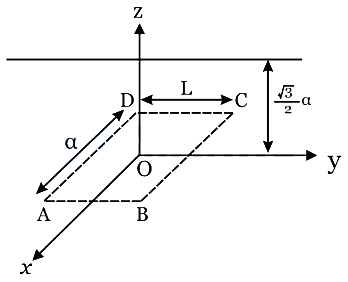
- An infinitely long uniform line charge distribution of charge per unit length lies parallel to the -axis in the - plane at (see figure). If the magnitude of the flux of the electric field through the rectangular surface lying in the - plane with its centre at the origin is ( permittivity of free space), then the value of is
 JEE Advanced 2015 Hard
 - An electron in a hydrogen atom undergoes a transition from an orbit with a quantum number to another quantum number . are the initial and final potential energies of the electron. If then the smallest isJEE Advanced 2017 Medium
- A charged particle is introduced at the origin with a given initial velocity . A uniform electric field and a uniform magnetic field exist everywhere. The velocity , electric field and a uniform magnetic field are given in the columns below
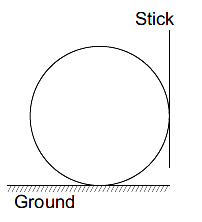
In which case would the particle move in a straight line along the negative direction of y axisColumn 1 Column 2 Column 3 1. Electron with (i) (P) 2. Electron with (ii) (Q) 3.Proton with =0 (iii) (R) 4. Proton with (iv) (S) JEE Advanced 2017 Medium - A boy is pushing a ring of mass \(2 \mathrm{~kg}\) and radius \(0.5 \mathrm{~m}\) with a stick as shown in the figure. The stick applies a force of \(2 \mathrm{~N}\) on the ring and rolls it without slipping with an acceleration of \(0.3 \mathrm{~m} / \mathrm{s}^2\). The coefficient of friction between the ground and the ring is large enough that rolling always occurs and the coefficient of friction between the stick and the ring is \(\frac{P}{10}\). The value of \(P\) is
 JEE Advanced 2011 Hard
 - Two men are walking along a horizontal straight line in the same direction. The man in front walks at a speed and the man behind walks at a speed . A third man is standing at a height above the same horizontal line such that all three men are in a vertical plane. The two walking men are blowing identical whistles which emit a sound of frequency . The speed of sound in air is At the instant, when the moving men are apart, the stationary man is equidistant from them. The frequency of beats in , heard by the stationary man at this instant, is __________.JEE Advanced 2018 Hard
More PYQs from JEE Advanced
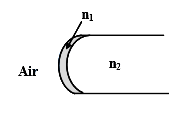
- A transparent thin film of uniform thickness and refractive index is coated on the convex spherical surface of radius R at one end of a long solid glass cylinder of refractive index , as shown in the figure. Rays of light parallel to the axis of the cylinder traversing through the film from air to glass get focused at distance f1 from the film, while rays of light traversing from glass to air get focused at distance f2 from the film. Then
 JEE Advanced 2014 Medium
 - The minimum number of times a fair coin needs to be tossed so that the probability of getting at least two heads is at least , isJEE Advanced 2015 Easy
- If \(f^{\prime \prime}(x)=-f(x)\), where \(f(x)\) is a continuous double differentiable function and \(g(x)=f^{\prime}(x)\). If \(F(x)=\left(f\left(\frac{x}{2}\right)\right)^2+\left(g\left(\frac{x}{2}\right)\right)^2\) and \(F(5)=5\), then \(F(10)\) isJEE Advanced 2006 Medium
- Let be a function defined by , where is the greatest integer less than or equal to . If then the value of isJEE Advanced 2015 Medium
- The maximum value of the expression \(\frac{1}{\sin ^2 \theta+3 \sin \theta \cos \theta+5 \cos ^2 \theta}\) isJEE Advanced 2010 Easy
- The tangent to the curve \(y=e^x\) drawn at the point \(\left(c, e^c\right)\) intersects the line joining the points \(\left(c-1, e^{c-1}\right)\) and \(\left(c+1, e^{c+1}\right)\)JEE Advanced 2007 Medium