


JEE Advanced · Physics · 8. Rotational Motion
A boy is pushing a ring of mass \(2 \mathrm{~kg}\) and radius \(0.5 \mathrm{~m}\) with a stick as shown in the figure. The stick applies a force of \(2 \mathrm{~N}\) on the ring and rolls it without slipping with an acceleration of \(0.3 \mathrm{~m} / \mathrm{s}^2\). The coefficient of friction between the ground and the ring is large enough that rolling always occurs and the coefficient of friction between the stick and the ring is \(\frac{P}{10}\). The value of \(P\) is
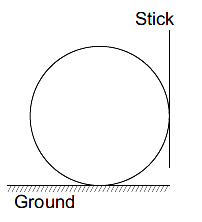
- A 2
- B 4
- C 6
- D 8
Answer & Solution
Correct Answer
(B) 4
Step-by-step Solution
Detailed explanation
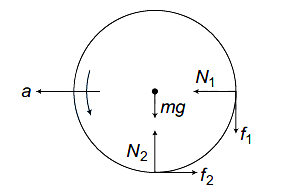
There is no slipping between ring and ground. Hence, \(f_2\) is not maximum. But there is slipping between ring and stick. Therefore, \(f_1\) is maximum. Now, let us write the equations.
\(I =m R^2=(2)(0.5)^2 \)
\( =\frac{1}{2} \mathrm{kgm}^{-2} \)
\( N_1-F_2 =m a \)
\( \text { or } N_1-F_2 =(2)(0.3)=0.6 \mathrm{~N} \)
\( a =R \alpha=\frac{R \tau}{I} \)
\( =\frac{R\left(f_2-f_1\right) R}{I}=\frac{R^2\left(f_2-f_1\right)}{I} \)
\( \therefore 0.3 =\frac{(0.5)^2\left(f_2-f_1\right)}{(1 / 2)} \)
\( \text { or } \quad f_2-f_1 =0.6 \mathrm{~N} \)
\( N_1^2+f_1^2 =(2)^2=4\)
Further \(\quad F_1=\mu N_1=\left(\frac{P}{10}\right) N_1\)
Solving above four equation, we get \(P \simeq 3.6\)
Therefore, the correct answer should be 4 .
Analysis of Question
(i) Question is moderately tough from concept point of view. But calculations are lengthy.
(ii) One has to think about the two components of the force applied by the stick.
(iii) Answer comes an integer when you consider only \(N_1\).
See the Complete Solution
Get step-by-step explanations for this and 2.5 Lakh+ more JEE, NEET & CET questions.
- Unlock all solutions
- Practice the full chapter
- Track accuracy across PYQs
4.8 rated on Google Play · 14,000+ reviews
More questions from Physics
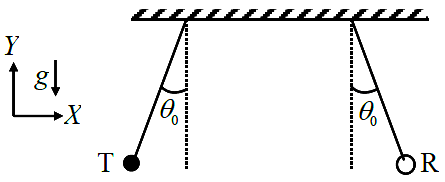
- An audio transmitter \((T)\) and a receiver \((R)\) are hung vertically from two identical massless strings of length 8 m with their pivots well separated along the \(X\) axis. They are pulled from the equilibrium position in opposite directions along the \(X\) axis by a small angular amplitude \(\theta_0=\cos ^{-1}(0.9)\) and released simultaneously. If the natural frequency of the transmitter is 660 Hz and the speed of sound in air is \(330 \mathrm{~m} / \mathrm{s}\), the maximum variation in the frequency (in Hz ) as measured by the receiver (Take the acceleration due to gravity \(g=10 \mathrm{~m} / \mathrm{s}^2\) ) is \(\qquad\)
 JEE Advanced 2025 Hard
 - One end of a horizontal thick copper wire of length and radius is welded to an end of another horizontal thin copper wire of length and radius. When the arrangement stretched by applying forces at two ends, the ratio of the elongation in the thin wire to that in the thick wire isJEE Advanced 2013 Easy
- The activity of a freshly prepared radioactive sample is \(10^{10}\) disintegrations per second, whose mean life is \(10^{-9} \mathrm{~s}\). The mass of an atom of this radioisotope is \(10^{-25} \mathrm{~kg}\). The mass (in \(\mathrm{mg}\) ) of the radioactive sample isJEE Advanced 2011 Medium
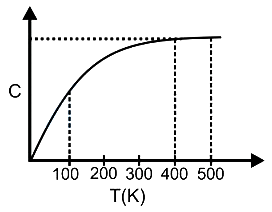
- The figure below shows the variation of specific heat capacity () of a solid as a function of temperature (). The temperature is increased continuously from to at a constant rate. Ignoring any volume change, the following statement (s) is (are) correct to a reasonable approximation.
 JEE Advanced 2013 Medium
 - A medium having dielectric constant fills the space between the plates of a parallel plate capacitor. The plates have large area, and the distance between them is . The capacitor is connected to a battery of voltage . as shown in Figure (a). Now, both the plates are moved by a distance of from their original positions, as shown in Figure (b).
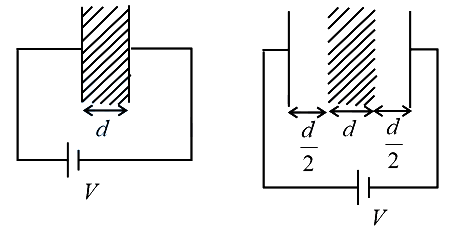
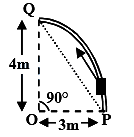
In the process of going from the configuration depicted in Figure (a) to that in Figure (b), which of the following statement(s) is(are) correct?JEE Advanced 2022 Medium - Consider an elliptically shaped rail PQ in the vertical plane with and . A block of mass 1 kg is pulled along the rail from P to Q with a force of 18 N, which is always parallel to line PQ (see the figure given). Assuming no frictional losses, the kinetic energy of the block when it reaches Q is Joules. The value of n is (take acceleration due to gravity = )
 JEE Advanced 2014 Hard
More PYQs from JEE Advanced
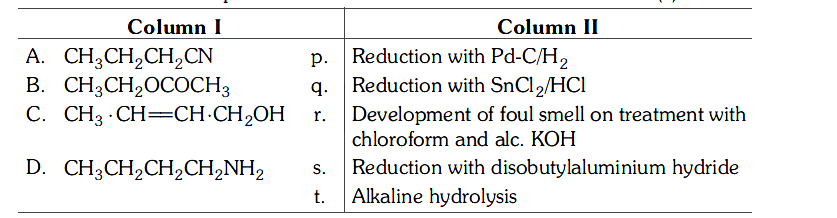
- Match each of the compounds is Column I with its characteristic reaction(s) is Column II.
 JEE Advanced 2009 Hard
 - Paragraph:
Let \(O\) be the origin, and \(\overrightarrow{O X}, \overrightarrow{O Y}, \overrightarrow{O Z}\) be three unit vectors in the directions of the sides \(\overrightarrow{Q R}, \overrightarrow{R P}\), \(\overrightarrow{P Q}\), respectively, of a triangle \(P Q R\).
Question:
\(|\overrightarrow{O X} \times \overrightarrow{O Y}|=\)JEE Advanced 2017 Easy - Let and be real numbers such that . If and , then the greatest integer less than or equal to isJEE Advanced 2022 Medium
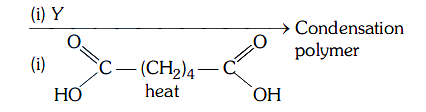
- The correct functional group \(X\) and the reagent/reaction conditions \(Y\) in the following schemes are \(\mathrm{X}-\left(\mathrm{CH}_2\right)_4-X\)
 JEE Advanced 2011 Hard
 - The compound (s) having peroxide linkage is(are) :JEE Advanced 2024 Easy
- A small electric dipole \(\vec{p}_0\), having a moment of inertia \(I\) about its center, is kept at a distance \(r\) from the center of a spherical shell of radius \(R\). The surface charge density \(\sigma\) is uniformly distributed on the spherical shell. The dipole is initially oriented at a small angle \(\theta\) as shown in the figure. While staying at a distance \(r\), the dipole is free to rotate about its center.
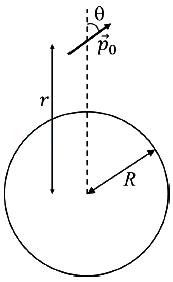
If released from rest, then which of the following statement(s) is(are) correct?
[ \(\varepsilon_0\) is the permittivity of free space.]JEE Advanced 2024 Medium