


JEE Advanced · Physics · 20. Magnetism & Current
A charged particle is introduced at the origin with a given initial velocity . A uniform electric field and a uniform magnetic field exist everywhere. The velocity , electric field and a uniform magnetic field are given in the columns below
| Column 1 | Column 2 | Column 3 |
| 1. Electron with | (i) | (P) |
| 2. Electron with | (ii) | (Q) |
| 3.Proton with =0 | (iii) | (R) |
| 4. Proton with | (iv) | (S) |
- A
- B
- C
- D
Answer & Solution
Correct Answer
(D)
Step-by-step Solution
Detailed explanation
For particle to move in -ve y-direction, either its velocity must be in –ve y-direction (if initial velocity 0) and force should be parallel to velocity or it must experience a net force in –ve y-direction only (if initial velocity = 0)
See the Complete Solution
Get step-by-step explanations for this and 2.5 Lakh+ more JEE, NEET & CET questions.
- Unlock all solutions
- Practice the full chapter
- Track accuracy across PYQs
4.8 rated on Google Play · 14,000+ reviews
More questions from Physics
- Three plane mirrors form an equilateral triangle with each side of length . There is a small hole at a distance from one of the corners as shown in the figure. A ray of light is passed through the hole at an angle and can only come out through the same hole. The cross section of the mirror configuration and the ray of light lie on the same plane.
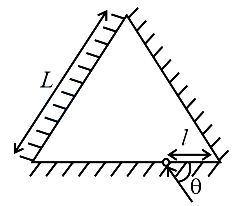
Which of the following statement(s) is(are) correct?JEE Advanced 2022 Medium - A resistance of \(2 \Omega\) is connected across one gap of a meter-bridge (the length of the wire is \(100 \mathrm{~cm}\) ) and an unknown resistance, greater than \(2 \Omega\), is connected across the other gap. When these resistances are interchanged, the balance point shifts by \(20 \mathrm{~cm}\). Neglecting any corrections, the unknown resistance isJEE Advanced 2007 Medium
- Highly excited states for hydrogen like atoms (also called Rydberg states) with nuclear charge Ze are defined by their principal quantum number n, where n >> 1. Which of the following statement(s) is (are) true?JEE Advanced 2016 Medium
- A cylindrical furnace has height and diameter both . It is maintained at temperature . The air getsheated inside the furnace at constant pressureand its temperature becomes . The hot air with density rises up a vertical chimney of diameter and height above the furnace and exits the chimney (seethe figure). As a result, atmospheric air of density,pressure and temperature entersthe furnace. Assume air as an ideal gas, neglect the variations inand inside the chimney and the furnace. Also ignore the viscous effects.
[Given: The acceleration due to gravityand]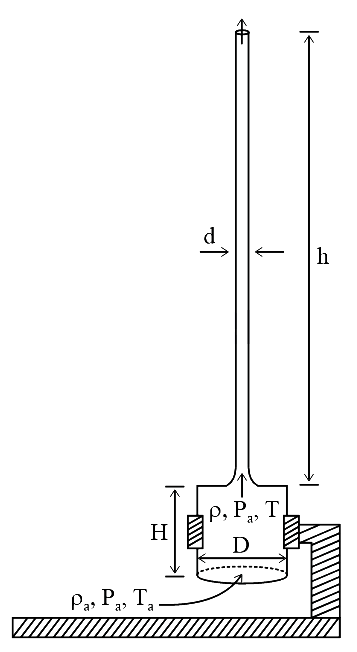
When the chimney is closed using a cap at the top, a pressure difference develops between the top and the bottom surfaces of the cap. If the changes in the temperature and density of the hot air, due to the stoppage of air flow, are negligible then the value of is _____ .JEE Advanced 2023 Medium - A steady current \(I\) goes through a wire loop \(P Q R\) having shape of a right angle triangle with \(P Q=3 x, P R=4 x\) and \(Q R=5 x\). If the magnitude of the magnetic field at \(P\) due to this loop is \(k\left(\frac{\mu_0 I}{48 \pi x}\right)\), find the value of \(k\).JEE Advanced 2009 Easy
- A mixture of 2 moles of helium gas (atomic mass \(=4 \mathrm{amu}\) ) and 1 mole of argon gas (atomic mass \(=40 \mathrm{amu}\) ) is kept at \(300 \mathrm{~K}\) in a container. The ratio of the rms speeds \(\left(\frac{v_{\mathrm{rms}}(\text { helium })}{v_{\mathrm{rms}}(\operatorname{argon})}\right)\) isJEE Advanced 2012 Easy
More PYQs from JEE Advanced
- The correct acidity order of the following is
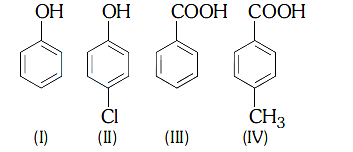 JEE Advanced 2009 Easy
 - is ethylenediaminetetraacetate ion. The total number of N - Co - O bond angles in complex ion isJEE Advanced 2013 Hard
- Let be a positive real number. Let and be the functions defined by and .
Then the value of is ______.JEE Advanced 2022 Medium - The total number of chiral molecules formed from one molecule of on complete ozonolysis is _____
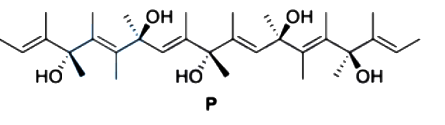 JEE Advanced 2022 Easy
 - If is the solution of the differential equation for , and the slope of the curve is never zero, then the value of is _____ .JEE Advanced 2022 Easy
- A particle of mass is subjected to a force which depends on the position as with . At time , the particle's position and its velocity . Let and denote the and the components of the particle's velocity, respectively. Ignore gravity. When , the value of is ______ .JEE Advanced 2022 Hard