


JEE Advanced · Mathematics · 25. AOD
The maximum value of the expression \(\frac{1}{\sin ^2 \theta+3 \sin \theta \cos \theta+5 \cos ^2 \theta}\) is
- A 9
- B 4
- C 2
- D 10
Answer & Solution
Correct Answer
(C) 2
Step-by-step Solution
Detailed explanation
Let
\[
\begin{aligned}
& f(\theta)=\frac{1}{\sin ^2 \theta+3 \sin \theta \cos \theta+5 \cos ^2 \theta} \\
& \text { Again let } \\
& g(\theta)=\sin ^2 \theta+3 \sin \theta \cos \theta+5 \cos ^2 \theta \\
& =\frac{1-\cos 2 \theta}{2}+5\left(\frac{1+\cos 2 \theta}{2}\right)+\frac{3}{2} \sin 2 \theta \\
& =3+2 \cos 2 \theta+\frac{3}{2} \sin 2 \theta \\
& \therefore \quad g(\theta)_{\min }=3-\sqrt{4+\frac{9}{4}}=3-\frac{5}{2}=\frac{1}{2} \\
& \therefore \quad f(\theta)=\frac{1}{g(\theta)_{\min }}=2
\end{aligned}
\]
\[
\begin{aligned}
& f(\theta)=\frac{1}{\sin ^2 \theta+3 \sin \theta \cos \theta+5 \cos ^2 \theta} \\
& \text { Again let } \\
& g(\theta)=\sin ^2 \theta+3 \sin \theta \cos \theta+5 \cos ^2 \theta \\
& =\frac{1-\cos 2 \theta}{2}+5\left(\frac{1+\cos 2 \theta}{2}\right)+\frac{3}{2} \sin 2 \theta \\
& =3+2 \cos 2 \theta+\frac{3}{2} \sin 2 \theta \\
& \therefore \quad g(\theta)_{\min }=3-\sqrt{4+\frac{9}{4}}=3-\frac{5}{2}=\frac{1}{2} \\
& \therefore \quad f(\theta)=\frac{1}{g(\theta)_{\min }}=2
\end{aligned}
\]
See the Complete Solution
Get step-by-step explanations for this and 2.5 Lakh+ more JEE, NEET & CET questions.
- Unlock all solutions
- Practice the full chapter
- Track accuracy across PYQs
4.8 rated on Google Play · 14,000+ reviews
More questions from Mathematics
- Paragraph:
Let \(f:[0,1] \rightarrow \mathbb{R}\) (the set of all real numbers) be a function. Suppose the function \(f\) is twice differentiable, \(f(0)=f(1)=0\) and satisfies \(f^{\prime \prime}(x)-2 f^{\prime}(x)+f(x) \geq e^{x}, x \in[0,1] .\)
Question:
If the function \(\mathrm{e}^{-x} f(x)\) assumes its minimum in the interval \([0,1]\) at \(x=\frac{1}{4}\), which of the following is true?JEE Advanced 2013 Hard - Consider the following linear equations
\[
a x+b y+c z=0, b x+c y+a z=0, c x+a y+b z=0
\]
Match the conditions/expressions in Column I with statements in Column II.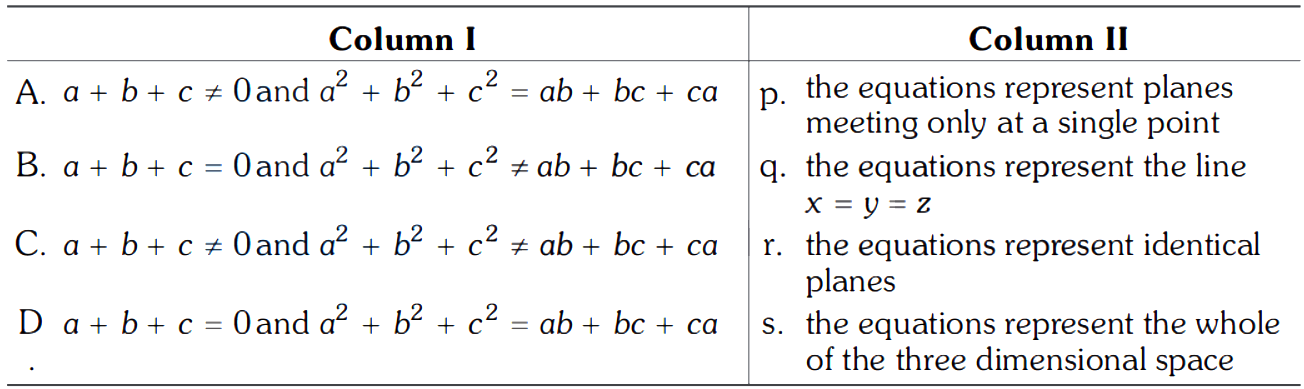 JEE Advanced 2007 Medium
 - Let \(k \in \mathbb{R}\). If \(\lim _{x \rightarrow 0^+}(\sin (\sin k x)+\cos x+x)^{\frac{2}{x}}=e^6\), then the value of \(k\) isJEE Advanced 2024 Easy
- If \(\lim _{x \rightarrow \infty}\left(\frac{x^{2}+x+1}{x+1}-a x-b\right)=4\), thenJEE Advanced 2012 Hard
- Let and be two distinct common tangents to the ellipse and the parabola . Suppose that the tangent touches and at the points and , respectively and the tangent touches and at the points and , respectively. Then which of the following statements is(are) true?JEE Advanced 2023 Medium
- The number of solutions of the pair of equations \(2 \sin ^2 \theta-\cos 2 \theta=0\) and \(2 \cos ^2 \theta-3 \sin \theta=0\) in the interval \([0,2 \pi]\) isJEE Advanced 2007 Easy
More PYQs from JEE Advanced
- The number of -digit integers in the closed interval formed by using the digits is ______.JEE Advanced 2022 Hard
- Let be non-zero complex numbers and be the set of solutions of the equation , where . Then, which of the following statement(s) is (are) TRUE?JEE Advanced 2018 Medium
- Paragraph:
There are some deposits of nitrates and phosphates in earth's crust. Nitrates are more soluble in water. Nitrates are difficult to reduce under the laboratory conditions but microbes do it easily. Ammonia forms large number of complexes with transition metal ions. Hybridisation easily explains the ease of sigma donation capability of \(\mathrm{NH}_3\) and \(\mathrm{PH}_3\). Phosphine is a flammable gas and is prepared from white phosphorus.
Question:
White phosphorus on reaction with \(\mathrm{NaOH}\) gives \(\mathrm{PH}_3\) as one of the products. This is aJEE Advanced 2008 Easy - In an experiment for determination of the focal length of a thin convex lens, the distance of the object from the lens is and the distance of its real image from the lens is . The error in the determination of focal length of the lens is . The value of is _____.JEE Advanced 2023 Easy
- Paragraph:
Consider the polynomial \(f(x)=1+2 x+3 x^2+4 x^3\). Let \(s\) be the sum of all distinct real roots of \(f(x)\) and let \(t=|s|\).Question:
The real number \(s\) lies in the intervalJEE Advanced 2010 Medium - let be defined by
List – I List – II (A) is (P) Onto but not one – one (B) is (Q) neither continuous nor one-one (C) of is (R) differentiable but not one-one (D) is (S) continuous and one-one JEE Advanced 2014 Medium