


JEE Advanced · Physics · 24. Ray Optics
A thin convex lens is made of two materials with refractive indices and as shown in figure. The radius of curvature of the left and right spherical surfaces are equal. is the focal length of the lens when The focal length is when and Assuming and the correct statement(s) is/are:
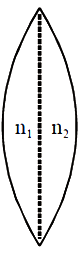
- A For and the value of will be (round off to decimal place)
- B The relation between and remains unchanged if both the convex surfaces are replaced by concave surfaces of the same radius of curvature.
- C
- D If then
Answer & Solution
Correct Answer
(A) For and the value of will be (round off to decimal place)
Step-by-step Solution
Detailed explanation
Given that the lens is made of two plano-convex lenses. Let it be or .
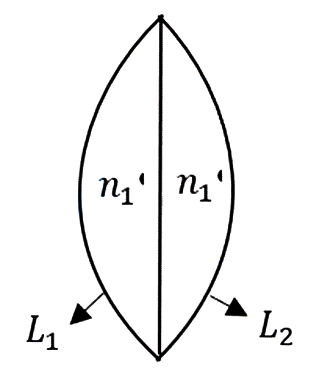
Let focal length of
An focal length of
Using lens maker's formula,
and
Now, for the first situation, given that,
and focal length of combination is
....(1)
In the second situation, and focal length=
.....(2)
Nos dividing equation (1)/(2) we get
Now, as is very small
Now, option
is correct.
Option
The relation between or is dependent of
Remain unchanged for convex or concave surfaces
is correct.
Option
As
is incorrect.
Option
If then using equation
is correct.
Let focal length of
An focal length of
Using lens maker's formula,
and
Now, for the first situation, given that,
and focal length of combination is
....(1)
In the second situation, and focal length=
.....(2)
Nos dividing equation (1)/(2) we get
Now, as is very small
Now, option
is correct.
Option
The relation between or is dependent of
Remain unchanged for convex or concave surfaces
is correct.
Option
As
is incorrect.
Option
If then using equation
is correct.
See the Complete Solution
Get step-by-step explanations for this and 2.5 Lakh+ more JEE, NEET & CET questions.
- Unlock all solutions
- Practice the full chapter
- Track accuracy across PYQs
4.8 rated on Google Play · 14,000+ reviews
More questions from Physics
- During Searle's experiment, zero of the Vernier scale lies between and of the main scale. The division of the Vernier scale exactly coincides with one of the main scale divisions. When an additional load of 2 kg is applied to the wire, the zero of the Vernier scale still lies between and of the main scale but now the division of Vernier scale coincides with one of the main scale divisions. The length of the thin metallic wire is 2 m and its cross-sectional area is . The least count of the Vernier scale is . The maximum percentage error in the Young's modulus of the wire isJEE Advanced 2014 Easy
- A block of base \(10 \mathrm{~cm} \times 10 \mathrm{~cm}\) and height \(15 \mathrm{~cm}\) is kept on an inclined plane. The coefficient of friction between them is \(\sqrt{3}\). The inclination \(\theta\) of this inclined plane from the horizontal plane is gradually increased from \(0^{\circ}\). Then,JEE Advanced 2009 Medium
- List-I shows four configurations, each consisting of a pair of ideal electric dipoles. Each dipole has a dipole moment of magnitude \(p\), oriented as marked by arrows in the figures. In all the configurations the dipoles are fixed such that they are at a distance \(2 r\) apart along the \(x\) direction. The midpoint of the line joining the two dipoles is \(X\). The possible resultant electric fields \(\vec{E}\) at \(X\) are given in List-II. Choose the option that describes the correct match between the entries in List-I to those in List-II.
List-I List-II \((P)\) 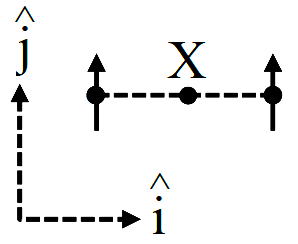
\((1)\) \(\vec{E}=0\) \((Q)\) 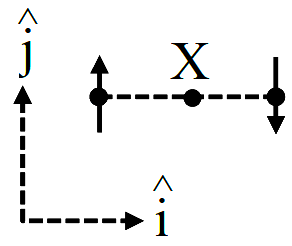
\((2)\) \(\vec{E}=-\frac{p}{2 \pi \epsilon_0 \mathrm{r}^3} \hat{\mathrm{j}}\) \((R)\) 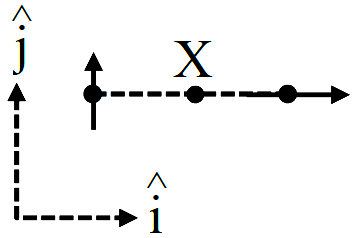
\((3)\) \(\vec{E}=-\frac{p}{4 \pi \epsilon_0 \mathrm{r}^3}(\hat{\mathrm{i}}-\hat{\mathrm{j}})\) \((S)\) 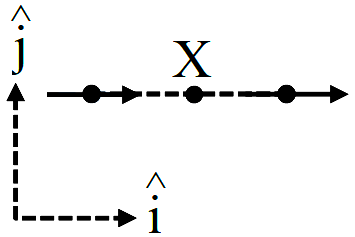
\((4)\) \(\vec{E}=\frac{p}{4 \pi \epsilon_0 \mathrm{r}^3}(2 \hat{\mathrm{i}}-\hat{\mathrm{j}})\) \((5)\) \(\vec{E}=\frac{p}{\pi \epsilon_0 \mathrm{r}^3} \hat{\mathrm{i}}\) JEE Advanced 2025 Hard - Using the expression , one calculates the values of by measuring the corresponding angle in the range to . The wavelength is exactly known and the error in is constant for all the values of . As increases from ,JEE Advanced 2013 Easy
- Column I showns four systems, each of the same length \(L\), for producing standing waves. The lowest possible natural frequency of a system is called its fundamental frequency, whose wavelength is denoted as \(\lambda_f\). Match each system with statements given in Column II describing the nature and wave length of the standing waves.
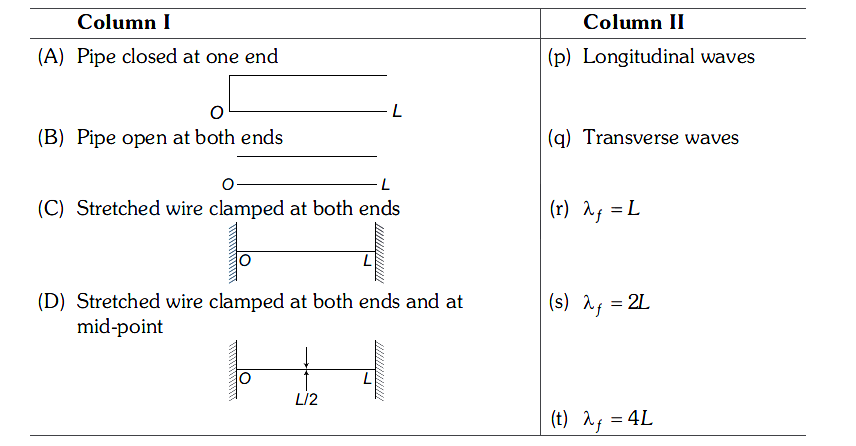 JEE Advanced 2011 Hard
 - A massless rod \(B D\) is suspended by two identical massless strings \(A B\) and \(C D\) of equal lengths. A block of mass ' \(m\) ' is suspended point \(P\) such that \(B P\) is equal to ' \(x\) ', if the fundamental frequency of the left wire is twice the fundamental frequency of right wire, then the value of \(x\) is
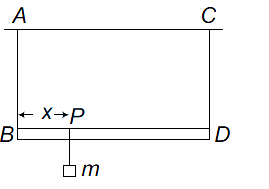 JEE Advanced 2006 Hard
More PYQs from JEE Advanced
- An ideal gas is expanding such that \(p T^2=\) constant. The coefficient of volume expansion of the gas isJEE Advanced 2008 Medium
- Paragraph:
The noble gases have closed-shell electronic configuration and are monoatomic gases under normal conditions. The low boiling points of the lighter noble gases are due to weak dispersion forces between the atoms and the absence of other interatomic interactions.
The direct reaction of xenon with fluorine leads to a series of compounds with oxidation numbers \(+2,+4\) and \(+6 . \mathrm{XeF}_4\) reacts violently with water to give \(\mathrm{XeO}_3\). The compounds of xenon exhibit rich stereochemistry and their geometries can be deduced considering the total number of electron pairs in the valence shell.
Question:
Argon is used in are welding because of itsJEE Advanced 2007 Medium - A block of weight is suspended by copper and steel wires of same cross-sectional area and, length and respectively. Their other ends are fixed on a ceiling as shown in figure. The angles subtended by copper and steel wires with ceiling are and respectively. If elongation in copper wire is and elongation in steel wire is then the ratio is _____.
[Young's modulus for copper and steel are and respectively]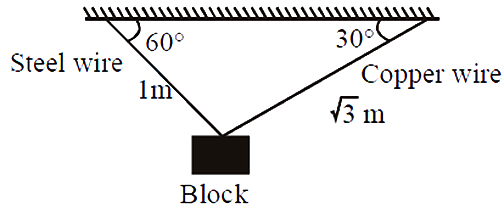 JEE Advanced 2019 Medium
 - In an experiment, m grams of a compound X (gas/liquid/solid) taken in a container is loaded in a balance as shown in figure I below. In the presence of a magnetic field, the pan with X is either deflected upwards (figure II), or deflected downwards (figure III), depending on the compound X. Identify the correct statement(s).
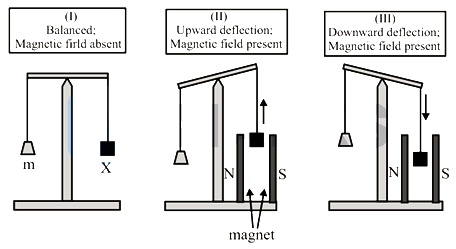 JEE Advanced 2020 Medium
 - A beaker of radius is filled with water up to a height as shown in the figure on the left. The beaker is kept on a horizontal table rotating with angular speed . This makes the water surface curved so that the difference in the height of water level at the centre and at the circumference of the beaker is , as shown in the figure on the right. Take this surface to be approximately spherical with a radius of curvature Which of the following is/are correct? ( is the acceleration due to gravity)
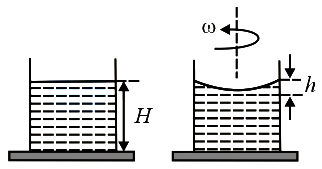 JEE Advanced 2020 Hard
 - Find the time constant for the given R C circuits in correct order.
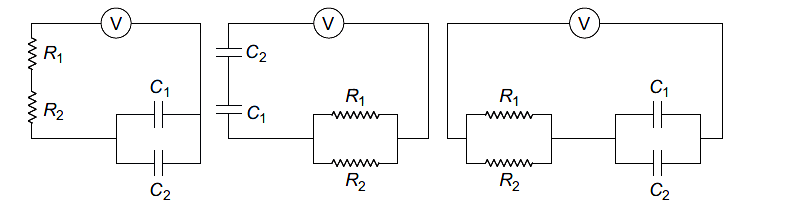
\(R_1=1 \Omega, R_2=2 \Omega, C_1=4 \mu \mathrm{F}, C_2=2 \mu \mathrm{F}\)JEE Advanced 2006 Easy